
You’ve probably seen the claim: sit in an infrared sauna for 30 minutes and burn hundreds of calories, no treadmill required. It sounds almost too good to be true and the real answer is more nuanced than most sauna blogs let on. Here’s what the actual research says about how many calories you burn, what’s really driving that number, and how much of it is fat versus just sweat.
Quick Answer: Most people burn roughly 200 to 600 calories during a 30-minute infrared sauna session, and some studies suggest longer, hotter sessions can push that toward 600–900+ calories per hour. That said, this is your body working to cool itself, not the same kind of calorie burn you get from running or lifting weights, and a meaningful chunk of the number on the scale afterward is water weight, not fat. If you want the honest, source-backed breakdown, keep reading.
How Many Calories Does Infrared Sauna Burn Per Session?
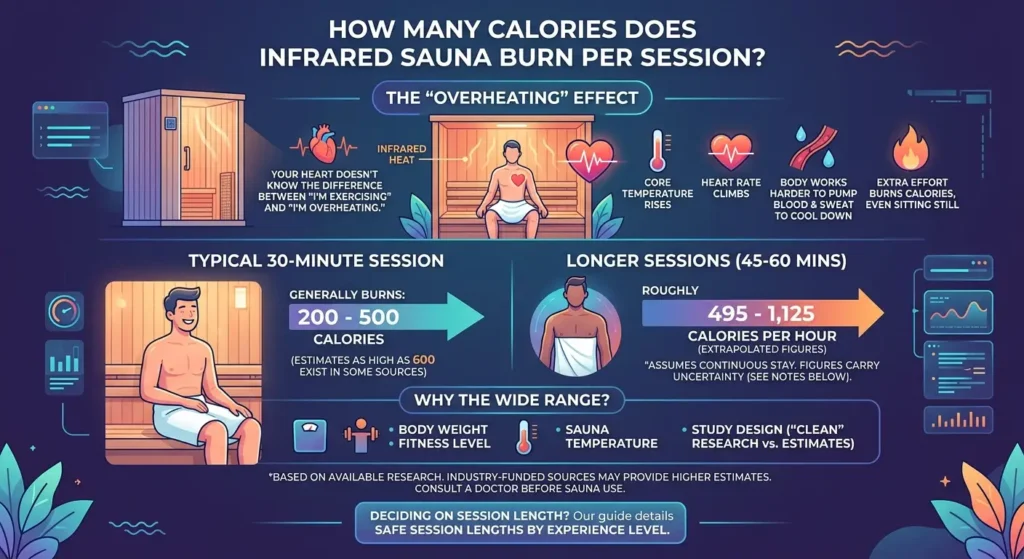
Your heart doesn’t know the difference between “I’m exercising” and “I’m overheating.” When your core temperature rises in an infrared sauna, your heart rate climbs, your blood vessels widen, and your body works harder to pump blood and sweat to cool itself down. That extra effort burns calories, even though you’re just sitting there.
Calories burned in 30 minutes: Based on available research, a 30-minute session generally burns somewhere between 200 and 500 calories, though estimates as high as 600 exist in less rigorous or industry-funded sources. The wide range exists because body weight, fitness level, sauna temperature, and how “clean” the study design was all change the number.


Paid Links - As an Amazon Associate, I earn from qualifying purchases.
Calories burned in 45–60 minutes: For longer sessions, some calculations extrapolate to roughly 495–1,125 calories per hour, based on body-fat math from a small athlete study. These figures assume you stay in continuously, which most people don’t and they carry real uncertainty (more on that below).
If you’re deciding how long to stay in for your goals, our guide on how long to stay in an infrared sauna breaks down safe session lengths by experience level.



Paid Links - As an Amazon Associate, I earn from qualifying purchases.
Quick Facts Box
- A 30-minute session: ~200–500 calories (typical range)
- A 60-minute session: ~495–1,125 calories (extrapolated estimate, wide uncertainty)
- Comparable everyday activity: roughly similar to a brisk 30–45 minute walk, though the mechanism is completely different
- A large share of any post-session weight change is water, not fat
Estimated Calorie Burn by Session Length
| Session Length | Estimated Calories Burned | Confidence Level |
|---|---|---|
| 15 minutes | 100–175 | Low (extrapolated) |
| 30 minutes | 200–500 | Moderate |
| 45 minutes | 300–650 | Low–Moderate (extrapolated) |
| 60 minutes | 495–1,125 | Low (small sample, extrapolated) |
These ranges are drawn from published studies and industry calorie calculators. None of them come from large, peer-reviewed, infrared-specific trials, so treat them as informed estimates, not guarantees.
How Does an Infrared Sauna Actually Burn Calories?
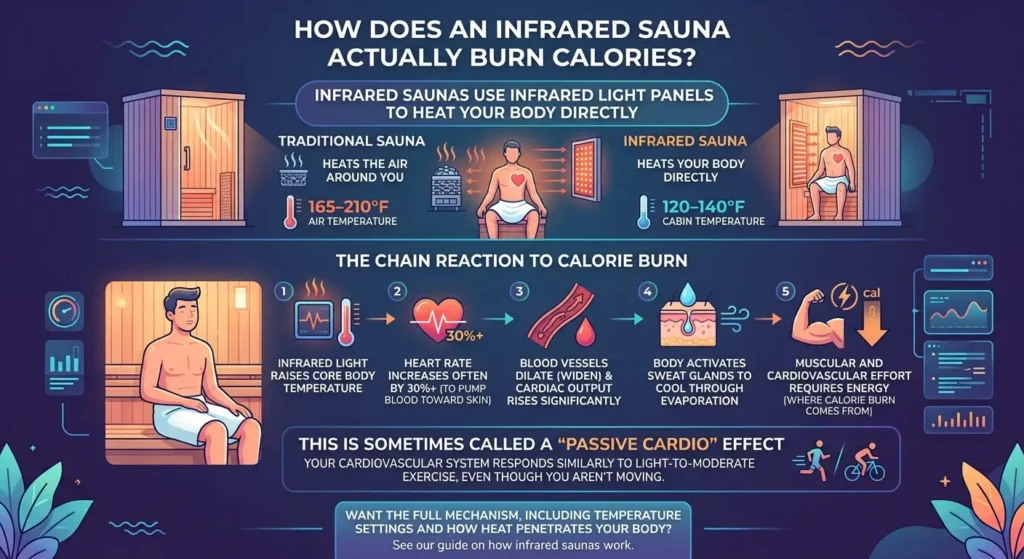
Infrared saunas use infrared light panels to heat your body directly, rather than heating the surrounding air the way a traditional steam or wood sauna does. That’s why you can sit comfortably in an infrared cabin at 120–140°F, while a traditional sauna needs 165–210°F air temperature to produce a similar sweat.
Here’s the chain reaction that leads to calorie burn:
- Infrared light raises your core body temperature.
- Your heart rate increases often by 30% or more to pump blood toward your skin.
- Blood vessels dilate (widen) to release heat, and cardiac output can rise significantly.
- Your body activates sweat glands to cool itself through evaporation.
- All of that muscular and cardiovascular effort requires energy which is where the calorie burn comes from.
This is sometimes called a “passive cardio” effect, because your cardiovascular system responds similarly to light-to-moderate exercise, even though you aren’t moving. Want the full mechanism, including temperature settings and how heat penetrates your body? See our guide on how infrared saunas work.



Paid Links - As an Amazon Associate, I earn from qualifying purchases.
What the Research Actually Says (and Doesn’t Say)
This is the part most articles in the internet skip, and it matters. Here’s an honest look at the actual evidence:
- A 2019 peer-reviewed study on Finnish (traditional) sauna use found overweight men burned about 333 calories during four 10-minute heat exposures totaling 40 minutes. This is one of the few studies with proper peer review, but it’s on traditional saunas, not infrared.
- A Binghamton University study found that people who used an infrared sauna three times a week for 30–45 minutes saw about a 4% reduction in body fat over four months, with a suggested ideal temperature around 110°F. This points to real, longer-term fat-loss benefit, but it doesn’t isolate calories burned per session.
- A small athlete study (three 20-minute sauna sessions with 5-minute breaks) found women lost about 0.39 kg and men about 0.89 kg of body weight. Calculators use this to estimate 495–1,125 calories per hour, but that math assumes a fixed ratio of fat loss to weight loss, which the researchers themselves flagged as an oversimplification much of that weight is water.
- The widely cited 300–690 calorie range for infrared sessions largely traces back to a 2017 conference abstract and manufacturer testing, not a peer-reviewed clinical trial.
Bottom line: There is real evidence that infrared sauna use raises heart rate, increases energy expenditure, and can support fat loss over time. But there isn’t yet a large, well-controlled study that nails down an exact calories-per-minute figure for infrared saunas specifically. Any number you see including the ranges in this guide is a reasonable estimate, not a lab-verified fact. If a source gives you one exact number with total confidence, be skeptical.
Sweat Loss vs. Fat Loss: What You’re Really Losing
Step on a scale right after a sauna session and you’ll likely see a lower number. Don’t mistake that for fat loss.
You can lose 0.5–1 kg (about 1–2 lbs) of fluid in a single 30-minute session through sweat. That weight comes right back once you rehydrate. The actual fat-loss benefit the kind that shows up over weeks and months comes from the repeated cardiovascular effort and metabolic adaptations (like improved insulin sensitivity), not from any single sweaty session.
This is exactly why the Binghamton study measured body fat percentage over four months, not calories in one sitting that’s a far more meaningful marker.
Infrared Sauna vs. Traditional Sauna: Which Burns More?
| Factor | Infrared Sauna | Traditional Sauna |
|---|---|---|
| Air temperature | 120–140°F | 165–210°F |
| Heating method | Direct infrared light on body | Heated air/steam |
| Core temp rise | Faster, deeper penetration reported | Slower, more surface-level |
| Estimated calories (30 min) | ~200–500 | ~165–220 (extrapolated from 40-min study) |
| Comfort for longer sessions | Generally more tolerable | Harder to sit in as long |
Infrared saunas are often described as more efficient at raising core temperature at a lower, more tolerable air temperature, which is why several sources estimate a somewhat higher calorie burn per session compared with traditional saunas. For a full side-by-side on comfort, health effects, and use cases, see infrared vs. traditional sauna: which is better for you.
Infrared Sauna vs. Exercise: Can It Replace a Workout?
Short answer: no, and no reputable source recommends treating it that way.
An infrared sauna session raises your heart rate and burns calories, but it doesn’t build muscle, improve bone density, or train your cardiovascular system the same way structured exercise does. Think of it as a complement, not a substitute.
Where sauna use genuinely helps:
- Recovery days when you can’t do intense training
- Supporting circulation and relaxation after a workout, see infrared sauna for muscle recovery
- Adding modest extra calorie expenditure on top of an existing healthy routine
- People with mobility limitations who need a lower-impact way to elevate heart rate
Where it falls short:
- No resistance training benefit (no muscle or bone strength gains)
- No skill or mobility development
- Calorie burn estimates are inconsistent and not guaranteed
What Affects How Many Calories You Burn
Several factors change your actual number, which is why ranges (not single figures) are more honest:
- Body weight: Heavier individuals generally burn more calories per session, similar to other forms of exertion.
- Session length: Longer sessions burn more, up to a safe limit.
- Temperature setting: Higher temperatures increase core body temperature faster, which may increase calorie burn within safe limits. See how hot should an infrared sauna be.
- Heat acclimation: Regular users sweat more efficiently, which can change the calorie-burn picture over time.
- Hydration status: Dehydration skews any weight-based estimate.
- Fitness level: A person with a higher resting heart rate response to heat may burn more in the short term.
How to Maximize Calorie Burn Safely
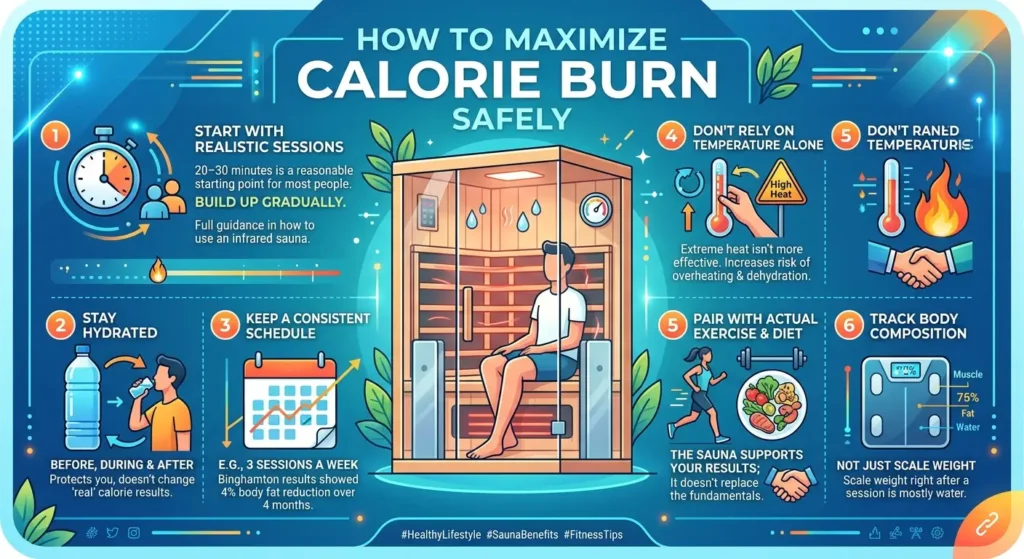
- Start with a realistic session length. 20–30 minutes is a reasonable starting point for most people; build up gradually. Full guidance in how to use an infrared sauna.
- Stay hydrated before and after, not just during this protects you and doesn’t change your “real” calorie result.
- Keep a consistent schedule. The Binghamton results (4% body fat reduction) came from three sessions a week over four months, not one big session.
- Don’t rely on temperature alone. Extreme heat isn’t proportionally more effective and increases risk of overheating or dehydration.
- Pair it with actual exercise and a solid diet. The sauna supports your results; it doesn’t replace the fundamentals.
- Track body composition, not just scale weight, since scale weight right after a session is mostly water.
Common Mistakes That Waste Your Session
- Weighing yourself immediately after and assuming it’s fat loss
- Cranking the heat too high, too fast, especially as a beginner
- Skipping hydration and then feeling lightheaded or fatigued
- Using it only occasionally and expecting the same results as consistent, scheduled use
- Treating it as a total replacement for exercise
FAQs
How many calories does a 20-minute infrared sauna session burn?
Roughly 130–330 calories, based on proportional estimates from longer-session research. Shorter sessions burn less overall but may be a good starting point for beginners.
Can infrared sauna use help me lose weight?
It can support weight and fat loss over time, especially with consistent use (like the Binghamton study’s three-times-weekly protocol), but it works best alongside exercise and a balanced diet, not as a stand-alone method.
Is the calorie burn from an infrared sauna the same as running?
No. While heart rate and energy expenditure can be comparable in range to light-to-moderate cardio, the physiological benefits (muscle engagement, cardiovascular training effect, bone loading) are different. Treat it as a complement, not equivalent.
Do I burn more calories in an infrared sauna than a traditional sauna?
Some estimates suggest slightly higher calorie burn in infrared sessions due to faster core-temperature increases at lower air temperatures, but neither type has been studied extensively enough for a definitive comparison.
Why do I weigh less right after a sauna session?
Mostly sweat loss fluid weight you’ll regain once you rehydrate. It’s not a reliable measure of fat loss.
How often should I use an infrared sauna to see fat-loss benefits?
Research suggesting measurable body-fat changes (like the Binghamton study) used about three sessions a week over several months. For a broader look at frequency and safety, see how often should I use an infrared sauna.
Is a hotter infrared sauna session better for burning calories?
Not necessarily. Higher temperatures raise the risk of dehydration and overheating faster than they reliably raise calorie burn. Moderate, consistent sessions are generally recommended over occasional extreme ones.
Does an infrared sauna raise your metabolism after the session ends?
Some research on heat exposure suggests short-term increases in metabolic rate and improved insulin sensitivity with regular use, though this isn’t the same as a large, sustained metabolic boost.
Can I use an infrared sauna instead of exercising?
No. It’s best used as a complement to exercise, not a replacement it doesn’t build strength, endurance, or bone density the way training does.
How accurate are online infrared sauna calorie calculators?
They’re useful for a ballpark estimate, but most are based on small studies with body-fat math assumptions, not direct calorimetry. Treat the output as a range, not an exact number.
Does body weight affect how many calories I burn in a sauna?
Yes. Heavier individuals typically expend more energy maintaining core temperature and cardiovascular response, similar to other forms of physical exertion.
Is it safe to do a longer session to burn more calories?
Only within recommended limits. Extending session length increases dehydration and overheating risk. See our infrared sauna dangers guide before pushing past recommended durations.
Final Thoughts
If you’re using an infrared sauna hoping it’ll melt away pounds on its own, temper those expectations but don’t dismiss it either. The honest picture, based on the research available today, is that infrared sauna sessions raise your heart rate and energy expenditure in a way that’s genuinely comparable to light-to-moderate physical activity, and consistent use has been linked to measurable body-fat reduction over months, not single sessions.
The exact calorie number you’ll see cited 300, 500, 900 depends heavily on which study or calculator someone is quoting, and none of them come from large, peer-reviewed, infrared-specific trials yet. Use the ranges in this guide as a realistic planning tool, not a guarantee. Pair regular sauna sessions with real exercise and solid nutrition, stay hydrated, and judge your progress by how you feel and by body composition over time, not by the number on the scale right after you towel off.