
Ten minutes as a Beginners. That’s the number most people should start with but it’s not the whole story and treating it like a universal rule is how people either waste a session or overdo it.
The honest answer is that infrared sauna time depends on three things: how experienced you are, what temperature you’re sitting in, and what you’re actually trying to get out of the session. Get those three rights, and the “how long” question mostly answers itself.
Key Takeaways
- Beginners: 10 to 15 minutes at a lower temperature (around 100–115°F).
- Regular users: 20 to 30 minutes is the sweet spot for most goals.
- Maximum: Most healthcare guidance caps sessions at 30 minutes, even for experienced users, though some seasoned bathers extend to 40–45 minutes.
- Frequency: 3 to 4 sessions a week is a reasonable, sustainable pace for most healthy adults.
- The real limit isn’t the clock — it’s how your body feels. Dizziness, nausea, or a pounding heartbeat means it’s time to get out, regardless of the timer.
Why Infrared Sauna Time Isn’t the Same as Traditional Sauna Time
Infrared saunas don’t heat the air around you the way a traditional Finnish sauna does. Instead, infrared panels warm your body directly, which lets the room run cooler while your skin and muscles still absorb a meaningful amount of heat. According to Cleveland Clinic, infrared saunas typically run between about 110°F and 135°F, compared to roughly 150°F to 195°F in a traditional sauna.
That lower air temperature is exactly why infrared sessions can and often should run a bit longer than a traditional sauna visit. Your body isn’t fighting off blistering air; it’s absorbing radiant heat at a gentler pace, so it takes longer to reach the same internal effect.


Paid Links - As an Amazon Associate, I earn from qualifying purchases.
That’s the physiological reason “20 minutes” shows up so often as a benchmark for infrared, while traditional sauna guidance tends to land closer to 15.
How Long Should You Stay in an Infrared Sauna?
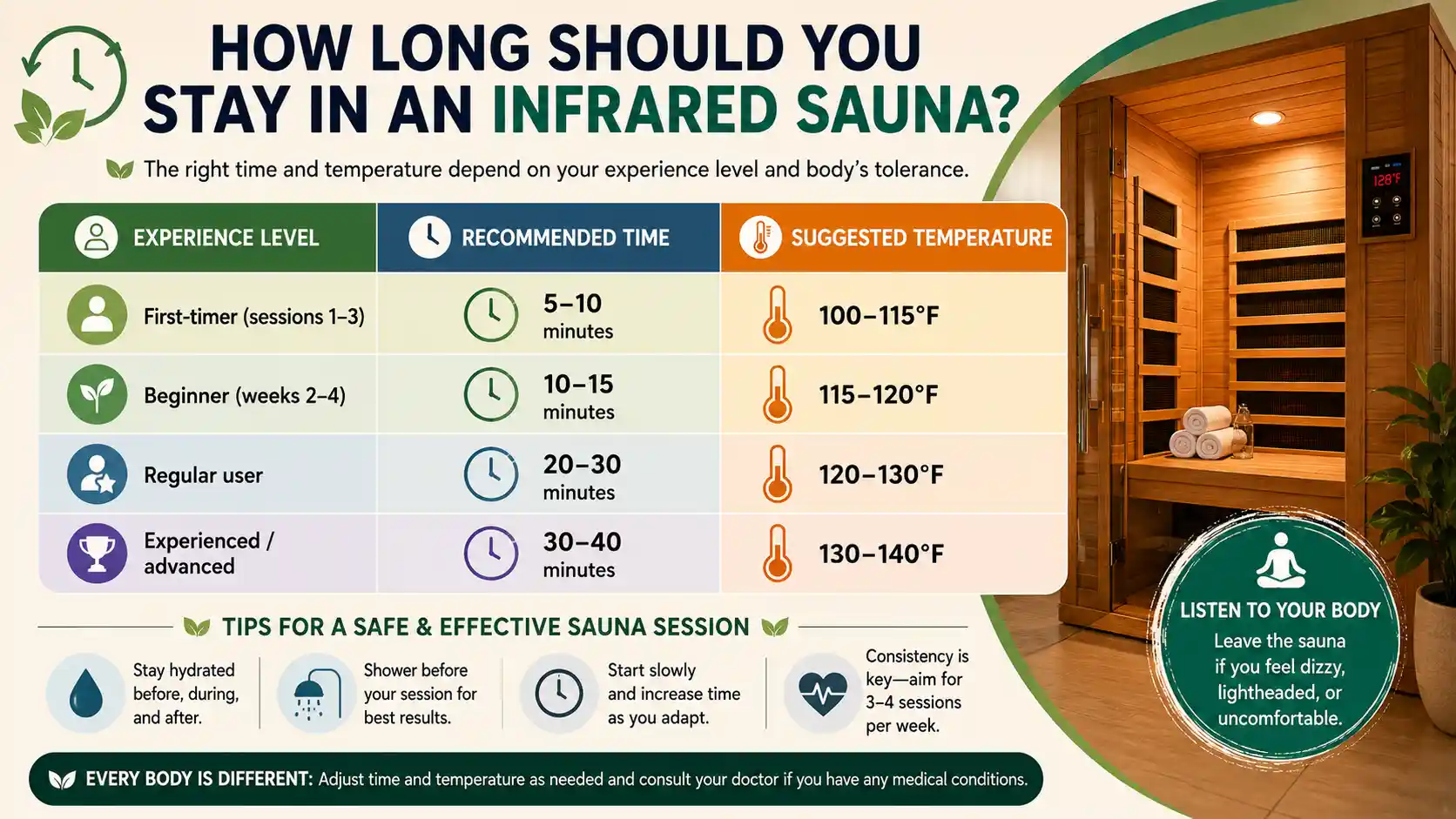
| Experience Level | Recommended Time | Suggested Temperature |
|---|---|---|
| First-timer (sessions 1–3) | 5–10 minutes | 100–115°F |
| Beginner (weeks 2–4) | 10–15 minutes | 115–120°F |
| Regular user | 20–30 minutes | 120–130°F |
| Experienced / advanced | 30–40 minutes | 130–140°F |
A functional medicine physician interviewed by Cleveland Clinic recommends that newcomers ease in around 110°F for five to ten minutes and adjust from there based on how they feel. The same guidance suggests that even experienced users keep sessions under 30 minutes and limit visits to three or four times a week, so the body doesn’t come under too much heat stress too often.



Paid Links - As an Amazon Associate, I earn from qualifying purchases.
Other sources give slightly more room at the top end: some sauna studios describe advanced users comfortably extending toward 40 minutes once they’ve built up tolerance over weeks or months. Treat 30 minutes as the sensible ceiling for most people and treat anything beyond that as an experienced-user choice made on a good, well-hydrated day not a default.
How Long Should a Beginner Stay in an Infrared Sauna?

For a beginner who have plan to start infrared sauns sessions there is a simple 4-week ramp-up plan for beginners.
A Simple 4-Week Ramp-Up Plan for Beginners
You don’t need to guess your way into a sauna habit. A gradual build is what actually prevents the lightheaded, “I need to lie down” experience that turns people off infrared saunas for good.
- Week 1: 2–3 sessions, 8–10 minutes each, temperature around 100–110°F
- Week 2: 2–3 sessions, 12–15 minutes each, temperature around 110–115°F
- Week 3: 3 sessions, 15–20 minutes each, temperature around 115–125°F
- Week 4 and beyond: 3–4 sessions, 20–30 minutes each, temperature around 120–130°F
If any week feels harder than the one before it, repeat it before moving on. Heat tolerance builds at different speeds for different people, and there’s no prize for rushing the schedule.



Paid Links - As an Amazon Associate, I earn from qualifying purchases.
Infrared Duration by Goal: What Are You Actually Trying to Get Out of It?
“How long should I stay in” changes depending on why you’re in there in the first place. Here’s how duration tends to map to common goals.
| Goal | Suggested Duration | Notes |
|---|---|---|
| Relaxation / stress relief | 15–20 minutes | Shorter sessions are enough to trigger a calming effect; there’s little added benefit from pushing longer |
| Muscle recovery after exercise | 20–30 minutes | Improved circulation supports recovery; pushing past 30 minutes doesn’t clearly improve results |
| Sleep support | 15–20 minutes, a few hours before bed | Leaves time for your core temperature to come back down before you lie down |
| Skin appearance | 20–25 minutes | Consistency over weeks matters more than any single session’s length |
| Cardiovascular / “passive exercise” effect | 20–30 minutes | Mimics some of the cardiovascular response of moderate exercise |
| Detoxification claims | 20–30 minutes | The idea that longer sessions “sweat out more toxins” is popular but not well established by strong research — treat this as a secondary reason to visit, not the main one |
A word on that last row: detox is one of the most repeated claims about infrared saunas, and it’s also one of the least settled scientifically. Cleveland Clinic notes that claims about sweating out heavy metals like cadmium and lead rest on research that’s still considered early-stage rather than conclusive.
If detoxification is your main motivation, it’s fine to enjoy the sauna for that reason just don’t extend your session length chasing an effect that isn’t well documented, and don’t treat sauna sweat as a substitute for your kidneys and liver doing their job.
Temperature and Time Work as a Pair, Not Separately
One of the most common mistakes is picking a duration without also considering the temperature — the two settings offset each other.
- Lower temperature (100–115°F): You can comfortably stay longer, often 20–30 minutes, because the heat stress is milder.
- Mid-range temperature (115–125°F): This is the most common “everyday” setting, generally paired with 15–25 minutes.
- Higher temperature (125–140°F): Shorten your session, often to 15–20 minutes, since the body is under more thermal strain per minute.
If you’re not sure where to start, dial the temperature down before you extend the time. A longer session at a gentler temperature is a safer way to build tolerance than a short blast at the highest setting.
How Often Should You Use an Infrared Sauna Per Week?
Frequency and duration are a package deal. Cleveland Clinic’s guidance of three to four visits a week lines up with what most sauna studios and manufacturers recommend for general wellness use. Some enthusiasts — particularly in traditional Finnish sauna culture — bathe far more often, but that’s typically built on years of acclimation and shorter, more frequent sessions rather than daily 30-minute sessions from day one.
A workable pattern for most people:
- New users: 2–3 times per week while you’re still finding your comfortable duration
- Regular use: 3–4 times per week, alternating with rest days
- Post-workout recovery: Right after training, on the days you train, kept to 20–30 minutes
Daily use isn’t inherently dangerous for a healthy adult using moderate settings, but more isn’t automatically better. Rest days give your body a chance to rehydrate and recover between heat-stress sessions, the same way it needs recovery between workouts.
Signs You’ve Stayed Too Long in Infrared Sauna
The timer on the wall is a guideline, not a rulebook. Your body’s signals override it every time. Step out immediately if you notice:
- Dizziness or lightheadedness
- Nausea
- A racing or pounding heartbeat that feels excessive
- Headache developing during the session
- Unusual fatigue or weakness
- Skin that feels uncomfortably hot rather than warm
- Trouble concentrating or a sense of confusion
Cleveland Clinic frames this plainly: if you suddenly feel dizzy or nauseated, the recommendation is to get out right away rather than waiting to see if it passes. These symptoms are your body telling you it’s struggling to regulate its temperature — pushing through them is how people end up with heat exhaustion instead of a good sweat session.
Who Should Be Careful or Skip the Sauna Entirely
Infrared saunas are generally considered a low-risk activity for healthy adults, but “generally low-risk” isn’t the same as “risk-free for everyone.” A few groups should either check with a doctor first or avoid sauna use altogether:
- Pregnant women: Medical guidance advises against sauna use, particularly early in pregnancy, due to potential risks to fetal development.
- People with multiple sclerosis: Heat intolerance is common with MS, and sauna use is generally discouraged for this group.
- Anyone trying to conceive: Heat exposure isn’t good for sperm health, so this is worth factoring in for couples trying to get pregnant.
- People who are currently sick, especially with a fever — wait until you’ve recovered.
- Anyone with cardiovascular disease, low blood pressure, or other chronic conditions — get a doctor’s go-ahead before starting a sauna routine, since the heat places a real (if usually manageable) demand on the heart.
- Anyone on medications that affect blood pressure, hydration, or heat regulation — some prescriptions interact poorly with heat exposure, so this is a conversation for a pharmacist or physician, not a guess.
If none of these apply to you, infrared sauna use is considered safe for most healthy adults when kept within sensible time and temperature ranges.
Practical Tips to Get the Most Out of Your Session
- Hydrate before, not just after. Drink water in the hour or two before your session, and keep water within reach inside the sauna.
- Skip alcohol before a session. Alcohol and heat exposure is a combination worth avoiding — it increases dehydration risk and can mask early warning signs like dizziness.
- Rinse off afterward. A shower after your session helps remove sweat (and whatever it carried out of your pores) before it’s reabsorbed into your skin.
- Don’t sauna on an empty stomach or right after a heavy meal. A light snack an hour or so before tends to work better than either extreme.
- Cool down gradually. Give your body a few minutes to come back to a normal temperature rather than jumping straight into a cold shower or air conditioning.
- Bring a towel to sit on. It’s a small comfort detail, but it also helps keep the wood surfaces clean for the next person if you’re using a shared or studio sauna.
FAQs
How long should a beginner stay in an infrared sauna?
Start with 5 to 10 minutes at a lower temperature (around 100–115°F) and build up gradually over several weeks as your body adjusts to the heat.
Is 20 minutes in an infrared sauna enough?
Yes. Twenty minutes is a common, effective session length for relaxation, muscle recovery, and general wellness once you’re past the beginner stage.
Can you stay in an infrared sauna for an hour?
It’s not generally recommended. Most guidance caps sessions at 30 to 40 minutes, even for experienced users, because dehydration and heat strain risk increase the longer you stay.
How long should you stay in an infrared sauna to lose weight?
Sessions of 20 to 30 minutes are typical, but keep in mind that sauna-related weight changes are mostly water loss through sweat, not fat loss — the number on the scale will bounce back once you rehydrate.
How long should you stay in an infrared sauna to detox?
Twenty to thirty minutes is a common recommendation, though the science behind sauna “detoxification” is still considered preliminary. Treat this as a bonus reason to use the sauna, not the primary one.
How many times a week should you use an infrared sauna?
Three to four times a week is a reasonable, sustainable frequency for most healthy adults, with rest days in between.
My Final Thoughts
How Long Should You Stay in an Infrared Sauna? If you only remember one number, make it this: 10 to 15 minutes to start, working up to 20 to 30 minutes as a comfortable regular routine, three to four times a week. Adjust the temperature and the clock together, hydrate like it’s part of the routine (because it is), and let how you actually feel not the timer decide when a session is over.