
You know that feeling at the end of a rough day? Your shoulders are up near your ears, your jaw is tight, and your brain is still running through tomorrow’s to-do list. Somebody tells you a warm infrared cabin might fix all that, and you wonder if it’s real or just another wellness trend.
That’s the question behind Infrared Sauna for Anxiety & Stress, and the honest answer sits somewhere in the middle. A session can feel wonderfully calming, and early research on heat and mood is promising. But the studies are small, and nobody has proven that an infrared sauna treats an anxiety disorder.
So let’s walk through what we know, what we don’t, and how to try it without making a mess of it.
Key takeaways
- For many people, infrared sauna sessions are incredibly relaxing, which is important for daily stress.
- The most popular heat study involved depression, not anxiety, and a medical device, not a home sauna.
- There are no strong trials that demonstrate that infrared saunas are more effective than traditional saunas for anxiety.
- Start with 10 to 15 minutes, drink water, and build up slowly.
- Check with a doctor first if you’re pregnant, take medication, or have heart or blood pressure problems.
- Treat it as a support for therapy or medical care, never a replacement.
Does an Infrared Sauna Help With Anxiety and Stress?
Short answer: it might, especially for stress and relaxation. For anxiety disorders, the evidence is thin. Early studies on heat therapy show mood benefits, and plenty of people say they feel calmer afterward. What’s missing is large, well-run research on infrared saunas and anxiety.


Paid Links - As an Amazon Associate, I earn from qualifying purchases.
Here’s a simple way to sort it out:
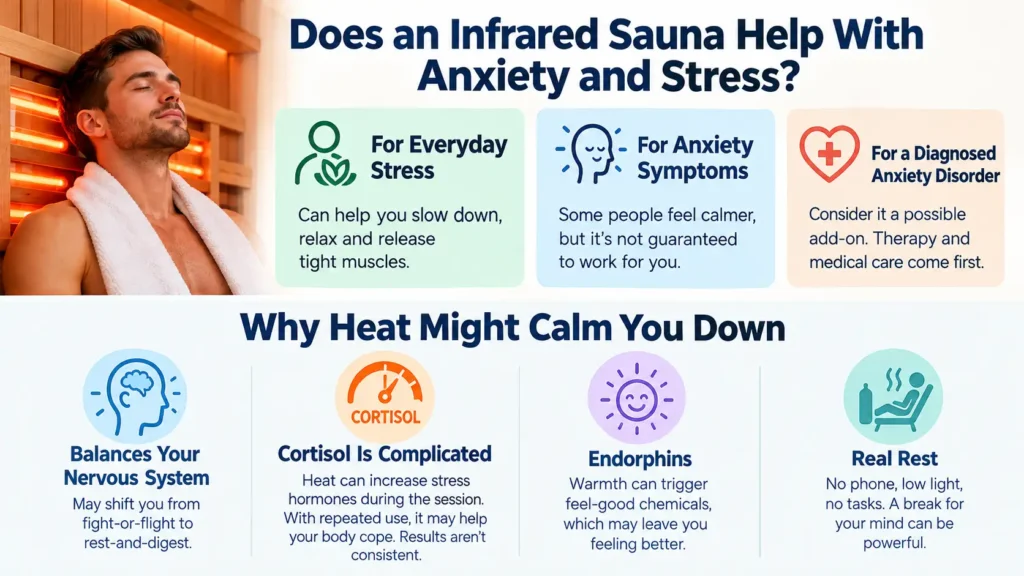
- For everyday stress: a sauna can be a dependable way to slow down, loosen tight muscles, and step away from the noise.
- For anxiety symptoms: some people feel calmer, but we can’t promise it will work for you.
- For a diagnosed anxiety disorder: think of it as a possible add-on. Therapy and medical care come first.
The National Institute of Mental Health estimates that roughly 1 in 5 U.S. adults deals with an anxiety disorder in any given year. If that’s you, you’re in very large company, and looking for extra tools is a perfectly reasonable thing to do.



Paid Links - As an Amazon Associate, I earn from qualifying purchases.
Why Heat Might Calm You Down
Scientists have a handful of theories about why a sauna feels so soothing. They’re explanations worth knowing about, but none is settled.
It may shift your nervous system toward “rest and digest”
Your body has two main gears. Fight-or-flight speeds you up. Rest-and-digest slows you down. Anxiety often feels like getting stuck in the first one.
After a sauna, lots of people feel loose, heavy, and slow in a pleasant way. That fits the idea that heating up and then cooling down helps the body settle. Still, direct measurements of this effect in infrared saunas are limited, so we’re working with a theory here.
Cortisol is messier than most articles admit
Many pages will say that saunas reduce your primary stress hormone, cortisol. The truth is more complicated. Heat is a gentle stress to the body, and stress hormones can actually be increased during the session. With repeated use, the idea is that your body will learn to cope with stress in the future.

Paid Links - As an Amazon Associate, I earn from qualifying purchases.
Some small studies suggest that there may be changes in cortisol following heat exposure, although the findings are not consistent. When a page provides you with a precise percentage drop, don’t trust it.
Endorphins and that post-sauna glow
Warmth is associated with the release of feel good chemicals such as endorphins, which is why people feel a glow after it. It’s also tough to separate from the plain fact that you just sat still and quiet for twenty minutes.
You finally get a break
This one is not as well known as it should be. A sauna session typically involves no phone, minimal light and no tasks that require your attention. That break might be a significant part of the benefit for a stressed-out brain. And that doesn’t make it “just a placebo.” Real rest is real medicine for stress.
What the Research Actually Says
Let’s separate what’s been tested from what people hope is true.
The best-known trial: JAMA Psychiatry, 2016
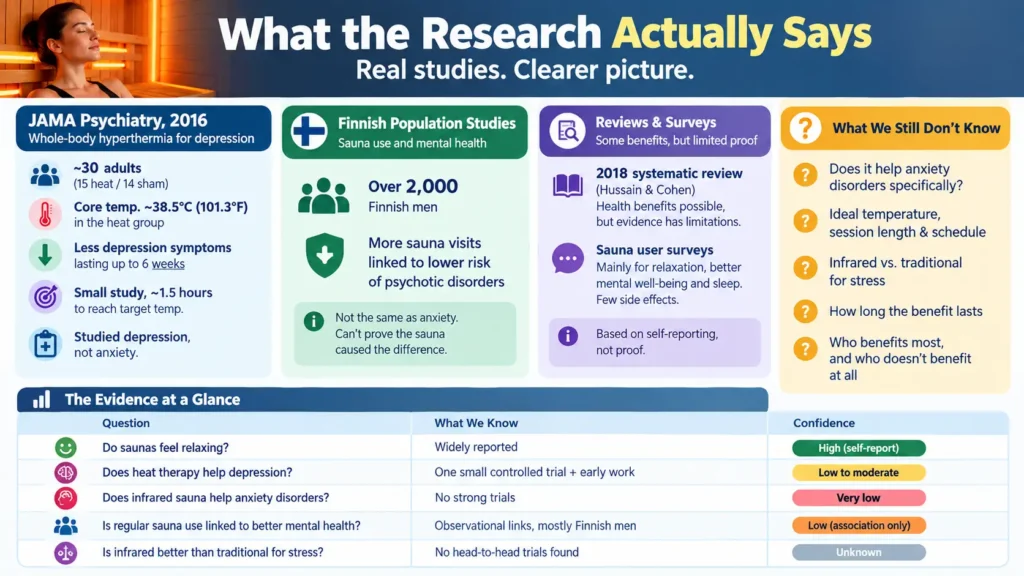
Whole-body hyperthermia was investigated in adult major depression patients by researchers at the University of Arizona. In the active group, one session was conducted with infrared heat, with core body temperature reaching approximately 38.5°C (101.3°F). A control group received a “placebo” treatment that involved minimal warmth.
A few details matter here:
- A total of approximately 30 adults completed the study, with approximately 15 in the heat group and 14 in the sham group.
- The heat group had a reduction in depression symptoms that lasted up to six weeks after a single treatment.
- The study looked at depression, not anxiety.
- It was small, and it took around an hour and a half just to reach the target temperature.
That’s a hopeful result, and it’s easy to over-read. A relaxing evening in a home infrared cabin is not the same as a supervised medical treatment. You can read the abstract yourself on PubMed by searching for Janssen and colleagues’ 2016 paper on whole-body hyperthermia for major depressive disorder.
Finnish population studies
The sauna is something that has been monitored in Finland for decades. A study of over 2000 Finnish men revealed that the more often men bathed in the sauna, the less likely they were to develop a psychotic disorder.
It is not the same condition as anxiety and the study cannot conclude that the sauna was the cause of the difference. Sauna users may just have different lifestyles.
Reviews and surveys
A 2018 systematic review of the regular use of dry saunas (Hussain and Cohen) found that there may be health benefits, but the evidence is not without its limitations.
In addition, surveys of sauna users reveal that individuals primarily use saunas for relaxation and that they frequently report improved mental well-being and sleep, and few side effects. Surveys are based on self-reporting and are clues, not proof.
What we still don’t know
- Whether infrared saunas help anxiety disorders specifically
- The ideal temperature, session length, and weekly schedule
- Whether infrared beats traditional saunas for stress
- How long any benefit lasts
- Who benefits most, and who doesn’t benefit at all
The evidence at a glance
| Question | What we know | Confidence |
|---|---|---|
| Do saunas feel relaxing? | Widely reported | High (self-report) |
| Does heat therapy help depression? | One small controlled trial plus early work | Low to moderate |
| Does infrared sauna help anxiety disorders? | No strong trials | Very low |
| Is regular sauna use linked to better mental health? | Observational links, mostly Finnish men | Low (association only) |
| Is infrared better than traditional for stress? | No head-to-head trials found | Unknown |
Sleep, Stress, and Anxiety are the three most common types of disorders.
Stress and sleep are in a vicious cycle. Stress disrupts your sleep and a poor night’s sleep increases your stress levels the following day.
Many people report that they fall asleep better after taking an evening sauna, and one of the reasons for this is the cool down that follows. When your body temperature drops, it may signal that it’s time to wind down.
If sleep is your biggest struggle, this guide on infrared sauna for better sleep goes deeper.There are some competitor pages that state exact sleep improvements, but I couldn’t find any solid sources behind those numbers, so I’m not including them.
A practical tip: try your session an hour or two before bed, then take a lukewarm shower. Skip the ice-cold one, which can wake you right back up. If you feel wired afterward, move your session earlier in the day.
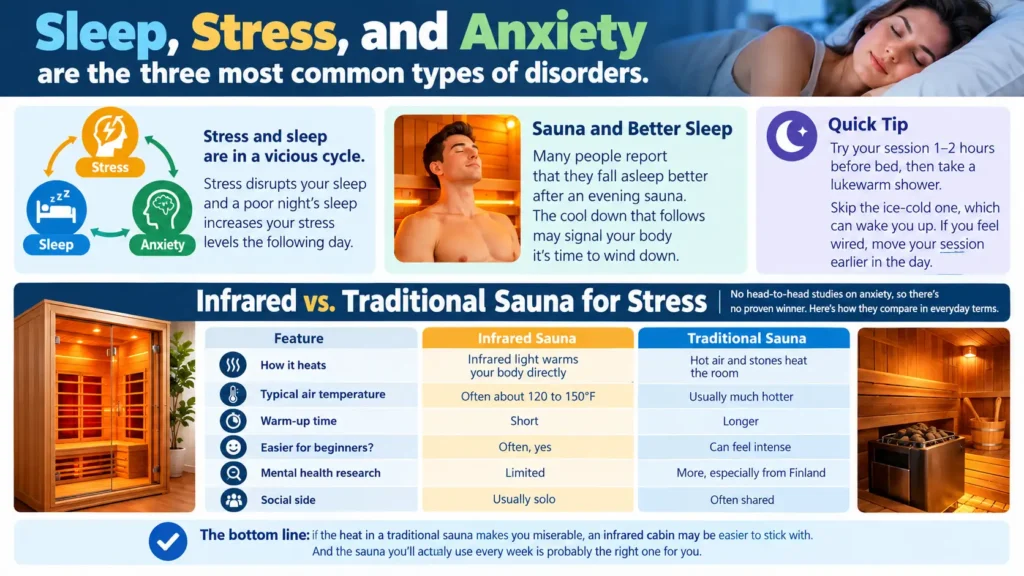
Infrared vs. Traditional Sauna for Stress
People often ask which type is better. Honestly, nobody has run the head-to-head studies on anxiety, so there’s no proven winner. Here’s how they compare in everyday terms, and you can find a fuller infrared versus traditional sauna breakdown if you’re choosing between them.
| Feature | Infrared sauna | Traditional sauna |
|---|---|---|
| How it heats | Infrared light warms your body directly | Hot air and stones heat the room |
| Typical air temperature | Often about 120 to 150°F | Usually much hotter |
| Warm-up time | Short | Longer |
| Easier for beginners? | Often, yes | Can feel intense |
| Mental health research | Limited | More, especially from Finland |
| Social side | Usually solo | Often shared |
The bottom line: if the heat in a traditional sauna makes you miserable, an infrared cabin may be easier to stick with. And the sauna you’ll actually use every week is probably the right one for you.
How to Use an Infrared Sauna for Anxiety
Everything below is general guidance, not medical advice and not a tested protocol. Use it as a gentle starting point.
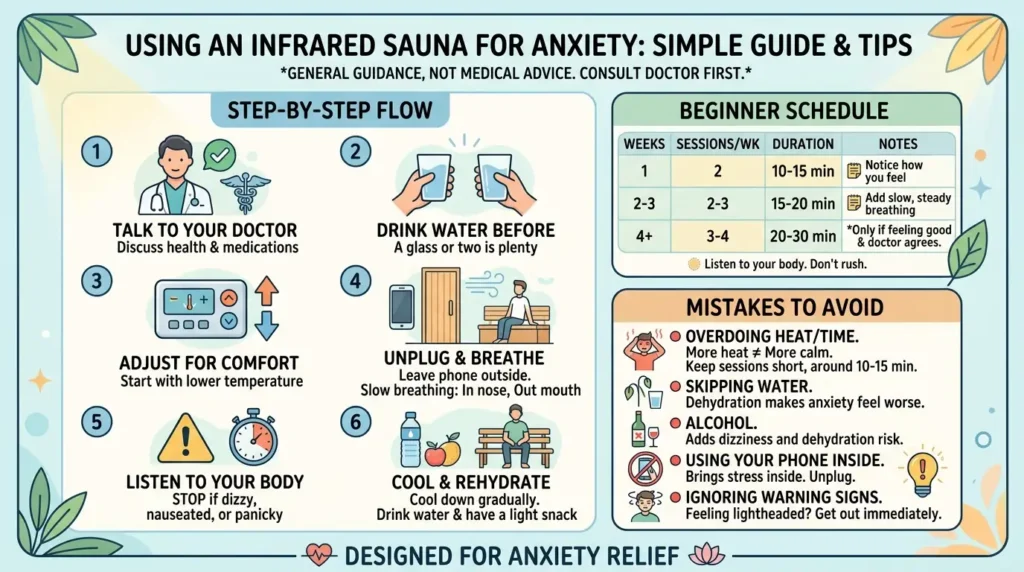
Step by step
- Talk to your doctor if you have a health condition or take medication.
- Drink water before you go in. A glass or two is plenty.
- Start with a lower temperature if your unit lets you adjust it.
- Keep your first sessions short, around 10 to 15 minutes.
- Leave your phone outside. The point is to unplug.
- Breathe slowly. In through your nose, out through your mouth.
- Stop right away if you feel dizzy, nauseated, or panicky.
- Cool down gradually. Sit for a few minutes before standing up quickly.
- Rehydrate afterward, and have a light snack if you need one.
A beginner schedule
| Week | Sessions per week | Length | Notes |
|---|---|---|---|
| 1 | 2 | 10 to 15 minutes | Notice how you feel afterward |
| 2 to 3 | 2 to 3 | 15 to 20 minutes | Add slow, steady breathing |
| 4 and up | 3 to 4 | 20 to 30 minutes | Only if you feel good and your doctor agrees |
Some wellness providers suggest two to three sessions a week at 20 to 30 minutes, which is a common starting point. It isn’t backed by trial data, though. If you’re wondering how long is too long, this piece on how long to stay in an infrared sauna is worth a read before you push past the beginner range.
Mistakes that sabotage the benefit
- Cranking the heat and staying too long. More heat doesn’t mean more calm.
- Skipping water. Dehydration makes anxiety feel worse.
- Drinking alcohol before or after. It adds dizziness and dehydration risk.
- Scrolling your phone inside. You’d be bringing the stress right in with you.
- Treating it like a cure. It’s one piece of a plan, not the whole plan.
- Ignoring warning signs. Feeling lightheaded is your body asking you to get out.
Infrared Sauna for Anxiety & Stress? Is it Safe, Who Should Check With a Doctor First
For many healthy adults, infrared saunas are considered safe. Even so, heat puts real demands on your heart and circulation, and a broader look at whether infrared sauna is safe for everyone is a smart read before your first session.
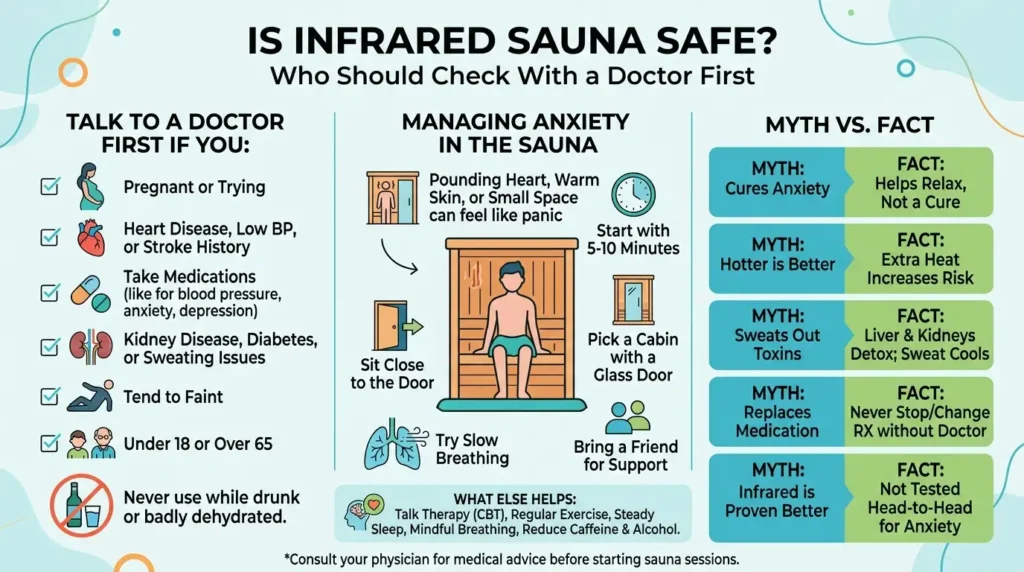
Talk to a doctor first if you:
- Are pregnant or trying to become pregnant
- Have heart disease, low blood pressure, or a history of stroke
- Take medication, including some drugs for anxiety, depression, blood pressure, or fluid control. Certain medicines change how you sweat or how your blood pressure reacts to heat.
- Have kidney disease, diabetes, or any condition that affects sweating
- Tend to faint
- Are under 18 or over 65
And never use a sauna while drunk or badly dehydrated.
One more thing, and I mean it kindly. If anxiety or stress is getting in the way of your daily life, please talk to a doctor or mental health professional. If you’re in crisis or thinking about hurting yourself, call or text 988 in the U.S. to reach the 988 Suicide & Crisis Lifeline.
Can a Sauna Trigger Anxiety or Panic?
It can, for some people. A pounding heart, warm skin, sweat, and a small enclosed space can feel a lot like the early signs of a panic attack. If you’re sensitive to those sensations, your first few sessions might feel uncomfortable.
A few things help:
- Start with just 5 to 10 minutes.
- Sit close to the door and remember you can walk out anytime.
- Pick a cabin with a glass door if enclosed spaces bother you.
- Try slow breathing, like four counts in and six counts out.
- Ask a friend or family member to stay nearby the first time.
Some people find that gradually getting used to these body sensations in a safe setting feels empowering over time. But if the sauna keeps setting off panic, stop and bring it up with a professional.
Myth vs. Fact
Myth: Infrared saunas cure anxiety. Fact: No trial shows that. They may help you relax as part of a bigger plan.
Myth: Hotter is always better. Fact: Extra heat raises your risk without any proven extra benefit.
Myth: Sweating out toxins fixes your mood. Fact: Your liver and kidneys handle detox. Sweat mainly cools you down.
Myth: A sauna can replace medication. Fact: Never stop or change a prescription without talking to your doctor.
Myth: Infrared is proven better than traditional. Fact: For anxiety, no one has tested them head to head.
What Else Helps Anxiety and Stress
A sauna fits best alongside habits with stronger evidence behind them. Talk therapy, especially cognitive behavioral therapy, has a solid track record. Medication helps many people when a clinician recommends it.
Regular exercise, steady sleep, mindful breathing, and cutting back on caffeine and alcohol all make a difference too. The NIMH website has a clear overview of anxiety disorders if you want a trustworthy place to start.
FAQs
Does infrared sauna help with anxiety?
It may help some people feel calmer, but research on anxiety is limited. Think of it as a relaxation tool rather than a treatment.
Is infrared sauna good for stress?
Many people find it relaxing, and rest itself lowers stress. Solid clinical proof for infrared saunas specifically is still missing.
How often should I use one for stress?
Two to three times a week is a common starting point. There’s no proven ideal schedule.
How long should I stay in an infrared sauna for anxiety?
Beginners can start with 10 to 15 minutes. Some people work up to 20 or 30 minutes if they feel good and their doctor agrees.
Can an infrared sauna make anxiety worse?
For some people, yes. Heat and a racing heart can feel like panic. Start short and leave if you feel unwell.
Can I use one while taking anxiety medication?
Often, but check with your prescriber first. Some medicines affect sweating, hydration, and blood pressure.
What’s the best time of day?
Evenings can help you wind down. If you feel energized afterward, switch to earlier in the day.
Does infrared sauna lower cortisol?
Results are mixed. Heat can briefly raise stress hormones, and the long-term effects aren’t well proven.
Can it replace therapy?
No. It can sit alongside therapy, but it shouldn’t take its place.
Is it safe during pregnancy?
Generally not, unless your doctor says it’s okay. Overheating is a real concern during pregnancy.
Final Thoughts
An infrared sauna isn’t a cure for anxiety, and anyone who says otherwise is getting ahead of the science. But as a quiet, screen-free, warming ritual, it can be a good way to ease everyday stress and wind down at night.
The research on heat and mood is early and encouraging, mostly for depression, and still pretty thin for anxiety. So keep your expectations realistic, and treat the sauna as one tool in a bigger toolbox that includes sleep, movement, and professional help when you need it.
If you want to try it, here’s a simple plan:
- Check with your doctor if you have health conditions or take medication.
- Try one short session of 10 to 15 minutes and notice how you feel.
- Jot down your stress level before and after, and how you slept that night.
- If anxiety is affecting your life, book time with a mental health professional.
This article is for information only and isn’t medical advice.