
Steam sauna accessories can turn a bare tiled room into a comfortable place to relax, or into a soggy, mouldy headache within a few months. The difference is almost always the material, because a steam sauna runs at close to 100 percent humidity and every item inside gets soaked in warm condensation.
This guide looks at the accessories that matter most: benches, buckets and ladles, thermometers and hygrometers, and the smaller extras. For each one, you will find what it does, what to look for, what is worth buying, what to skip, and how to look after it.
A quick note before you buy


#Paid Links
Specs and prices in this guide were checked against official manufacturer and retailer sources at the time of writing. Prices are 2026 planning estimates and vary by brand and region, so verify current specs and listings before you buy. Steam saunas are wellness tools, not medical treatments, and nothing in this guide is medical advice.


#Paid Links
How to Judge Any Steam Sauna Accessory
Steam is a much harsher test than dry heat. In a dry sauna, wood dries out between sessions, but in a steam sauna, wood, metal, fabric, and plastic stay damp for hours after every session. That changes what counts as good quality.
Before you buy anything, run it through these four checks. If an accessory fails even one of them, it will probably not last in a steam room.
1. Can it handle constant moisture?
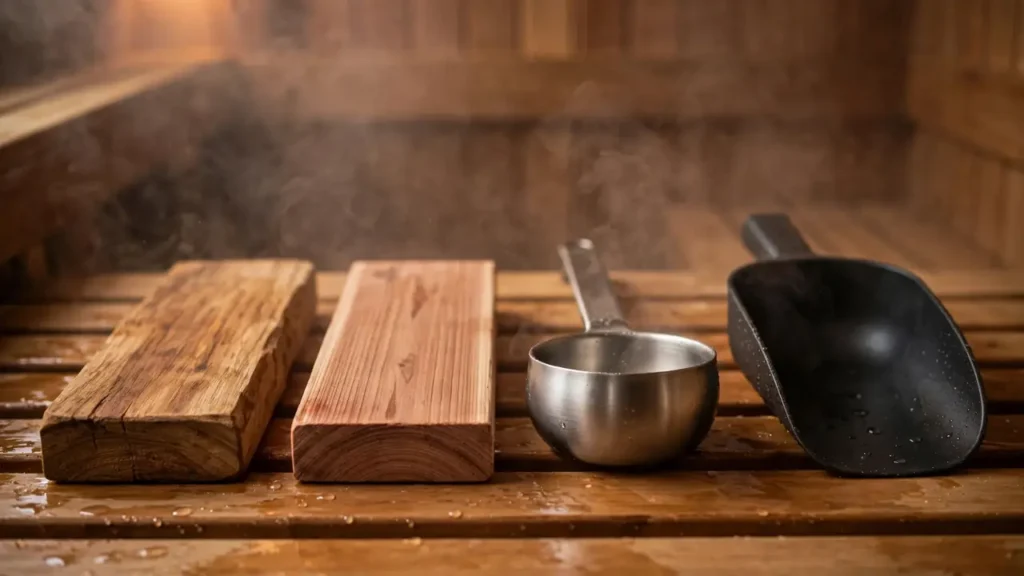
The best steam sauna materials either resist water or dry out fast. Teak, cedar, and aspen cope well with repeated wetting, stainless steel in grades 304 or 316 resists rust, and sealed, steam-rated plastics hold up well.
Materials that struggle include untreated pine, MDF and chipboard, plain carbon steel, chrome-plated fittings, and ordinary painted wood. If a product description does not say it is suitable for steam rooms or wet rooms, treat that as a warning sign.
2. Is it easy to clean and dry?
A steam room accessory should have smooth surfaces, few hidden joints, and no fabric that stays wet. Slatted benches dry faster than solid slabs, and anything with deep grooves or glued joints traps moisture and is harder to keep clean.
3. Is it safe to touch when hot and wet?
Steam rooms are slippery, and surfaces get hot. Wood stays comfortable to sit on and does not conduct heat the way metal does, so smooth, rounded edges matter, and anything you step on should have a non-slip surface.


#Paid Links
4. Does it earn its place?
A steam room is usually a small space, and every item in it takes up room and adds something to clean. Before buying, ask what the accessory actually improves.
A thermometer improves safety because you can see the temperature at a glance, and a bucket is useful for rinsing or adding scent. A decorative item that does nothing will just collect moisture.
The Short Answer: What to Buy First
If you want the short version, buy these four things first and stop there until you have used your steam sauna for a few weeks.
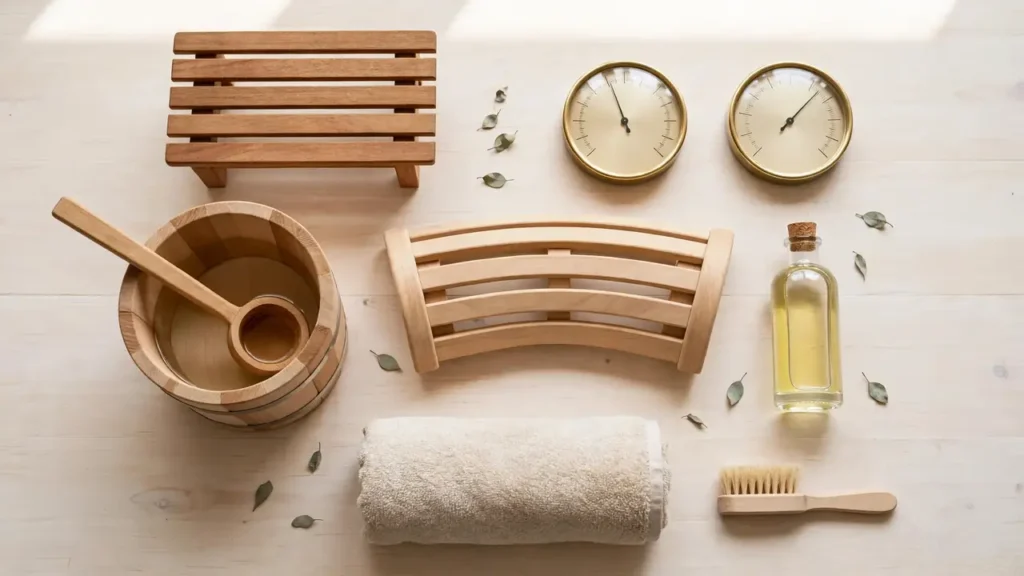
- A slatted teak or cedar bench or seat. This is where you sit, so it matters more than anything else, and slats let water drain and air circulate.
- A wooden bucket and ladle. A 1 to 2 gallon bucket is enough for most home steam rooms, and it is useful for rinsing, cooling down, and adding scented water.
- A thermometer and hygrometer. Steam rooms feel hotter than the number on the dial suggests, so a clear wall gauge helps you keep sessions safe and comfortable.
- A wooden headrest. A simple curved headrest makes a 15 minute session far more comfortable, and it costs little.
Starter kit at a glance
A solid starter set of bench, bucket and ladle, thermometer and hygrometer, and headrest typically costs about $180 to $550 as a 2026 planning estimate, depending on wood type and size. A single premium teak bench alone can cost more than the whole basic kit.
Benches and Seating: The Most Important Accessory
The bench is the one accessory you cannot do without. You will sit on it, lean on it, and rest your feet on it in every session, so a good steam sauna bench must be comfortable, drain well, and survive daily soaking without warping or growing mould.
What to look for in a steam sauna bench
- Slatted construction. Gaps of about 5 to 10 mm between slats let water drain and air move through, while solid bench tops trap water underneath and stay damp far longer.
- Steam-tolerant wood. Teak is the top choice because its natural oils resist water and it barely moves when wet. Cedar is a close second and smells pleasant, while aspen and abachi stay cool to the touch.
- Rounded edges. Every edge you sit or lean on should be sanded smooth and rounded, because sharp edges feel uncomfortable and are easy to catch in a steamy room.
- Stainless fixings. Screws, bolts, and brackets should be stainless steel, grade 304 or better, because ordinary steel rusts fast in steam and stains the wood.
- The right depth and height. A seat about 45 to 55 cm deep lets most adults sit comfortably with their feet flat, and seat height is usually 45 to 50 cm for a lower bench and 90 to 105 cm for an upper bench. Our guide to steam room bench layout, seating height, and sealing mistakes covers the build side in detail, including the height errors that are hardest to fix later.
Worth buying vs. what to skip
Worth buying: a slatted teak or cedar bench seat, especially a freestanding or drop-in seat you can lift out for cleaning. A two-tier setup is worth it in a taller room because heat rises.
Skip for now: upholstered or cushioned bench pads that are not rated for wet rooms. They soak up steam, take days to dry, and can develop a musty smell. The same goes for painted or varnished benches.
Most varnishes peel in constant steam. If you want a softer seat, use a washable cotton towel instead and wash it after each session.
Bench care in a steam room
Leave the door open after each session so the bench can dry, and wipe standing water off the slats once a week. Give the bench a light sanding once or twice a year if the surface feels rough, and use a sauna-specific wood oil if you oil it at all, because ordinary furniture oil can go rancid in constant humidity.
As a 2026 planning estimate, a small slatted seat starts around $80 to $150, a full-length teak bench runs about $250 to $600, and a custom two-tier bench setup can cost $500 or more.
Buckets and Ladles: Small, Simple, and Easy to Get Wrong
A steam sauna bucket has a different job from a dry sauna bucket. There are no stones to ladle water onto, so the bucket is for rinsing, cooling your face and neck, and mixing a few drops of essential oil into water for scent.
What to look for in a bucket and ladle
- Size. A bucket of 4 to 8 litres (about 1 to 2 gallons) is right for most home steam rooms. Smaller buckets are easier to lift when full and you refill them more often, which keeps the water fresh.
- Material. Wood is the classic choice, but it needs care. Teak and cedar buckets resist water well, while stainless steel buckets are the low-maintenance option and last almost indefinitely. Steam-rated plastic buckets are light and cheap, but check that the plastic is rated for hot water and will not soften or warp.
- A matching ladle. A wooden ladle with a long handle keeps your hand away from hot water. Stainless steel ladles are fine too, but they get hot to hold, so look for one with a wooden handle.
- Metal bands that will not rust. Wooden buckets are held together by bands. Those bands should be stainless steel. Galvanised or plain steel bands rust in steam and stain the wood within weeks.
Worth buying vs. what to skip
Worth buying: a mid-priced wooden bucket and ladle set with stainless bands, or a stainless steel bucket if you prefer zero upkeep. Either one will last for years with basic care.
Skip: very cheap buckets with thin staves and painted metal bands. They leak, the bands rust, and the wood splits after a few months of steam. Also skip oversized buckets, which are heavy when full and take up bench space you could use for sitting.
Bucket care in a steam room
Empty the bucket after every session and turn it upside down to drain. Rinse it weekly and let it dry outside the room. Wooden buckets can shrink if left empty for a long time, so soak one in water for a few hours before first use and after any long break to swell the staves and seal the joints.
As a 2026 planning estimate, a wooden bucket and ladle set costs about $30 to $90, and a stainless steel bucket costs about $40 to $120.
Thermometers and Hygrometers: The Safety Gauge
A thermometer is the one accessory that genuinely improves safety. Steam feels hotter than the number suggests, because humid air transfers heat to your skin far more efficiently than dry air, so without a gauge it is easy to stay in too long or let the room get hotter than planned.
Most steam rooms run between about 100 and 120 degrees Fahrenheit (38 to 49 degrees Celsius), with humidity close to 100 percent. A thermometer lets you confirm the room is in that range, and many wall gauges combine a thermometer and hygrometer in one unit. Our steam sauna temperature guide explains the safe range and session lengths in more detail.
Analog or digital?
Analog dial gauges are the classic choice. They need no batteries, they are easy to read through steam, and a good one lasts for years. Look for a wooden or stainless case, a clear dial with large numbers, and a glass or acrylic face that will not fog permanently.
Digital gauges give a precise number and some include a timer, which is genuinely useful. The catch is that the sensor and display must be rated for steam rooms. A standard indoor digital thermometer will fail in 100 percent humidity, so check that the maker states it is suitable for steam rooms.
Where to put the thermometer
Mount the gauge at head height when seated, on the wall opposite the steam head and away from the direct steam outlet. A gauge mounted right next to the steam inlet reads hotter than the room actually is, and one mounted too low reads cooler.
Worth buying vs. what to skip
Worth buying: a combined thermometer and hygrometer in a wooden or stainless case. It costs little more than a thermometer alone and tells you both numbers that matter. A simple sand timer mounted outside the door is also worth having, because time is the other half of a safe session.
Skip: novelty gauges with tiny dials, unsealed plastic cases, or no steam rating. They fog, they drift, and they give false confidence. Also skip gauges that mount with adhesive pads, because adhesive fails in steam.
As a 2026 planning estimate, a good analog thermometer and hygrometer costs about $20 to $60, and a steam-rated digital gauge costs about $40 to $100.
Headrests and Backrests: Small Comfort, Big Difference
A headrest is one of the cheapest upgrades you can make, and it changes how a session feels. Resting your head on a tiled wall is hard and cold at first, then uncomfortably hot, while a curved wooden headrest supports your neck and lets you relax fully instead of holding your head up for 15 minutes.
What to look for
- A curved, ergonomic shape. The best headrests curve to fit the back of the head and neck, and a shaped rest is noticeably more comfortable than a flat block of wood.
- The same steam-tolerant woods as the bench. Teak, cedar, aspen, and abachi all work well, and matching the headrest wood to your bench wood keeps the colours ageing evenly.
- Slatted or open design. A headrest with gaps between slats dries faster and stays fresher than a solid block, and it is lighter to move around the bench.
Backrests work the same way. A slatted wooden backrest leaned against the wall stops you touching hot tile and gives your back air circulation. S-shaped backrests support the lower back and are worth having if you take long sessions.
Worth buying: one curved wooden headrest per regular user. They are inexpensive and they last. Skip: foam or fabric neck pillows that are not rated for wet rooms. They soak up steam and can develop mould.
As a 2026 planning estimate, a wooden headrest costs about $25 to $60, and a slatted backrest costs about $40 to $120.
Aromatherapy Reservoirs and Essential Oils
Scent is one of the pleasures of a steam sauna, because the warm humid air carries fragrance well. Eucalyptus is the classic choice, and many people also use lavender, mint, or pine. The key point is how you add the scent: never pour undiluted essential oil directly onto a steam outlet or into a generator, because concentrated oil can damage seals and leave residue in the system.
The safe options are a dedicated aromatherapy reservoir or a few drops of oil mixed into the water in your bucket. A reservoir is a small cup or tray, usually stainless steel or ceramic, that sits near the steam inlet and holds scented water for the steam to carry into the room. Our guide to aromatherapy reservoirs for steam showers covers the different designs and how to fit one.
What to look for in a reservoir
- Heat-proof material. Stainless steel and ceramic are the safest choices, and thin plastic cups can warp near a steam outlet.
- Easy to remove and clean. A reservoir that lifts out in seconds gets cleaned, while one fixed in place with screws gets forgotten and old oil residue goes stale.
- The right size. A reservoir of 100 to 200 ml is enough for a home steam room, and larger ones waste oil and can make the scent overpowering.
Use only a few drops of essential oil per session, diluted in water first. If you have asthma, allergies, or sensitive skin, be cautious with strong scents and stop using them if they irritate your breathing. For more detail, see our guide to how to use essential oils in a steam sauna.
Worth buying: a stainless steel or ceramic reservoir if you enjoy scented sessions. Skip: cheap plastic oil cups and any product that asks you to put oil directly into the generator. As a 2026 planning estimate, a good reservoir costs about $15 to $50, and a small bottle of eucalyptus oil costs about $8 to $20.
Lighting, Mats, and Floor Comfort
Steam rooms are often windowless, so lighting matters more than people expect. The wrong light is either too dim to see the thermometer or so harsh that it ruins the relaxed mood, and any light inside a steam room must be rated for wet locations with a fitting sealed against steam.
Steam-safe lighting
Look for lights with an IP65 rating or better, which means they are protected against water jets and steam. Warm white light, around 2700K, suits a steam room best, and LED strips hidden behind a bench or along the ceiling edge give a soft glow without a visible fitting to clean.
Any electrical work in a steam room should be done by a licensed electrician, and local electrical codes must be followed. This is not a do-it-yourself job.
Mats and floor comfort
Steam room floors get wet and slippery. A duckboard, a slatted wooden platform for the floor, gives you a non-slip surface to stand on and lets water drain underneath. Lift it after each session so the tiles underneath can dry.
Rubber anti-slip mats are cheaper, but lift and clean them often, because mould can grow underneath in a warm wet room. Whatever you use on the floor, treat it as something that needs regular cleaning.
Worth buying: a wooden duckboard if your floor is slippery, and one steam-rated light fitting if your room is dim. Skip: ordinary bathroom rugs, fabric bath mats, and any light fitting that is not rated for wet locations. As a 2026 planning estimate, a teak duckboard costs about $60 to $180, and a steam-rated LED fitting costs about $40 to $120, not including installation.
Cleaning Tools and Water Care
A steam sauna is not maintenance-free, and the accessories you choose affect how much cleaning the room needs. Wooden accessories left wet grow mould, and buckets left full go stale, so a little regular care keeps everything fresh and extends the life of every accessory you own.
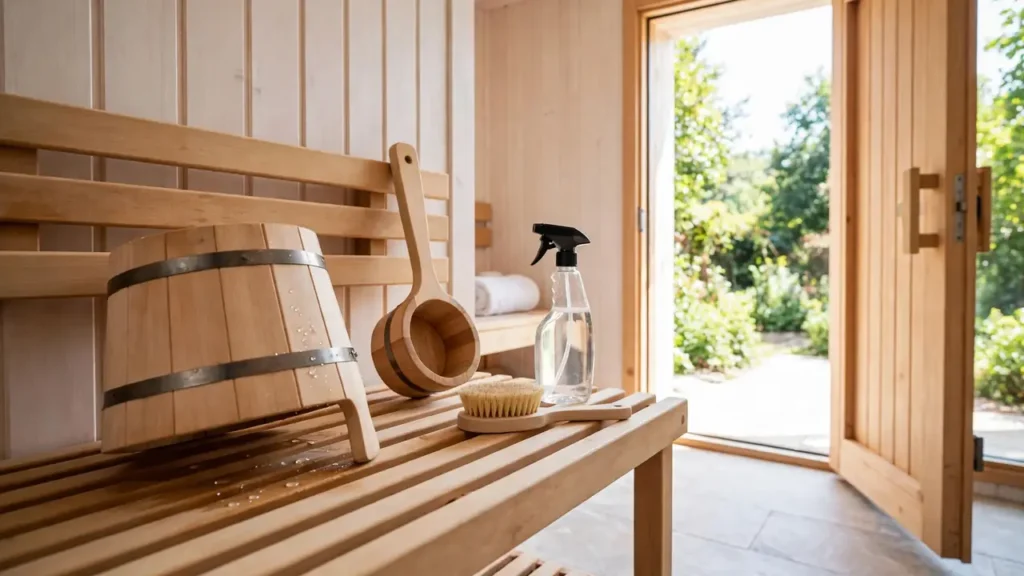
The cleaning tools worth owning are simple: a soft brush for wooden slats, a squeegee for tiles and glass, and a spray bottle with a mild, sauna-safe cleaner. Avoid harsh bleach-based cleaners on wood. Our guide to how to clean a steam sauna gives the full routine for tile, glass, and wood.
Water quality matters more than most people realise
Hard water leaves limescale in your steam generator and white marks on accessories. A simple in-line filter or water softener, fitted by a licensed plumber, is worth considering if your tap water is hard. Read our guide to the best water to use in a steam sauna before deciding.
If you are still choosing a generator, our comparison of steam generator brands including MrSteam, ThermaSol, Kohler, and Amerec will help you weigh the options.
Materials That Survive Steam vs. Materials That Fail
Check this table before you buy any accessory. The same material can be perfect in a dry sauna and a poor choice in a steam room, because constant humidity is a different test from dry heat.
| Material | Steam performance | Best for | Watch out for |
|---|---|---|---|
| Teak | Excellent, natural oils resist water | Benches, buckets, duckboards | Highest price of the common sauna woods |
| Cedar | Very good, aromatic and stable | Benches, headrests, backrests | Softer than teak, dents more easily |
| Aspen and abachi | Good, stay cool to the touch | Benches, headrests | Paler colour darkens with age in steam |
| Stainless steel 304 or 316 | Excellent, rust-resistant | Buckets, ladles, fixings, reservoirs | Gets hot to hold, choose wooden handles |
| Steam-rated plastic | Good if rated for hot water | Buckets, scoops, light fittings | Cheap unrated plastic warps and cracks |
| Untreated pine | Poor, absorbs water and warps | Not recommended in steam rooms | Swells, splits, and grows mould fast |
| Chrome-plated steel | Poor, plating peels in steam | Not recommended in steam rooms | Rusts underneath the peeling chrome |
| MDF and chipboard | Very poor, falls apart when wet | Not recommended anywhere near steam | Swells and crumbles within weeks |
| Painted or varnished wood | Poor, finish peels in constant steam | Not recommended in steam rooms | Flaking finish is unpleasant and hard to fix |
The Verdict Table: Every Accessory Ranked
Use this table as your shopping list. The verdict column is our honest view of what is worth buying, based on how much difference each item makes and how long it lasts.
| Accessory | 2026 planning estimate | Priority | Verdict |
|---|---|---|---|
| Slatted bench seat | $80 to $600 | Essential | Buy first, spend the most here |
| Bucket and ladle | $30 to $120 | Essential | Buy, wood or stainless steel |
| Thermometer and hygrometer | $20 to $100 | Essential | Buy, it improves safety |
| Wooden headrest | $25 to $60 | Essential | Buy, cheap comfort upgrade |
| Aromatherapy reservoir | $15 to $50 | Nice to have | Buy if you enjoy scented sessions |
| Slatted backrest | $40 to $120 | Nice to have | Buy for long sessions |
| Duckboard floor mat | $60 to $180 | Nice to have | Buy if your floor is slippery |
| Steam-rated lighting | $40 to $120 | Nice to have | Buy if your room is dim |
| Cleaning brush and squeegee | $15 to $40 | Essential | Buy, they protect every other accessory |
| Cushioned bench pads | $30 to $80 | Skip | Skip, they stay wet and go musty |
| Oversized bucket | $60 to $150 | Skip | Skip, heavy and wastes bench space |
| Foam neck pillow | $15 to $40 | Skip | Skip, soaks up steam and moulds |
| Unrated plastic gauge | $10 to $25 | Skip | Skip, it fogs and gives false readings |
All prices are 2026 planning estimates. They vary by brand, size, and region, so verify current listings before buying. The ranges above assume a typical home steam room, not a commercial spa.
Care and Maintenance: Keeping Accessories in Good Shape
Accessories last for years when dried and cleaned regularly, and fail fast when left wet. The routine below takes only a few minutes and protects everything you have bought.
| When | What to do | Why it matters |
|---|---|---|
| After every session | Empty the bucket, leave the door open, and hang towels outside the room | Airflow dries wood and tile before mould can start |
| After every session | Tip wooden buckets upside down to drain | Standing water stains wood and breeds bacteria |
| Weekly | Wipe benches and headrests, rinse the bucket, and squeegee tiles and glass | Removes body oils and soap residue before they build up |
| Weekly | Lift duckboards and mats and let the floor dry underneath | Mould grows fastest in dark, damp spots under mats |
| Monthly | Deep-clean wood with a soft brush and sauna-safe cleaner, and check fixings for rust | Catches small problems before they become replacements |
Ventilation is the other half of maintenance. A steam room that stays shut and damp between sessions will grow mould no matter how good the accessories are. Leave the door open after use, run any extractor fan, and let the room dry fully.
What to Skip: Accessories That Are Not Worth It
Some steam sauna accessories sound appealing but add little and create extra work. Here are the ones we would skip.
- Decorative items with no function. Ornaments, candles, and framed pictures have no place in a steam room. They collect moisture and are hard to clean, and candles are a fire risk in a hot room.
- Electronic gadgets that are not steam-rated. Speakers, tablets, and phone holders that are not rated for steam rooms fail quickly in 100 percent humidity. If you want music, use a waterproof speaker placed outside the room.
Three Sensible Starter Kits and What They Cost
Here is how the costs add up for three realistic setups, using the price bands in the verdict table as 2026 planning estimates. Your actual total will depend on the brands and sizes you choose, so verify current listings before buying.
The basic kit: about $180 to $400
A small slatted seat, a wooden bucket and ladle, a combined thermometer and hygrometer, a wooden headrest, and a brush and squeegee. This is everything you need for a small home steam room or a converted shower.
The comfortable kit: about $400 to $800
Everything in the basic kit, plus a full-length teak bench, a slatted backrest, a stainless steel aromatherapy reservoir with eucalyptus oil, and a teak duckboard.
The premium kit: about $800 to $1,500 or more
Everything in the comfortable kit, plus a custom two-tier teak bench, steam-rated LED lighting fitted by a licensed electrician, and a water filter or softener fitted by a licensed plumber.
Start with the basic kit and add one item at a time. Use the room for a month first, and you will quickly learn whether you want a backrest, a duckboard, or scented sessions.
Safety Basics for Steam Sauna Sessions
Accessories make a steam sauna more comfortable, but safe habits matter more than any product. Keep sessions short, usually 10 to 20 minutes, and drink water before and after. Leave the room straight away if you feel dizzy, unwell, or overheated, and do not drink alcohol before a session.
Talk to your doctor before using a steam sauna if you are pregnant, have a heart condition, circulation problems, or low blood pressure, or take medication that affects how your body handles heat. Our guide to steam sauna use for seniors, including safe temperatures and session lengths has more detail.
Children should only use a steam sauna with adult supervision, for very short sessions at lower temperatures. Never leave a child alone in a steam room.
Frequently Asked Questions
What are the most important steam sauna accessories?
A slatted bench, a bucket and ladle, a thermometer and hygrometer, and a wooden headrest are the four essentials. Together they cover seating, rinsing, safety, and comfort.
What wood is best for steam sauna accessories?
Teak is the best all-round choice because its natural oils resist constant moisture. Cedar is a close second and smells pleasant. Aspen and abachi are good lighter options that stay cool to the touch. Avoid untreated pine, painted wood, and varnished wood in a steam room, because they warp, peel, or grow mould.
Do I need a thermometer in a steam sauna?
Yes, a thermometer is one of the most useful accessories you can buy. Steam feels hotter than the number suggests, so a gauge helps you keep the room in the usual 100 to 120 degrees Fahrenheit range. A combined thermometer and hygrometer is the best value.
Can I use essential oils in a steam sauna?
Yes, but only a few drops, diluted in water, and never poured directly into the generator. Use a stainless steel or ceramic aromatherapy reservoir, or mix the oil into the water in your bucket. Stop using scented oils if they irritate your breathing.
How do I stop steam sauna accessories from going mouldy?
Choose steam-tolerant materials, empty buckets after each session, and leave the steam room door open so everything dries. Wipe benches weekly, lift mats and duckboards so the floor dries underneath, and clean wood monthly with a soft brush and sauna-safe cleaner.
How much should I budget for steam sauna accessories?
As a 2026 planning estimate, a basic starter kit costs about $180 to $400, a comfortable kit costs about $400 to $800, and a premium kit costs about $800 to $1,500 or more.
Final Thoughts
Steam sauna accessories are worth buying when they are made from the right materials and solve a real problem. A good bench, a solid bucket, a clear thermometer, and a simple headrest will improve every session you take. Everything after that is a comfort upgrade, worth adding slowly once you know how you use your steam room.
Start with the essentials, choose teak or cedar over cheap alternatives, and build the habit of drying and cleaning your accessories after each session. Your steam sauna will stay fresh, your accessories will last for years, and you will not waste money on items that were never going to survive the steam.