
If you live with eczema or psoriasis, an infrared sauna can sound both inviting and worrying. Warmth and sweat may feel soothing on stiff joints and tired muscles, yet the same heat can leave skin red, itchy, or tight. That tension is real, and it is the reason this guide exists.
This is a dedicated skin safety guide for people with eczema (atopic dermatitis) or psoriasis who are thinking about using an infrared sauna. It explains how the two conditions differ, how infrared heat and sweating affect each one, and how to build a gentle routine that puts your skin first. It also covers flare-ups, skin care before and after a session, medicines and light sensitivity, and the warning signs that mean you should stop.
Nothing here is a treatment plan. An infrared sauna is a wellness tool, not a treatment for eczema or psoriasis, and no sauna session can replace the care plan you have with your dermatologist. Read this guide as practical, cautious information to help you ask better questions and make safer choices.
Please read first: this is not medical advice. Saunas are wellness tools, not treatments. If you have eczema or psoriasis, check with your dermatologist before using an infrared sauna, especially during a flare-up, if your skin is broken or infected, or if you use prescription creams, oral medicines, or light therapy. Stop a session at once if you feel dizzy, faint, nauseous, or unwell, and seek medical help if symptoms do not pass quickly.


#Paid Links
Key takeaways
- Eczema and psoriasis are different conditions, and heat affects them differently, so they need different caution.
- During a flare-up, with broken or infected skin, the safest choice is usually to skip the sauna and wait.
- Start with short sessions at a low setting, and increase time only if your skin stays calm for a day or two afterwards.
- Shower gently after every session, pat dry, and moisturise while skin is still slightly damp.
- Check prescription creams, oral medicines, and light therapy with your dermatologist first, because some raise heat or light sensitivity.
- Leave the sauna at once if skin burns, stings badly, or you feel dizzy, faint, or unwell.
The Short Answer: Can You Use an Infrared Sauna With Eczema or Psoriasis?
Many people with eczema or psoriasis can use an infrared sauna safely when their skin is calm, their sessions are short and gentle, and they look after their skin before and after. Many others find that heat makes itching or redness worse, and for them the sauna is best avoided or used only rarely. Both outcomes are normal, because skin conditions vary so much from person to person.


#Paid Links
That is why this guide focuses on decisions rather than promises. It will help you tell a calm day from a flare day, choose a starting session that is easy to reverse, and spot the early signs that your skin is not happy. If you take one idea from this page, make it this one: a short, gentle session that leaves your skin calm is worth far more than a long, hot session that leaves it irritated for days.
If you are new to infrared saunas in general, start with the broader skin overview on this site. Our guide to the benefits of infrared sauna for skin explains how heat and sweating affect healthy skin, while is an infrared sauna good for skin covers the general pros and cons. This article goes further, with the condition-specific detail those general guides do not carry.
Eczema vs Psoriasis: Two Different Conditions, Two Different Risks
Eczema and psoriasis are often mentioned together, but they are not the same condition. Eczema, most often atopic dermatitis, is linked to a weakened skin barrier and an overactive immune response. Psoriasis is an immune condition in which skin cells grow too quickly and build up into thick, scaly patches. Knowing which one you have matters, because heat, sweat, and friction affect them in different ways.
With eczema, the skin barrier lets moisture escape too easily and lets irritants in too easily. Heat and sweat can trigger itching, and scratching then damages the barrier further. Dry air after a hot session can also leave skin feeling tight and rough.



#Paid Links
With psoriasis, heat is less often the main trigger, but sweating, friction from clothing or towels, and skin injury can irritate plaques. A knock, a scratch, or a patch of rubbed skin can sometimes trigger new psoriasis in that spot, a response dermatologists call the Koebner phenomenon.
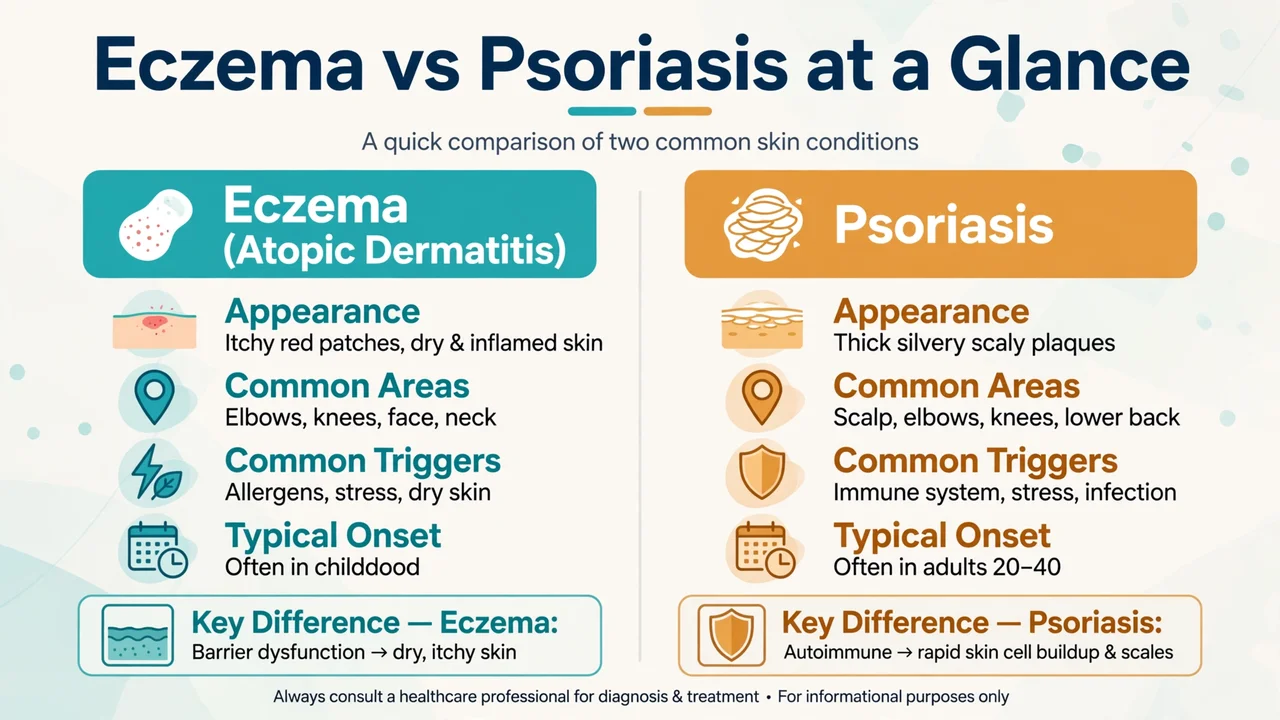
Eczema at a Glance
Eczema patches are often red, dry, and very itchy. In adults they commonly appear in the folds of the elbows and knees, on the hands, neck, and face, though they can appear almost anywhere. The skin may weep or crack during a flare, and it often feels rough or scaly between flares. Children with eczema often have patches on the cheeks and the outer arms and legs.
Heat is a common eczema trigger. Warm rooms, hot showers, heavy clothing, and sweating can all set off itching. That does not mean every person with eczema must avoid warmth entirely, but it does mean that a hot, sweaty environment deserves respect. A session that raises your core temperature and makes you sweat heavily is exactly the kind of change that can provoke an itch cycle.
Eczema skin is also more open to infection when it is cracked or scratched. Broken skin in a warm, shared sauna is a reason to stay out, both for your own comfort and to lower the chance of infection. If your skin is weeping, crusted, or has open cracks, wait until it has healed before you consider a session.
Psoriasis at a Glance
Psoriasis patches, called plaques, are usually raised, red, and covered with silvery-white scales. They often appear on the elbows, knees, scalp, and lower back, though they can appear on the palms, soles, and nails too. Unlike eczema, psoriasis is usually less itchy, though it can itch, burn, or crack painfully, especially on the hands and feet.
Some people with psoriasis find gentle warmth soothing, particularly when joints feel stiff. Others find that heat and sweating irritate their plaques or make the skin around them sore. Sunlight helps some people with psoriasis, which is one reason light therapy exists, but that is a medical treatment with controlled doses, not the same as sitting in a hot cabin. Never treat a sauna as a substitute for prescribed light therapy.
Friction matters more with psoriasis than many people expect. Tight clothing, a rough towel, or sitting on a hard bench for a long time can irritate plaques. Choose soft, loose clothing, sit on a clean soft towel, and avoid rubbing your skin dry afterwards. Pat dry instead, and keep the pressure light.
Eczema vs Psoriasis: A Side-by-Side Comparison
The table below sums up the main differences that matter for sauna use. Use it as a quick reference, then read the sections that match your own condition in detail. If you are unsure which condition you have, ask your dermatologist before you rely on any part of this guide.
| Feature | Eczema (atopic dermatitis) | Psoriasis |
|---|---|---|
| Typical look | Red, dry, itchy patches; may weep or crack in a flare | Raised red plaques with silvery-white scales |
| Main skin problem | Weakened skin barrier and strong itch response | Skin cells growing too fast and building up |
| Heat and sweat | Common trigger for itching and flares | Can irritate plaques; some find gentle warmth soothing |
| Friction risk | Scratching damages the barrier and worsens itch | Rubbing or injury can trigger new plaques in that spot |
| Broken skin | Higher infection risk; skip sauna until healed | Skip sauna if plaques are cracked, bleeding, or infected |
| After-session priority | Cool rinse, pat dry, moisturise quickly | Gentle rinse, pat dry, moisturise plaques and nearby skin |
How Infrared Heat and Sweating Affect Sensitive Skin
An infrared sauna warms your body directly with infrared light, rather than heating the air around you to the high temperatures of a traditional sauna. The cabin still gets warm, and you still sweat, but many people find the heat feels gentler and easier to tolerate. That gentler feel is a real advantage for sensitive skin, but it does not remove the risks. Sweat, warmth, and dry air after the session can each affect eczema or psoriasis.
Sweat itself is not dirty, but sweat left sitting on irritated skin can sting and itch. Salt in sweat can irritate cracked skin, and damp skin under tight clothing can chafe. The fix is simple and practical: keep sessions short enough that sweating stays moderate, rinse off soon afterwards, and change into dry, soft clothing. Do not sit in sweaty clothes for an hour after a session.
Heat also widens blood vessels near the skin surface, which is why skin looks flushed after a sauna. For most people that flush fades within an hour. For someone with eczema or psoriasis, flushing can come with itching, burning, or a feeling of tightness.
A flush that fades quickly and leaves no itch behind is reassuring. A flush that turns into hours of itching, new redness, or soreness is a sign that the session was too long or too hot for your skin.
What the Research Can and Cannot Tell You
There is no large, high-quality trial showing that infrared saunas improve eczema or psoriasis, and there is none showing they make these conditions worse for everyone. Most sauna research looks at general health, heart health, or muscle recovery, often in traditional dry saunas rather than infrared cabins. Where studies exist, they are usually observational, which means they show an association, not proof of cause, and their results may not apply to people with a skin condition.
Small reports and personal stories exist in both directions. Some people with psoriasis say their skin feels calmer after gentle warmth and moisturising. Some people with eczema say heat makes their itching worse.
Neither story is proof, and neither one predicts what will happen to you. The only reliable way to learn how your skin responds is a careful, gradual trial, with your dermatologist aware of what you are doing.
Why Infrared May Feel Different From a Traditional Sauna
Traditional saunas heat the air to high temperatures, and the air itself heats your skin. Infrared cabins work at lower air temperatures and warm the body more directly. Many users report that they can stay comfortable at a lower setting, breathe more easily, and sweat at a gentler pace. For sensitive skin, that lower air temperature can mean less sudden flushing and less drying of the skin surface.
If you have a choice between sauna types, our comparison of sauna or steam room for skin explains the trade-offs in more detail. Later in this guide, a short comparison table covers infrared, steam, and traditional saunas side by side for eczema and psoriasis specifically.
Flare-Up vs Remission: When to Sauna and When to Wait
The single most important decision in this guide is not about temperature or time. It is about timing. Using an infrared sauna when your skin is calm is a very different choice from using one in the middle of a flare-up. Most problems happen when people sauna through a flare because they hope the heat will help, and instead the heat adds irritation to skin that is already struggling.
Remission, or a quiet period, means your skin is settled: no new patches, no spreading redness, itching that is mild and manageable, and no broken or weeping areas. A flare-up means the opposite: spreading redness, intense itching, new patches, cracked or bleeding skin, weeping, crusting, or signs of infection such as warmth, swelling, yellow crusts, or pus. If you are in any doubt about which state you are in, treat it as a flare and wait.
| Skin state | Sauna or wait? | What to do instead |
|---|---|---|
| Calm, settled skin | A short, gentle session may be reasonable | Follow the starter ladder below and moisturise after |
| Mild, stable dryness | A very short, low session only, if skin stays calm | Moisturise well before and after; stop if itching rises |
| Active flare-up | Wait, do not sauna | Follow your prescribed flare care and contact your dermatologist |
| Broken, weeping, or cracked skin | Wait, do not sauna | Keep the area clean and covered as advised until it heals |
| Signs of infection | Wait and seek medical advice promptly | Do not sauna, do not share towels, and get checked soon |
| New medicine or treatment just started | Ask your dermatologist first | Wait until you know how your skin reacts to the new treatment |
How to Judge a Flare Honestly
It helps to check your skin in good light before you decide. Look at the areas that usually flare first, and ask three questions: Is the redness spreading or new? Is the itch stronger than yesterday?
Is any skin broken, wet, or crusted? If the answer to any of these is yes, the day is not a sauna day. Write the answers down for a week or two, and you will start to see your own pattern.
The Day-After Test
Judge a session the next day, not just in the moment. Skin can feel warm and relaxed right after a sauna, then become itchy, dry, or red several hours later or the following morning. That delayed reaction is common, and it is easy to miss if you only check how you feel when you step out.
After each early session, check your skin at three points: one hour after, before bed, and the next morning. Note any new itching, redness, tightness, flaking, or soreness. If all three checks are calm, you can consider the same length again. If any check shows a reaction, go back to a shorter session, or take a break and try again only when your skin has settled fully.
A Gentle Starting Routine: Temperature and Session Length
There is no medically proven session length for eczema or psoriasis, so the routine below is a cautious starting suggestion, not a prescription. It is built on the general sauna safety principle of starting short and low, then building slowly only when your skin stays calm. If your dermatologist or your sauna manufacturer gives you different guidance, follow theirs instead.
Start at the lowest comfortable setting on your cabin, and stay in for ten minutes or less on your first session. Ten minutes is long enough to feel the warmth and to learn how your skin reacts, and short enough that a bad reaction is usually mild and brief. Do not try to sweat heavily on a first session.
Sweat is not the goal. Calm skin the next day is the goal.
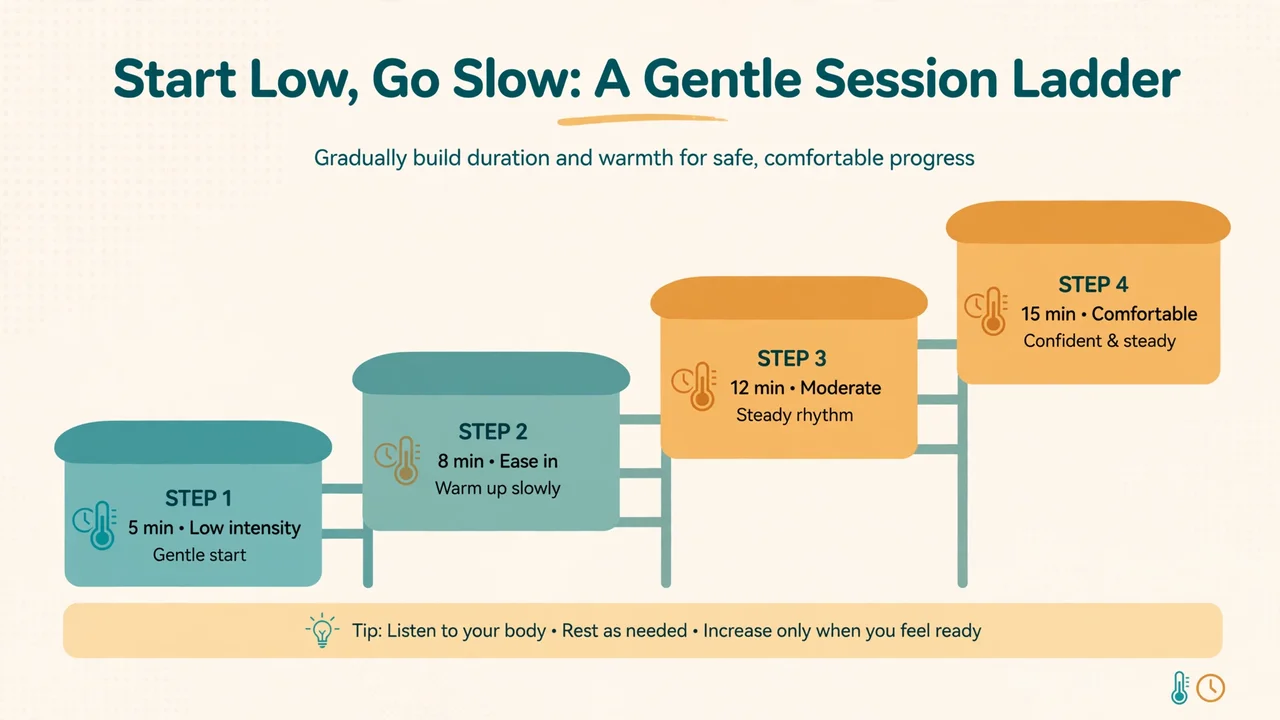
The Four-Step Starter Ladder
Move up one step at a time, and only after two or three sessions at the current step have left your skin calm the next day. If a step causes itching, redness, or tightness that lasts more than a few hours, drop back to the previous step for at least a week. There is no prize for reaching the top of the ladder, and many people with sensitive skin stay happily on the lower steps for good.
| Step | Session length | Heat setting | When to move up |
|---|---|---|---|
| Step 1: First trial | Up to 10 minutes | Lowest comfortable setting | After 2 to 3 sessions with calm skin the next day |
| Step 2: Building comfort | 10 to 15 minutes | Low setting | After 2 to 3 sessions with calm skin the next day |
| Step 3: Steady routine | 15 to 20 minutes | Low to moderate setting | Only if skin stays calm for a full week at this step |
| Step 4: Regular use | 20 minutes, and no longer unless your dermatologist agrees | Moderate setting, never the highest | Stay here; longer or hotter is not a goal for sensitive skin |
How Often Should You Go?
Start with one session a week, or two at most, with at least two rest days in between. Rest days matter because they give your skin time to show you how it really reacted. Daily sessions make it hard to tell whether a flare came from the sauna, from something else, or from a build-up of small irritations. Once you have a month of calm sessions, you can discuss a regular frequency with your dermatologist.
For more on session length in general, see how long you should stay in an infrared sauna. That guide covers healthy users, so treat its upper ranges as too long for sensitive skin, and use the ladder above instead. For setting the cabin itself, how hot an infrared sauna should be explains the controls, and the lowest settings are the right starting point for you.
Before Your Session: Skin Prep That Protects the Barrier
Good skin care starts before you step into the cabin. The aim is simple: go in clean, comfortable, and hydrated, with nothing on your skin that could trap heat or cause a reaction. A few minutes of preparation can prevent hours of itching afterwards.
Shower before your session if you can, using lukewarm water and a gentle, fragrance-free cleanser. Rinse off sweat, sunscreen, and the products you used during the day, then pat dry. Do not scrub, and do not use exfoliants, harsh soaps, or strong active products on the day of a session. Skin that is already irritated by a scrub will not enjoy heat on top of it.
Moisturise lightly before you go in, if that is part of your usual routine and your dermatologist has not told you otherwise. A thin layer of your regular moisturiser helps the barrier hold moisture during the session. Do not apply thick ointments, prescription creams, or new products just before a session unless your dermatologist has advised it. Heat can change how a product feels on the skin, and a heavy layer can trap sweat underneath it.
- Check your skin in good light. Skip the session if you are flaring, broken, weeping, or infected.
- Shower with lukewarm water and a gentle, fragrance-free cleanser, then pat dry.
- Apply only your usual light moisturiser, if any. Skip new products, exfoliants, and heavy ointments.
- Drink water before you start, and bring water and a clean, soft towel.
- Wear loose, soft clothing, and sit on a clean towel, not directly on the bench.
- Set the cabin to its lowest comfortable setting and set a timer for ten minutes or less on early sessions.
During Your Session: Stay Comfortable, Stay in Control
Once you are inside, your job is to stay comfortable and to notice what your skin is telling you. Sit or recline in a position that does not press hard on your worst patches. Keep a towel between your skin and the bench, and shift position gently if one area starts to feel hot or sore. Do not lie flat on a plaque or an itchy patch for the whole session.
Watch for three feelings in particular: burning, intense itching, and a feeling of skin tightening or stinging that grows rather than fades. Mild warmth and light sweating are expected. Burning, sharp stinging on cracked skin, or itching that makes you want to scratch hard are signals to step out, cool down, and rinse off. Scratch gently, or better, press a cool damp cloth against the itch instead of scratching it.
After Your Session: The Skin Care That Matters Most
What you do in the thirty minutes after a session matters more than what you do during it. Sweat, salt, and heat are still sitting on your skin, and the barrier is at its most open. A gentle rinse and a quick moisturise will do more for your skin than any product you could buy for the session itself.
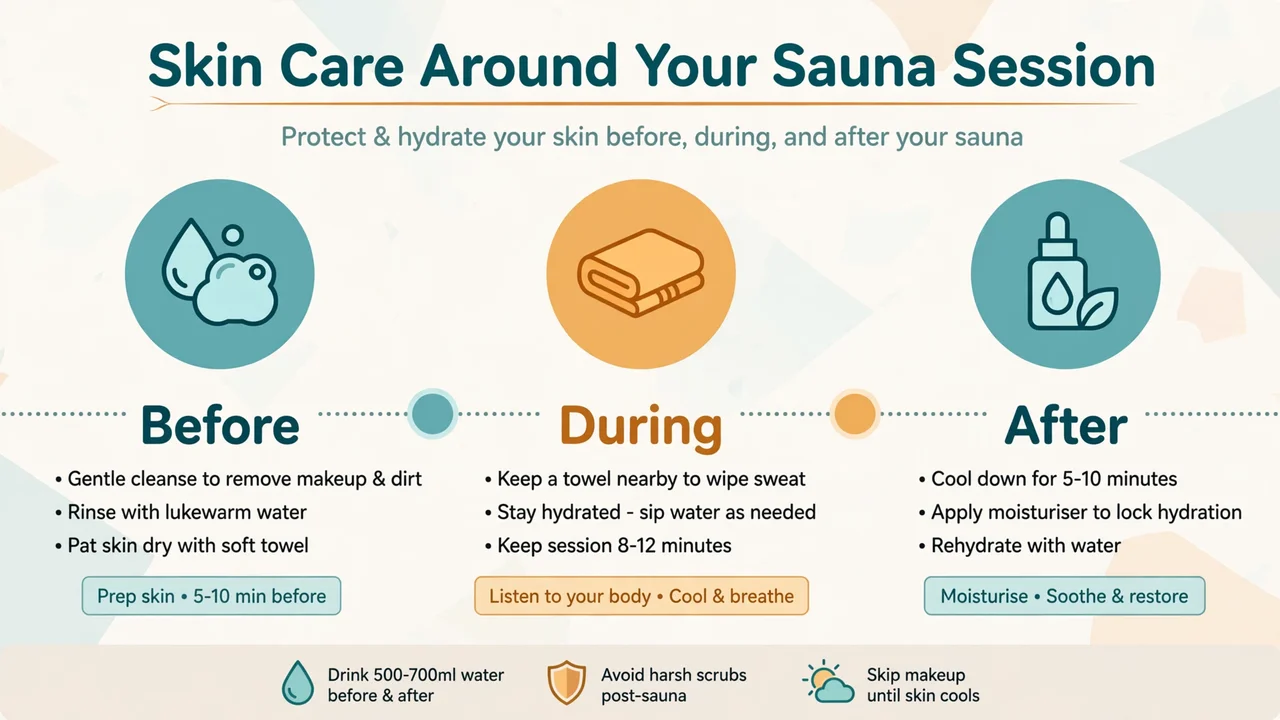
The After-Session Timeline
| When | What to do | Why it helps |
|---|---|---|
| Right away | Step out, sit somewhere cool, and sip water | Lets body temperature and flushing settle gradually |
| Within 10 minutes | Rinse with lukewarm water and a gentle cleanser if needed | Removes sweat and salt before they irritate skin |
| Within 3 minutes of rinsing | Pat dry gently, then moisturise while skin is slightly damp | Locks in moisture while the barrier is open and receptive |
| Next hour | Change into dry, soft clothing and re-check your skin | Prevents chafing from damp clothes and catches early reactions |
| Next morning | Check again for itching, redness, or new dryness | Confirms whether the session suited your skin before you repeat it |
Use lukewarm water for the rinse, never hot. Hot water strips the skin barrier further and can restart itching just when you have calmed it down. Keep the rinse short, use your hands rather than a rough cloth, and avoid loofahs, brushes, and exfoliating washes entirely on sauna days. If your skin feels clean enough with water alone, that is fine, and a gentle cleanser is only needed where you have used sunscreen or heavy products.
Moisturise within a few minutes of rinsing, while the skin is still slightly damp. Use the moisturiser your dermatologist recommends, and apply it in the direction of hair growth with light, smooth strokes. Pay attention to the areas that were worst before the session, and to the folds where sweat collects. If your skin still feels tight an hour later, apply a second thin layer rather than one very thick one.
For the wider before-and-after routine, what to do before and after an infrared sauna covers timing, food, and cooling down in more detail. The steps above are the skin-specific additions to that routine, and they should sit alongside it, not replace it.
Medications, Topical Treatments, and Photosensitivity
Medicines change the safety picture, and this is the section where a conversation with your dermatologist matters most. Some treatments for eczema and psoriasis raise sensitivity to heat or light, some dry the skin further, and some affect how your body handles warmth. Never stop a prescribed treatment to use a sauna, and never change a dose because of a sauna session.
Topical steroids and other prescription creams are usually applied at set times of day, and heat can affect how they feel and how they are absorbed. Ask your dermatologist whether to apply them before or after a session, and whether to skip an application on sauna days. The same question applies to calcineurin inhibitors, vitamin D creams, and any other topical treatment you use. Do not apply a prescription cream just before stepping into a hot cabin unless your dermatologist has told you to.
Some oral medicines and biologics can affect heat tolerance, blood pressure, or the immune response. Others, including some antibiotics and acne medicines, can raise sensitivity to light. Infrared light is not the same as ultraviolet light, and an infrared sauna is not a sunbed, but if you are taking any medicine that warns about sun or light sensitivity, ask your doctor or pharmacist before you use a sauna. Bring a list of your medicines to the conversation, and include creams and over-the-counter products, not just tablets.
- Ask about every topical cream, including steroids, before your first session.
- Ask about oral medicines and biologics, and about heat tolerance in general.
- Mention any medicine that warns about sun or light sensitivity.
- Ask whether sauna days should change the timing of any treatment.
- Ask about phototherapy, and whether sauna sessions should pause during a course.
- Never stop, skip, or change a prescribed treatment to fit a sauna session.
What to Wear, What to Bring, and When to Stop
Wear loose, soft, breathable clothing, or a clean cotton towel, and avoid tight synthetics that rub plaques or trap sweat against itchy skin. Bring water, a clean soft towel to sit on, a second towel for patting dry, and your usual moisturiser for afterwards. Skip fragranced lotions, essential oils, exfoliants, and any new product on sauna days, and skip the session entirely if you feel unwell, have a fever, or are dehydrated.
Stop a session at once and cool down if you feel dizzy, faint, nauseous, or unusually hot, if your heart is racing, or if your skin burns, stings sharply, or itches intensely. Step out, sit somewhere cool, sip water, and rinse off gently. Seek medical help promptly if dizziness, chest pain, breathlessness, or confusion does not pass quickly, or if skin becomes badly blistered, swollen, or infected-looking. For general sauna safety, is an infrared sauna safe covers the wider precautions that apply to everyone.
Infrared vs Steam vs Traditional for Sensitive Skin
Each sauna type heats the body differently, and each has a different trade-off for eczema or psoriasis. Infrared cabins usually run at lower air temperatures and feel gentler, which suits many people with sensitive skin. Steam rooms add humidity, which some people find soothing for dry skin, though the damp heat can also feel heavy and the shared surfaces need care. Traditional dry saunas run hottest and dry the skin surface most, so they are the hardest test for irritated skin.
| Sauna type | Heat and humidity | For eczema | For psoriasis |
|---|---|---|---|
| Infrared cabin | Lower air temperature, dry heat, direct body warming | Often the gentlest starting point, if sessions stay short | Often well tolerated at low settings with soft seating |
| Steam room | Warm and very humid | Humidity may soothe dryness, but damp heat can trigger itching | Moist heat may feel kind, but watch for irritation and hygiene |
| Traditional dry sauna | High air temperature, low humidity | Hardest on dry, itchy skin; keep sessions very short or skip | Heat and dry air can irritate plaques; use only with care |
Talking to Your Dermatologist and Planning Your First Month
Take this guide, or at least your session notes, to your next dermatology visit. A short conversation before your first session can prevent a flare that takes weeks to settle, and it gives your dermatologist a chance to adjust the timing of creams or treatments around sauna days. Ask whether your current skin state suits a trial, what session length they would accept, and what signs should make you stop for good.
- Is my skin calm enough now for a short, low trial session?
- Should any cream or treatment change timing on sauna days?
- Are any of my medicines a reason to avoid heat or light?
- What signs mean I should stop sauna use and contact you?
- How long should I wait after a flare before trying again?
If your dermatologist agrees to a trial, use the first month to learn, not to push. Week one means one short session of up to ten minutes at the lowest setting, then a full check the next day. Week two repeats the same session once, and only if the first week stayed calm.
Week three may rise to fifteen minutes, and week four holds at that level while you review your diary. If any week brings itching, redness, or soreness that lasts, drop back a step and stay there.
Common Mistakes to Avoid
- Sauna use during a flare-up, hoping the heat will fix it.
- Starting with a long, hot session instead of a short, low one.
- Skipping the rinse and moisturise step after a session.
- Scrubbing, exfoliating, or using hot water on sauna days.
- Applying prescription creams just before stepping into the cabin without asking.
- Treating a sauna as a replacement for prescribed treatment or light therapy.
- Ignoring a next-day reaction and repeating the same session anyway.
Used with care, an infrared sauna can be a calm, pleasant part of a routine for some people with eczema or psoriasis. Used carelessly, it can set skin back for days. The difference is rarely the cabin itself. It is the timing, the length, the setting, and the skin care around the session, and those are all choices you control.
Frequently Asked Questions
Is an infrared sauna safe for eczema?
It can be safe for some people when skin is calm, sessions are short and low, and skin is rinsed and moisturised afterwards. Heat often triggers eczema itching, so check with your dermatologist first and skip sessions during a flare-up.
Is an infrared sauna safe for psoriasis?
It can be safe for some people with psoriasis when plaques are calm and unbroken, sessions stay short, and friction is kept low. Avoid saunas if plaques are cracked, bleeding, or infected, and ask your dermatologist first.
Can an infrared sauna cure eczema or psoriasis?
No. An infrared sauna is a wellness tool, not a treatment, and no good evidence shows it cures eczema or psoriasis. It should never replace prescribed creams, medicines, or light therapy.
Should I use an infrared sauna during a flare-up?
No. During a flare-up, or when skin is broken, weeping, cracked, or infected, the safest choice is to skip the sauna and wait until your skin has settled. Follow your prescribed flare care instead.
How long should my first infrared sauna session be?
Start with up to ten minutes at the lowest comfortable setting. Increase only after two or three sessions leave your skin calm the next day, and stay at or below twenty minutes unless your dermatologist agrees otherwise.
Should I moisturise before or after a sauna session?
Both can help, but after matters most. Use a light layer of your usual moisturiser before if you wish, then rinse with lukewarm water after and moisturise within a few minutes while skin is still slightly damp.
Can I use an infrared sauna while using prescription creams?
Ask your dermatologist first. Heat can change how creams feel and work, so they may advise changing the timing of steroid creams, vitamin D creams, or other topical treatments on sauna days. Never stop a prescribed cream to use a sauna.
When should I see a dermatologist about sauna use?
See your dermatologist before your first session, during a flare-up, if you start a new medicine or light therapy, or if a session leaves your skin itchy, red, sore, or infected. Take your session diary to the visit.