
Walk up to almost any outdoor sauna and the first thing you touch is the door. It is the part you open and close every session, the part guests notice first, and the part that decides how much of your heat stays inside the room. Outdoor sauna doors and glass fronts shape the whole experience, from how bright the room feels to how private it is and how long the heater has to work.
That matters because an outdoor sauna fights the weather on every side. Wind, rain, snow, and cold air all pull heat away from the walls and roof. The door is the one opening you use constantly, so even a small gap or a thin pane can undo good insulation elsewhere. Pick the door well and the room heats faster, holds its warmth longer, and feels calmer to sit in.
This guide walks through the choices in plain terms. You will learn how doors and glass fronts lose heat, how wood and glass compare, what safety glass really means, how to keep your privacy without giving up the view, and what to check in seals, hinges, and frames before you buy or build. There are no product picks here and no prices. For door styles you can browse, see our roundup of sauna glass doors and our look at barrel saunas with glass fronts.


#Paid Links
Please read first: This article is general guidance only. It is not a substitute for your local building code, your sauna maker’s instructions, or a licensed professional. Rules for glazing, clearances, and permits vary by place, so check with your local permit or code office and use licensed professionals for installation work, gas lines, and electrical hookups.
Why Your Sauna Door Decides How Warm the Room Stays
A sauna room is a small, hot box sitting outside in the cold. Every surface gives up some heat, but the walls and roof usually have insulation, a vapour barrier, and thick timber working for them. The door has none of that luxury. It is thinner, it moves, and it has edges where air can slip through. That combination makes it the weakest point in the shell of most outdoor saunas.
The effect shows up in everyday ways. The heater runs longer to reach temperature. The room cools faster between rounds of heat. Bathers near the door feel a cool draught on their legs while the top bench stays hot. None of this means a glass door is a bad idea. It means the door deserves the same careful thought as the heater size or the wall build, because it quietly sets the ceiling for how comfortable the room can be.
The Four Ways Heat Leaves Through a Door
Heat escapes a sauna door in four ways, and each one points to a different fix. First, heat passes straight through the door material itself. Solid wood slows it down. A single pane of glass lets it through much faster. Second, warm air leaks out through gaps around the edges, and cold air sneaks in to replace it. Third, every time the door opens, a puff of hot air leaves and cold air rushes in. Fourth, the frame and the hardware can act as a bridge that carries heat from the warm side to the cold side.
Good doors deal with all four. A thicker or better insulated leaf slows conduction. A proper gasket and a true, square frame cut the leaks. A self closing hinge or a door that shuts firmly limits how long the opening stays open. And a frame made from wood, or a thermally broken design, reduces the bridge effect. When you compare doors, ask how each one handles all four paths, not just how it looks.
Why Outdoor Saunas Feel Door Heat Loss More
An indoor sauna sits inside a heated house, so the air on the other side of the door is already warm. An outdoor sauna faces the open air. On a cold or windy day the temperature difference across the door can be very large, and wind pushes cold air into every small gap. That is why a door that feels fine on a mild evening can feel draughty in January, and why outdoor sauna owners notice door quality more than indoor owners do.


#Paid Links
Placement helps too. A door that faces away from the prevailing wind leaks less than one that takes the wind full on. A small porch roof or windbreak in front of the door cuts the pressure that drives air through gaps. These are simple site choices, and they cost little, but they work together with the door itself. If you are still planning the shell, read our guide to outdoor sauna insulation, foil, and vapour barriers alongside this article, because the door and the walls have to work as one system.
Wood Doors vs Glass Doors at a Glance
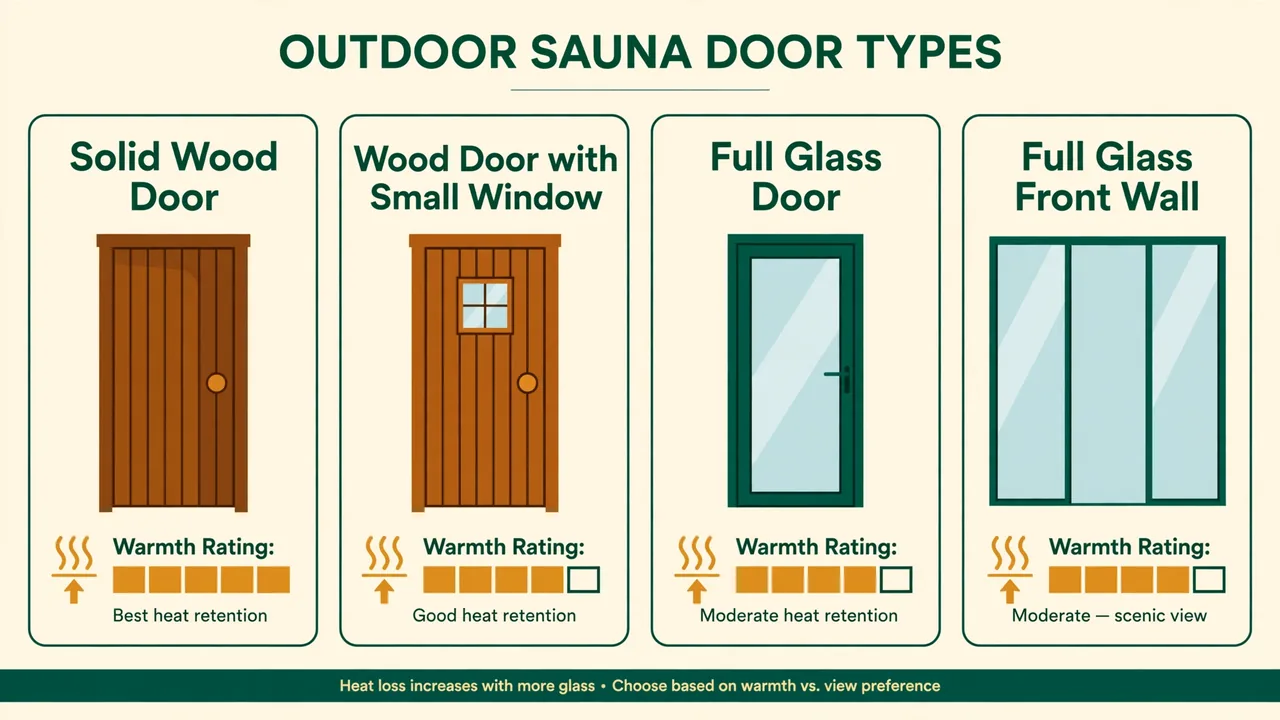
Before the detail, here is the short version. Wood keeps heat in and keeps eyes out. Glass brings in light and views and gives some of that heat back. The table below compares the common options on the points that matter most. The ratings are relative, not lab measurements, and they assume a well fitted door with a proper seal. A badly fitted wood door can lose more heat than a well fitted glass one.
| Door type | Heat retention | Light and view | Privacy | Upkeep | Best for |
|---|---|---|---|---|---|
| Solid wood door | High | Low, no view out | High | Low, occasional oiling | Cold climates and full privacy |
| Wood door with small window | High | Medium, a peek of light | High | Low to medium | A bright room without losing warmth |
| Full glass door in wood frame | Medium | High, open and bright | Low unless tinted or frosted | Medium, regular glass cleaning | Garden views and a light room |
| Full glass door, frameless | Medium to low | Very high, near invisible | Low unless treated | Medium, seals need checks | Modern looks and open views |
| Full glass front wall | Low | Very high, panoramic | Low unless screened | High, more glass to clean and seal | Showpiece saunas and mild climates |
Read the table as a set of trade offs, not a ranking. The best door is the one that fits your climate, your garden, and how you actually use the sauna. A family that bathes at night in a fenced garden has different needs from a lakeside cabin that faces a public path. The rest of this guide helps you match the door to your own situation.
Solid Wood Doors: Warm, Private, and Forgiving
The solid wood door is the traditional choice, and it is still the warmest simple option. A thick timber leaf, often cedar, aspen, alder, or thermo treated wood, slows heat far better than a pane of glass. It also gives full privacy with no extra work, and it suits the look of a log or timber cabin without trying. For cold climates and for saunas that face neighbours, it is hard to beat.
Wood has another quiet advantage. It moves a little with humidity and temperature, but a well made sauna door is built to allow for that. Good makers use vertical staves or a frame and panel design that lets the timber expand and shrink without warping the whole leaf out of square. Cheap flat doors made from a single wide board are more likely to cup or twist over time, and a twisted door never seals properly.
What to Look For in a Wood Door
- Thickness and build. A solid, well jointed leaf seals better and holds heat better than a thin hollow one. Ask how the door is built, not just what wood it uses.
- The right timber. Sauna friendly woods such as cedar, aspen, and alder handle heat and humidity without heavy resin or sharp splinters. If you are choosing timber for the whole build, our comparison of thermowood vs cedar vs spruce for outdoor saunas explains how each one behaves outside.
- A handle that stays cool enough to hold. Wooden handles are the norm for a reason. Metal handles look smart but can get uncomfortably hot, so check what the handle is made from and where it sits.
- Hinges that close the door fully. The door should swing shut on its own or with a light push and sit flat against the seal all the way round. A door that needs a shove is a door that will leak.
- Finish on both faces. Sauna doors need a finish that can handle steam and heat without peeling or giving off fumes. Use a product made for sauna interiors and follow the maker’s instructions.
One more practical point: a wood door hides scuffs and water marks far better than glass. In a busy family sauna, or one used by guests at a rental cabin, that matters. A quick wipe and an occasional light oiling keep a wood door looking good for years, while glass shows every fingerprint and water spot.
Wood Doors With a Window: A Middle Path
If you like the warmth of wood but want a little light and a way to see out, a wood door with a window is the middle path. A small tempered glass panel set into the upper half of the door lets daylight in and lets you check who is outside before you open up. The heat loss is modest because most of the leaf is still solid timber, and the privacy cost is small when the window is high and narrow.
The window also helps with safety in a simple way. You can see into the room before entering, and someone inside can signal if they need help. For households with children, older bathers, or guests using the sauna alone, that small window is worth more than it looks. Keep the glass tempered, keep the frame well sealed around it, and treat it like any other glass in the room: check the seal and the edges once a season.
Size the window with care. A narrow vertical slot gives light and a view while keeping most of the door solid. A wide window starts to behave like a glass door and gives up more of the heat advantage. If you want a big view, you are really choosing a glass door, so read the next section and decide with open eyes.
Full Glass Doors: Bright Rooms With a Heat Trade-Off
A full glass door changes the feel of a sauna completely. The room feels bigger, lighter, and more open. You can watch the garden, the trees, or the sunset while you sit on the bench, and the sauna becomes a feature of the garden rather than a closed box. For many owners, that feeling is the whole point of building outside in the first place.
The trade off is heat. Glass passes heat far more readily than wood, so a glass door will always lose more warmth than a solid timber door of the same size. That does not make it a bad choice. It means you should expect a slightly longer heat up time, a little more heater work on cold days, and a cooler patch of air near the door. In a mild climate or a well insulated cabin, most owners find that price worth paying. In a very cold climate, think twice, or choose a smaller glass area and a better glazing unit.
Single Pane, Double Glazing, and Insulated Units
Not all glass doors are equal, and the glazing is where the difference lives. A single pane of tempered glass is the simplest and cheapest option. It looks clean and it is strong, but it is also the coldest choice, because there is nothing to slow heat passing through it. Condensation can form on the inside face when the room is hot and the air outside is cold, and that water runs down onto the threshold and floor.
A double glazed door uses two panes with a gap between them, and an insulated glass unit seals that gap at the factory. The trapped air, and sometimes an inert gas fill, slows heat transfer noticeably compared with a single pane. The door is heavier and costs more, and the seals around the unit matter a great deal, but for an outdoor sauna in a cold region it is the sensible version of a glass door. Ask the supplier what the unit is made of, how thick the panes are, and whether the spacer and seal are rated for high heat and humidity.
One caution applies to every glass door: the glass and the frame expand at different rates as the room heats and cools. A good design leaves room for that movement. A rigid frame that clamps the glass too tightly can stress the edges over time. Check the maker’s guidance on fitting and leave the clearances they specify, rather than forcing a tight fit that looks neat on day one and cracks later.
Full Glass Fronts: When the Whole Wall Is Glass
A full glass front takes the glass door idea to its limit. Instead of one glazed door, the whole front wall, or a large part of it, is glass. Barrel saunas with glass fronts are the best known example, and they look spectacular at dusk, with the warm light glowing through the curve of glass. If your sauna sits somewhere with a view worth framing, a glass front turns every session into a lookout.
The heat cost is real and should be planned for, not discovered later. A large glass area loses heat far faster than a timber wall, so the heater works harder and the room takes longer to reach temperature, especially in winter. That has knock on effects: a bigger heater, more fuel or electricity, and a room that cools quickly once the heater is off. None of that is a reason to say no. It is a reason to size the heater for the glass you actually have, to choose insulated glazing units rather than single panes, and to be honest about winter use before you commit.
Privacy needs a plan too, because a glass front is a window in both directions. A sauna that faces a fence, a hedge, or a private view is a different proposition from one that faces a road or a neighbour’s windows. Screens, planting, tint, and curtains all help, and the privacy section below covers them in detail. If you want to see how makers handle the look, our guide to barrel saunas with glass fronts shows the common layouts and what to watch for.
Finally, think about cleaning and care. A full glass front is a large surface that shows water spots, dust, and fingerprints from both sides. If you love the look but hate cleaning glass, be honest with yourself before you order it. A squeegee kept by the door and a quick wipe after each session keep it clear with little effort, but only if someone actually does it.
Safety Glass: Tempered, Laminated, and What the Labels Mean
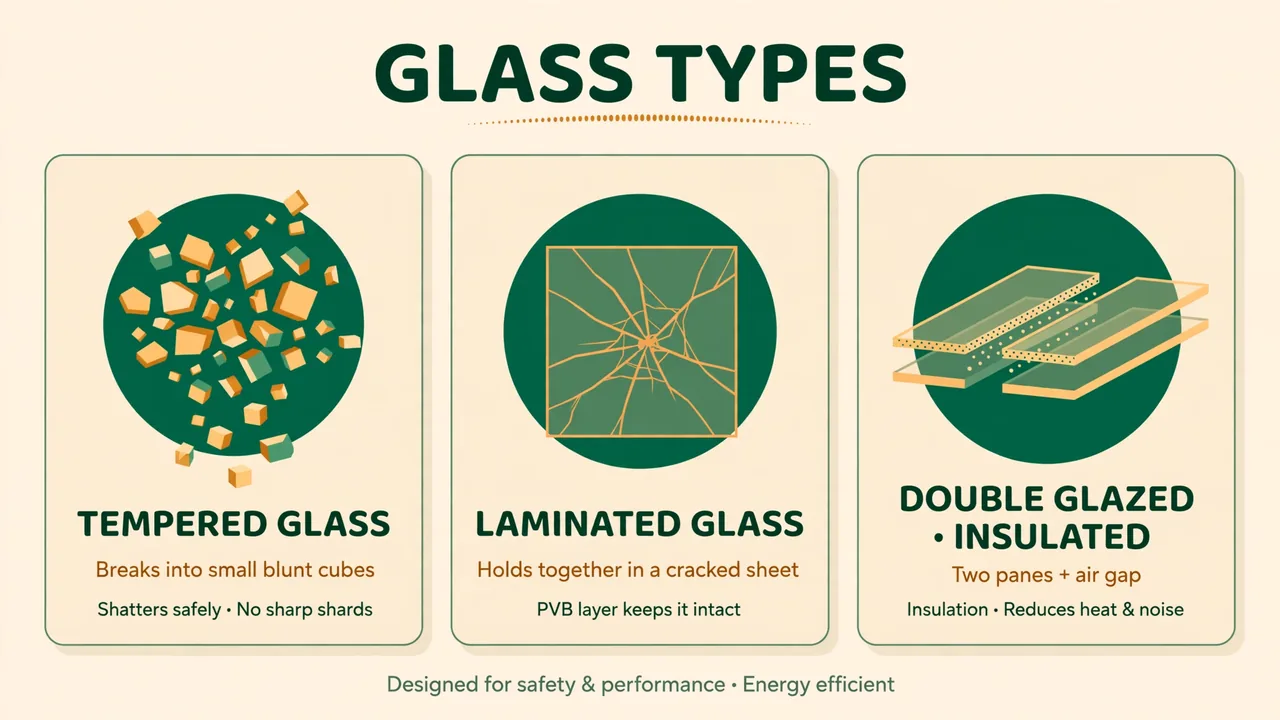
This is the section that matters most for safety, so read it carefully. Ordinary window glass has no place in a sauna door. It can crack under heat stress, and if it breaks it forms large, sharp shards. Sauna glass must be safety glass, and in practice that means tempered glass, laminated glass, or a combination of the two. The type matters because each one fails differently, and failing safely is the whole point.
Tempered Glass: Strong, and Safe When It Breaks
Tempered glass, sometimes called toughened glass, is ordinary glass that has been heated and cooled rapidly to put its surfaces under compression. The result is a pane several times stronger than untreated glass of the same thickness, and much more resistant to the thermal shock of a hot room meeting cold air. If it does break, it shatters into small, blunt, pebble like pieces rather than long sharp blades. That is why it is the standard choice for sauna doors and shower screens.
Tempered glass has limits worth knowing. It cannot be cut, drilled, or reshaped after tempering, so every hole for a handle or hinge must be made before the glass goes into the furnace. Its edges are its most vulnerable point, so a chip or knock on the edge deserves attention rather than a shrug. And once tempered, the pane cannot be trimmed to fit a frame that was measured wrong, so measure twice and confirm the sizes with the supplier before ordering.
Laminated Glass: The Pane That Stays in Place
Laminated glass is two panes bonded to a clear plastic interlayer. When it breaks, the pieces stick to the interlayer and the pane stays largely in its frame instead of falling out. That makes it a good choice for large glass fronts and overhead glazing, where a falling sheet would be dangerous. Laminated panes also block more sound and filter more ultraviolet light than a single tempered pane.
The trade off is weight and cost. Laminated units are heavier, so hinges and frames need to be sized for them. For a standard sauna door, tempered glass is usually enough. For a very large glass front, a tall frameless panel, or any glass above head height, ask the supplier whether laminated glass, or a laminated and tempered combination, is the right call for your design. Follow the maker’s advice and your local code rather than guessing.
How to Check the Glass You Are Buying
- Look for the etched mark. Tempered glass usually carries a small etched stamp in a corner showing the standard it meets and the maker’s name. Ask the supplier to point it out before you accept the door.
- Ask for the specification in writing. The quote or order should state the glass type, the pane thickness, and whether the unit is single, double glazed, or laminated. If it just says “glass door” with no detail, ask for more.
- Check the edges. Run a finger, carefully, along the exposed edges. They should be smooth and polished, not rough or chipped. Rough edges are a weak point and a cut risk.
- Confirm the heat rating. Ask whether the glass and the seals are rated for sauna temperatures. A shower door is not automatically a sauna door, and the two jobs are not the same.
- Keep the paperwork. Hold on to the order, the specification, and any warranty. If a pane ever fails, that paperwork is what proves what was supplied.
| Glass type | How it breaks | Stays in frame? | Typical sauna use | Watch out for |
|---|---|---|---|---|
| Tempered (toughened) | Small blunt pieces | No, falls away in pieces | Standard sauna doors and windows | Edge chips; cannot be cut after tempering |
| Laminated | Cracks but holds together | Yes, pieces stick to the interlayer | Large glass fronts and tall panels | Heavier; needs stronger hinges |
| Tempered and laminated | Small pieces held in place | Mostly yes | Large fronts and high risk spots | Highest cost; check the weight |
| Double glazed unit | Depends on the panes used | Depends on the build | Cold climate glass doors and fronts | Seal failure shows as fogging inside |
| Ordinary annealed glass | Large sharp shards | No | Not suitable for saunas | Do not use in a sauna door |
Privacy: Keep the Light and Lose the Audience
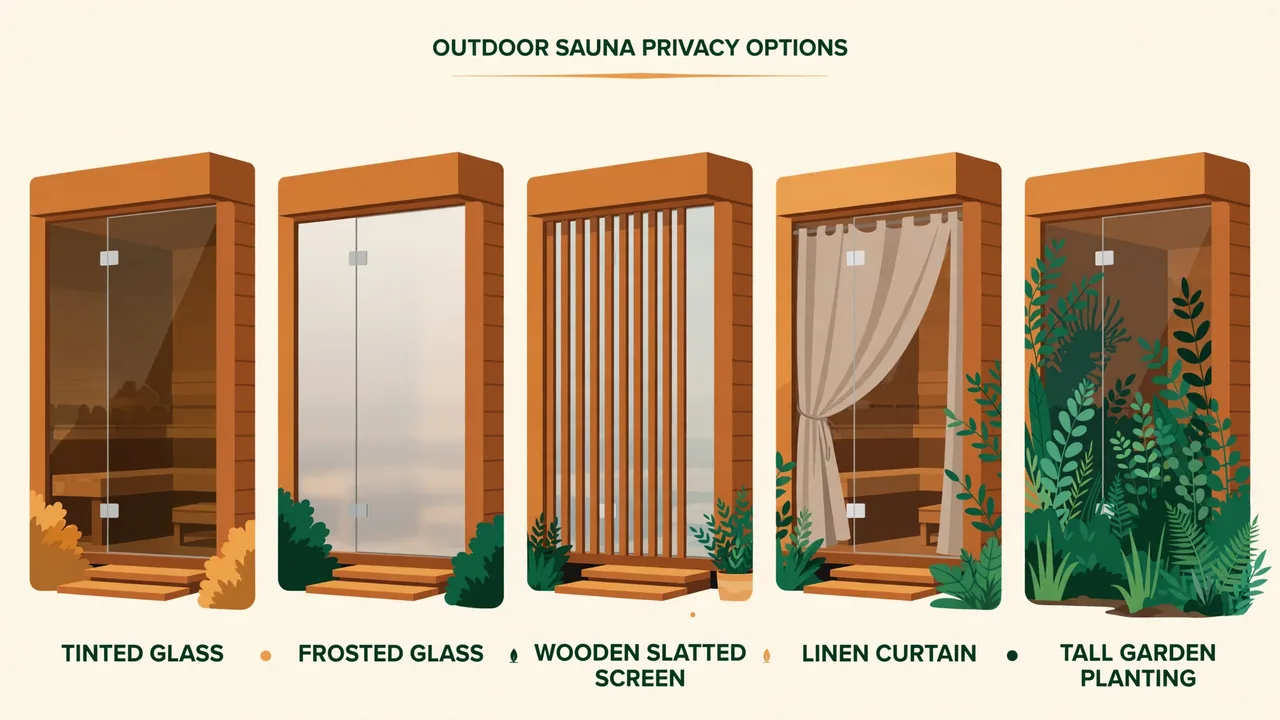
A glass door is a wonderful thing until you realise the neighbours can see in as clearly as you can see out. Privacy is the most common regret with glass sauna doors, and it is also one of the easiest problems to solve, as long as you plan for it before the glass is ordered. Changing a clear pane after fitting costs far more than choosing the right treatment at the start.
Tinted Glass
Tinted glass, often in bronze or grey, cuts glare and makes it harder to see in during daylight, while still letting you enjoy the view out. It also softens the light inside the room, which many bathers prefer in the evening. The trade off is that tint works best in daylight. At night, with the sauna lights on and the garden dark, the effect reverses, and people outside can see in more easily. Tint alone is not a full privacy solution for evening sessions.
Frosted and Patterned Glass
Frosted glass scatters light so shapes behind it blur into soft outlines. It gives real privacy day and night while still letting daylight through, which makes it a strong choice for saunas that face neighbours or paths. Patterned and textured glass does the same job with a little more character. The cost is the view: you keep the light, but you lose the clear sightline to the garden. A popular compromise is a clear lower panel with a frosted band at eye level, or a door that is frosted on the lower half and clear above.
Films, Curtains, and Blinds
If the glass is already fitted, films, curtains, and blinds are the flexible fixes. A privacy film sticks to the inside face and can be frosted, patterned, or one way tinted, and it can be removed or replaced later. Make sure any film you choose is rated for high heat and humidity, because a film made for a bathroom window may peel or bubble in a sauna. Curtains in linen or cotton, hung inside the door, give instant privacy and a soft look, but they must sit clear of the heater and must not block the door from opening freely. A simple wooden slatted screen outside the door works well too, and it never needs to survive the heat inside.
Placement and Planting: Privacy Without Touching the Glass
Sometimes the best privacy fix is not on the door at all. Turning the sauna so the glass faces a fence, a hedge, or a private corner of the garden solves the problem at the source. Tall grasses, bamboo in planters, or a trellis with climbing plants can screen a glass front within a season or two, and they soften the look of the building at the same time. Just keep planting clear of the heater flue, the vents, and any access the installer needs, and remember that a screen that blocks the view also blocks the breeze that dries the building after rain. Our guide to rain, humidity, roofing, and mould prevention for outdoor saunas explains why airflow around the building matters as much as airflow inside it.
Seals and Draughts: The Small Gaps That Cost the Most Heat
Ask any experienced sauna owner where the heat goes, and many will point at the door seal before the glass. A door can have the best glazing in the world and still leak like a sieve if the gasket is flat, the frame is out of square, or the door does not pull tight when it closes. Seals are unglamorous, cheap, and decisive, which is exactly why they get overlooked.
A good sauna door seal is usually a soft silicone or rubber gasket set into the frame, with a magnetic catch or a firm latch that holds the door against it. Wood doors often use a simple compressible strip. Glass doors rely on a combination of a bottom sweep, side seals, and a magnetic strip that snaps the door closed. Whichever type you have, the test is the same: close the door on a thin strip of paper at several points around the frame and pull gently. If the paper slides out easily, the seal is not gripping there, and warm air is escaping through that gap.
Hinges, Handles, and the Door That Will Not Stay Shut
A door that drifts open is a door that wastes heat and lets in cold air, and it is usually a hinge or latch problem rather than a glass problem. Self closing hinges are worth having on an outdoor sauna, because they remove the human habit of leaving the door ajar. Check them once a season: open the door halfway and let go, and it should swing gently closed and latch. If it hangs, sticks, or bounces back, adjust the tension or the strike plate before the gap becomes a habit.
Handles deserve the same check. A loose handle lets the door rattle in its frame, and a rattling door never seals. Tighten fixings, check that the latch meets the strike plate squarely, and replace worn parts promptly. These are five minute jobs, and they save far more heat than any upgrade to the glazing ever will.
Draughts Are Not Ventilation
It is worth clearing up a common confusion. A leaky door is not the same as ventilation, and it is not a substitute for it. A sauna needs planned fresh air in and stale air out, through vents placed where the designer intended, so the room breathes in a controlled way. A random gap under the door just dumps cold air on the floor and lets hot air out at the top. If your room feels stuffy, fix the ventilation rather than loosening the door. Our guide to outdoor sauna ventilation shows where vents belong and how to set them through the seasons.
Cold Weather and Winter Sessions
Winter is the real test of any outdoor sauna door. Cold air is denser, wind is stronger, and the temperature gap across the door is at its widest. A door that felt fine in summer can suddenly show every weakness: a stiff gasket that no longer compresses, a threshold that lets in snow melt, condensation that freezes on the frame overnight.
A few habits help. Clear snow and ice from the threshold before each session so the door can close fully. Wipe condensation from the glass and frame after the session so it does not sit and freeze. Keep the path to the door safe underfoot, because a slippery step outside a hot room is a real fall risk, especially when you are warm and relaxed. And give the heater a little more time in deep cold rather than forcing it: a steady heat up is kinder to the stove, the glass, and the timber than a rushed one.
If you bathe through winter, a wood door or a double glazed glass door is the safer bet. A single pane glass door can work in winter, but expect longer heat up times and more condensation, and be ready to dry the frame after each use. A full glass front in a cold climate needs insulated units, a heater sized for the glass, and a realistic view of running costs before you commit.
Before You Buy or Build: A Door Checklist
Use this list when you are comparing doors, talking to a supplier, or checking a kit before assembly. It takes ten minutes and it catches the mistakes that cost the most later.
- Measure the opening twice, and confirm whether the sizes are for the door leaf or the whole frame. A wrong measurement is the most expensive mistake on this list.
- Decide how much glass you really want, and where the door faces. A view is only a view if the door faces something worth looking at.
- Confirm the glass type in writing: tempered as a minimum, laminated for large panels, and insulated units for cold climates.
- Ask about the frame and the seal. What gasket is used, how does the door latch, and is the hardware rated for sauna heat and humidity?
- Check the swing direction and the clear space outside. The door should open without hitting steps, decking, or a cold plunge tub.
- Plan the privacy now, not after fitting. Tint, frosting, film, a screen, or planting, chosen before the order goes in.
- Match the door to the heater and the room size. A big glass front in a small room needs a heater sized for the glass, not just the floor area. See our guide on how to size an outdoor sauna before you finalise the shell.
- Ask about permits and code. Some places treat large glazing or a new outbuilding as work that needs approval. Check with your local permit or code office before you build.
- For wood fired saunas, keep the door and its hardware clear of the stove and the flue, follow the maker’s clearance instructions exactly, and never leave a lit stove unattended.
- Test the finished door on day one: the paper strip test around the seal, the self closing check, and a look for daylight leaking through any edge. Fix niggles now, while the supplier is still involved.
Care and Maintenance Through the Seasons
A sauna door is a working part, not a fit and forget one. Timber moves, gaskets flatten, hinges loosen, and glass spots up. A short seasonal routine keeps all of it working, and it takes less time than one sauna session.
- Every session: wipe the glass with a squeegee or a soft cloth after the room cools a little, and leave the door ajar briefly once the room is empty so moisture can escape. Never throw cold water on hot glass.
- Monthly: check the handle, hinges, and latch for looseness, and wipe the seals clean so grit does not wear them down.
- Each spring: inspect the gasket and replace it if it is flat, cracked, or hard. Check the frame for water damage, especially at the threshold, and re-oil a wood door if the finish looks dry.
- Each autumn: do the paper strip test around the whole seal, adjust the hinges and strike plate, and clear leaves and debris from the threshold and the drainage around the door.
- After storms: look for wind driven rain around the frame and the threshold, and dry any standing water promptly. Moisture left sitting against timber is what shortens a door’s life.
Clean glass with a soft cloth and a mild cleaner made for glass, and avoid abrasive pads that can scratch tempered panes. Clean wood with a damp cloth and a sauna safe cleaner, and never use harsh chemicals inside the hot room. If a gasket, hinge, or handle needs replacing, use parts rated for the heat and humidity of a sauna, not generic hardware store parts that may soften or corrode.
Mistakes That Waste Heat and Money
Most door regrets come from the same small set of mistakes. They are easy to avoid once you know them, and expensive to fix after the sauna is built.
- Ordering the biggest glass first and thinking about heat second. Start with your climate and your winter use, then choose the glass area to match.
- Using ordinary glass or a shower door in a sauna. Sauna glass must be tempered at minimum and rated for the heat. A bathroom fitting is not a sauna fitting.
- Ignoring the seal. The most expensive glazing in the world cannot save a door with a flat gasket and a warped frame.
- Forgetting privacy until the first evening session. Decide on tint, frosting, film, or screening before the glass is ordered.
- Putting the door where the wind hits hardest. A door facing the prevailing wind leaks more and feels colder. Turn the sauna or add a windbreak.
- Skipping the test on installation day. A door that is a little out of square is a quick fix on day one and a permanent draught by year two.
Frequently Asked Questions
Do glass sauna doors lose a lot of heat?
Yes, a glass door loses more heat than a solid wood door of the same size, because glass passes heat more readily than timber. Double glazing narrows the gap, and a good seal matters as much as the glass itself. In a mild climate the difference is modest, while in a cold climate it shows up as a longer heat up time and more heater work.
Is tempered glass required for a sauna door?
Tempered safety glass is the standard for sauna doors, because it is stronger than ordinary glass and breaks into small blunt pieces instead of sharp shards. Ordinary window glass should not be used in a sauna door. For large glass fronts, laminated glass or a tempered and laminated combination is often the better choice, so ask your supplier what suits your design.
Can I add privacy to a glass sauna door I already have?
Yes. A privacy film rated for high heat and humidity, a linen curtain hung clear of the heater, or a slatted screen or planting outside the door can all add privacy to existing glass. Frosting and tinting are easier and cheaper to choose before the glass is ordered, but a retrofit is still very workable.
Why does my sauna door not close properly?
The usual causes are a worn or flattened gasket, loose hinges, a latch that no longer meets the strike plate, or timber that has swollen or warped with humidity. Start with the paper strip test around the seal to find where the gap is, then tighten the hardware, adjust the strike plate, and replace the gasket if it has lost its spring. If the frame itself is out of square, ask the supplier or an installer to look at it.
Should I choose a wood door or a glass door for a cold climate?
A solid wood door, or a wood door with a small window, is the warmer choice for a cold climate, and it is the simplest way to keep heat in and hold privacy. If you want glass, choose a double glazed unit with a strong seal and a heater sized for the glass, and face the door away from the prevailing wind where you can.
How do I stop condensation on my sauna glass door?
Some condensation is normal when hot, humid air meets a cold pane, and double glazing reduces it. Wipe the glass after each session, leave the door ajar briefly once the room is empty so moisture can escape, and make sure the room’s ventilation is working as designed. Persistent heavy condensation can also point to a failed seal in a double glazed unit, which shows up as fogging between the panes.
The Bottom Line
There is no single best outdoor sauna door, only the best door for your sauna, your climate, and your garden. A solid wood door is the warmest and most private choice, and it asks the least of you. A glass door trades some of that warmth for light and a view, and it repays the trade when the glazing is good, the seal is tight, and the heater is sized for the glass. A full glass front is the boldest version of that trade, and it works best where the view deserves it and the climate is kind.
Whatever you choose, spend your attention on the unglamorous parts: the glass specification, the gasket, the hinges, and the fit of the frame. Those details decide whether your sauna heats quickly and holds its warmth, or whether it leaks heat through the one opening you use every single session. Get them right and the door disappears into the background, which is exactly what a good door should do.
A final note on using the sauna safely. A sauna is a wellness tool, not a treatment, so keep sessions short, hydrate before and after, and leave the room at once if you feel dizzy, unwell, or overheated. Avoid alcohol before and during sessions. If you are pregnant, live with a heart or circulation condition or low blood pressure, or take medication that affects heat tolerance, check with your doctor first. The door will keep the heat in. Your own judgment keeps the session safe.