
Heat Shock Proteins Explained: How Sauna Heat Triggers Your Cells’ Repair Response
Please note: This article is for general information only and is not medical advice. Saunas are wellness tools, not treatments. If you are pregnant, live with a heart or circulation condition or low blood pressure, or take medication that affects heat tolerance, check with your doctor before using a sauna.
You have probably heard that sauna sessions do more than help you relax. One of the reasons researchers are interested in heat exposure is a family of molecules called heat shock proteins. They are part of how your cells cope with stress, and heat is one of the triggers that switches them on.
This article explains what heat shock proteins are, how a sauna session can trigger them, what the research actually shows so far, and how to approach sauna use sensibly. It focuses on infrared saunas, but the underlying biology applies to heat exposure in general.
What Are Heat Shock Proteins?
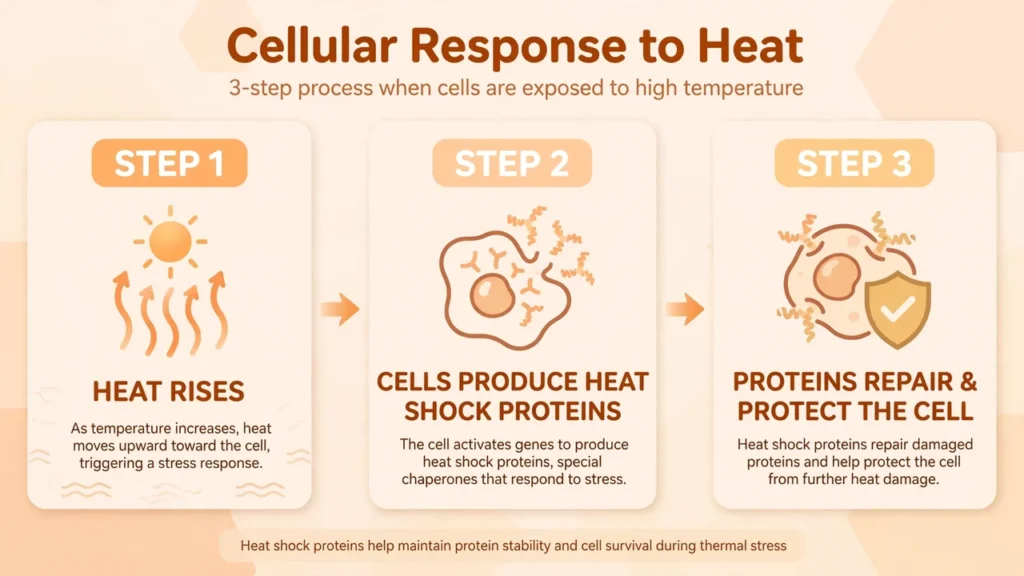
Heat shock proteins, often shortened to HSPs, are proteins your cells produce when they are under stress. Heat is the classic trigger, which is where the name comes from, but exercise, illness, and other stressors can raise them too.


Paid Links - As an Amazon Associate, I earn from qualifying purchases.
Think of HSPs as a cellular repair crew. When heat stresses a cell, some of its proteins can lose their shape or stop working properly. HSPs help refold damaged proteins, protect structures inside the cell, and support the cleanup of proteins that cannot be repaired.
Scientists have known about HSPs for decades, and they are found in nearly every living organism, from bacteria to humans.



Paid Links - As an Amazon Associate, I earn from qualifying purchases.
How Does Sauna Heat Trigger Them?
When you sit in a sauna, your core body temperature rises. Your body reads that rise as a stress signal, and one of its responses is to increase production of heat shock proteins. The process is a normal, built-in defence mechanism, not something artificial or forced.
Infrared saunas heat the body differently from a traditional sauna. Instead of heating the air around you to very high temperatures, infrared panels emit radiant heat that warms your body more directly, so the cabin air stays at a lower temperature. Many people find this gentler and easier to tolerate, which can make it simpler to build a regular routine.
That said, what matters for HSP production is the rise in body temperature, not the type of sauna as such. Research on heat shock proteins has mostly used traditional saunas, exercise, or laboratory heat exposure, so findings should not be assumed to transfer exactly to infrared sessions. If you want background on the wider picture, see our guide to infrared sauna health benefits.
What the Research Actually Shows (and Its Limits)
Studies in people and animals have found that heat exposure can raise levels of certain heat shock proteins, particularly one called HSP70. Some research has also linked regular sauna use with markers associated with cardiovascular and general health.



Paid Links - As an Amazon Associate, I earn from qualifying purchases.
It is important to be honest about the limits here. Much of the best-known sauna research, including the Finnish KIHD cohort studies often cited in sauna articles, is observational. That means it shows an association between sauna habits and health outcomes, not proof that sauna use caused those outcomes. Those studies also looked mainly at traditional dry sauna use in Finland, not infrared saunas specifically.
Laboratory and small-scale studies on HSPs are promising but preliminary. They tell us the mechanism is real — heat does trigger these proteins — but they do not prove that raising HSPs through sauna use prevents disease or extends life. Anyone claiming otherwise is going further than the evidence allows. For a careful look at the Finnish research, read our article on sauna for longevity and the Finnish studies.
Why People Care About Heat Shock Proteins
Interest in HSPs comes down to resilience. As we age, our cells’ ability to handle stress and repair damage tends to decline. Researchers are studying whether regularly activating the body’s own repair systems — through heat, exercise, or other mild stressors — could help maintain that resilience.
This idea is sometimes called hormesis: a small, controlled dose of stress that prompts the body to adapt and become stronger. A sauna session fits that pattern in principle — a short, manageable heat stress followed by recovery.
It is also worth keeping perspective. HSPs are one piece of a much larger puzzle that includes sleep, diet, movement, and overall lifestyle. A sauna routine is best seen as one supportive habit among many, not a shortcut. For a broader view, see what the benefits of an infrared sauna are.
How to Approach Infrared Sauna Sessions
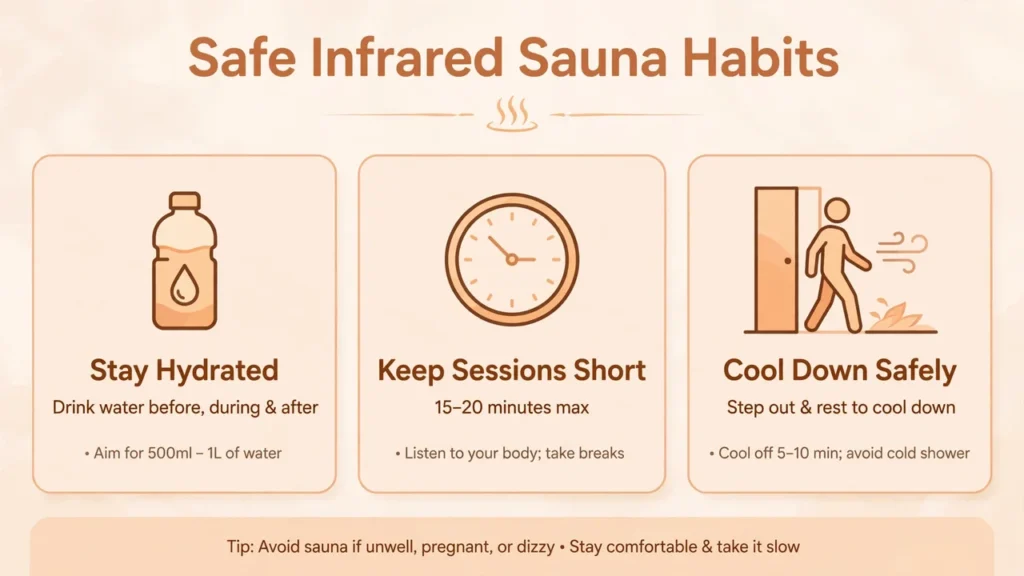
If you are new to infrared saunas, start short and build up gradually. Many beginners start with sessions of around 15 minutes and work up to 20–30 minutes as they get used to the heat. These are typical user guidance ranges, not a prescription — listen to your body and stop sooner if you feel uncomfortable.
Hydrate before and after every session, and keep water nearby. Avoid alcohol before or during a sauna session, as it impairs your body’s ability to regulate temperature and increases dehydration risk. Leave the sauna immediately if you feel dizzy, nauseous, or unwell, and cool down gradually afterwards.
Timing can also make a difference to how you feel. Some people prefer a morning session to start the day, while others use the sauna in the evening to unwind. Our guide to the best time to use an infrared sauna compares the options. If you like contrast therapy, the infrared sauna cold plunge beginner protocol explains how to combine heat and cold safely as a newcomer.
Who Should Be Extra Careful
- Pregnant women should check with their doctor before using a sauna, as overheating is a known concern in pregnancy.
- People with heart or circulation conditions should get medical clearance first, since heat places extra demand on the cardiovascular system.
- Anyone with low blood pressure should be cautious, as heat can lower blood pressure further and cause lightheadedness.
- People taking medication that affects heat tolerance — including some blood pressure, heart, and psychiatric medicines — should ask their doctor or pharmacist whether sauna use is safe for them.
- Children and older adults are more sensitive to heat and should use shorter, milder sessions with supervision where appropriate.
These cautions are not meant to put you off. They are there so that a relaxing habit stays a safe one. When in doubt, a quick conversation with your doctor is worth far more than any article, including this one.
Frequently Asked Questions
What do heat shock proteins do in the body?
Heat shock proteins help cells cope with stress. They assist in refolding damaged proteins, protecting cell structures, and clearing proteins that cannot be repaired, supporting cellular recovery after heat or other stress.
Does an infrared sauna trigger heat shock proteins?
Heat exposure in general can raise heat shock protein levels, and an infrared sauna raises body temperature, which is the key trigger. Most direct HSP research has used traditional saunas or laboratory heat, so results should not be assumed to transfer exactly to infrared sessions.
How long should a sauna session be to trigger heat shock proteins?
There is no proven session length that guarantees a specific HSP response. Beginners typically start with around 15 minutes and build up to 20–30 minutes over time, but this is general guidance, not a prescription, and individual responses vary.
Are heat shock proteins a treatment for any disease?
No. Heat shock proteins are a normal cellular stress response, not a treatment or cure. Research into their role in health is ongoing and largely preliminary, and sauna use should not replace medical care for any condition.