
Search for an outdoor steam sauna and you’ll find a cedar barrel, a pop-up tent and a tiled backyard room, all sold under the same name. They aren’t the same thing. Mixing them up is how people end up with a setup that’s cold, soggy or underpowered.
This outdoor steam sauna guide sorts that out. You’ll learn what each type really is, which features matter, how to spot good quality, what research says about the benefits, and what it takes to set one up safely outside. No hype. Just what you need to know before you spend a dollar.
Key takeaways
- “Steam sauna” can mean a true steam room, a traditional sauna that makes steam from hot rocks, or a portable steam tent.
- A true steam room runs about 110°F to 120°F at near 100% humidity. A Finnish sauna runs about 150°F to 200°F and feels dry.
- Outdoors, the hard parts are moisture, cold and power.
- The best-known sauna research studied dry saunas, not steam rooms.
What Is an Outdoor Steam Sauna?
An outdoor steam sauna is a sealed, heated space outside your home that fills with warm, wet air. Most of the time that air sits around 110°F to 120°F with humidity close to 100%. It feels thick and soft, almost like standing in a warm cloud.


Paid Links - As an Amazon Associate, I earn from qualifying purchases.
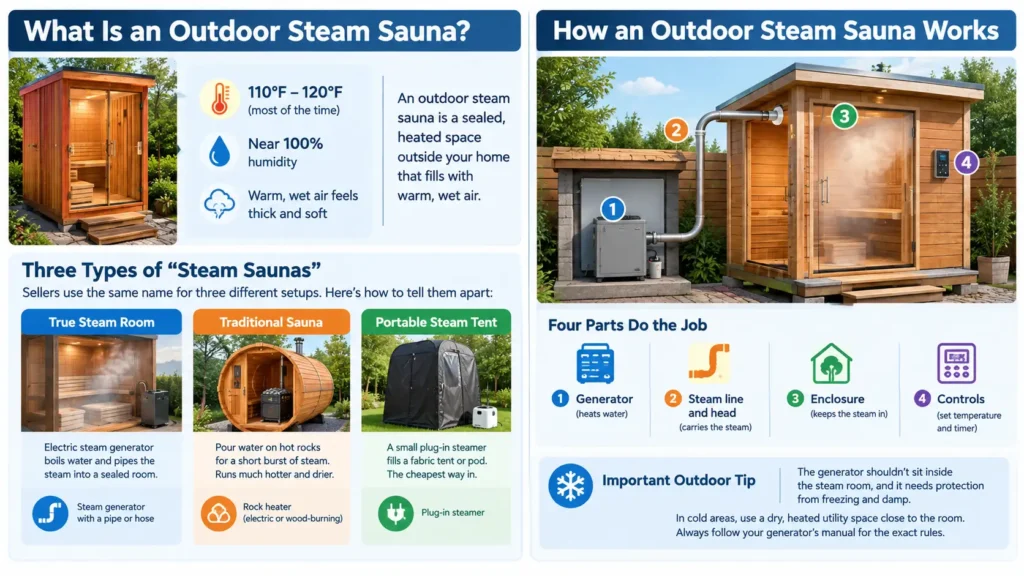
The trouble is the label. Sellers use “steam sauna” for three different things:
- A true steam room. An electric steam generator boils water and pipes the steam into a sealed room.
- A traditional sauna. You pour water on hot rocks and get a short burst of steam. This is the classic barrel or cabin sauna, and it runs much hotter and drier.
- A portable steam tent. A small plug-in steamer fills a fabric tent or pod. It’s the cheapest way in.
Here’s a quick way to tell them apart. Look for the heat source. A steam generator with a pipe or hose means a true steam room. A rock heater, electric or wood-burning, means a traditional sauna. If a listing doesn’t say, ask before you buy.
How an Outdoor Steam Sauna Works
Think of it as a kettle connected to a sealed room. A generator heats water until it turns to steam. A line carries the steam into the room, where it keeps the air warm and humid. A control lets you set the temperature and a timer.
Four parts do the job: the generator, the steam line and head, the enclosure, and the controls. Most people only think about the generator. The enclosure matters just as much, because steam escapes through every tiny gap.
Here’s the outdoor catch that most guides skip. Steam room construction guides, and many generator manuals, say the generator shouldn’t sit inside the steam room, and it needs protection from freezing and damp.
In a cold area, that means a dry, heated utility space close to the room. A bare box in the yard won’t cut it. Always follow your generator’s manual for the exact rules.


Paid Links - As an Amazon Associate, I earn from qualifying purchases.
Steam Sauna vs Dry Sauna vs Infrared
Temperature and humidity are the big differences. Sources vary a little, but these ranges are typical.
| Steam room | Finnish (dry) sauna | Infrared sauna | |
|---|---|---|---|
| Air temperature | About 110°F–120°F | About 150°F–200°F | About 120°F–150°F |
| Humidity | Near 100% | Low | Low |
| Heat source | Steam generator | Rock heater | Infrared panels |
| Best interior | Non-porous surfaces | Wood | Wood |
Why does steam feel hotter than the number suggests? Because at near 100% humidity your sweat can’t evaporate, so your body can’t cool itself well. That’s also why steam sessions are shorter. If you’re still torn, this look at dry sauna vs steam sauna goes deeper on how each one feels and who each suits.
Infrared is a different animal. It warms your body directly with panels instead of heating the air, so it runs cooler and stays dry. Some people find it easier to tolerate. Others miss the thick, humid wrap of real steam. Neither is “better.” It comes down to what you enjoy.
Types of Outdoor Steam Saunas
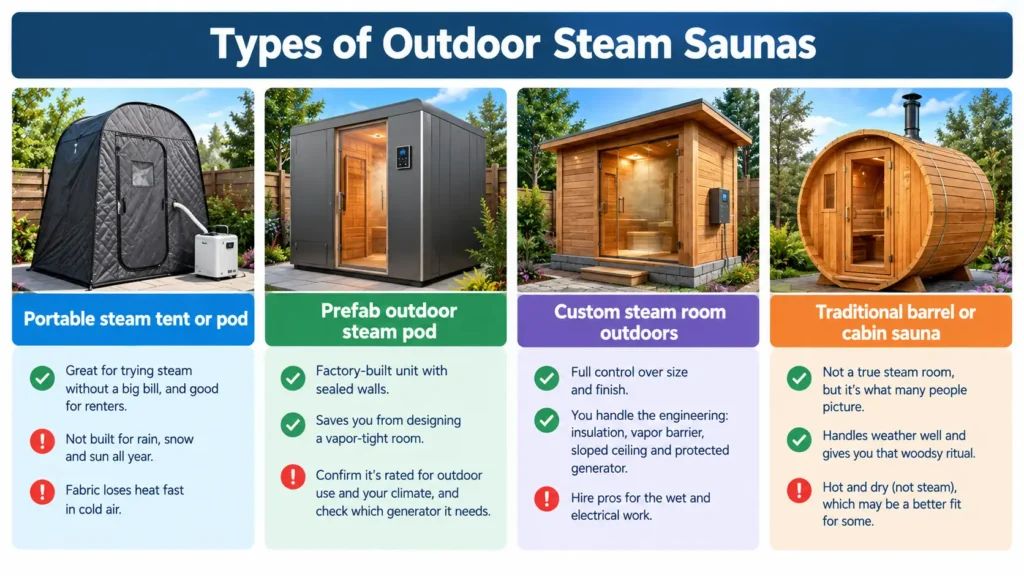
- Portable steam tent or pod. Great for trying steam without a big bill, and good for renters. The downside: most are built for light, sheltered use, not for sitting in rain, snow and sun all year. Fabric also loses heat fast in cold air. For a closer look at what to expect, see this guide to portable steam sauna options.
- Prefab outdoor steam pod. A factory-built unit with sealed walls. It saves you from designing a vapor-tight room yourself. Just confirm it’s rated for outdoor use and for your climate, and check which generator it needs.
- Custom steam room outdoors. You get full control over size and finish. You also take on the engineering: insulation, vapor barrier, sloped ceiling and a protected generator. Hire pros for the wet and electrical work.
- Traditional barrel or cabin sauna. Not a true steam room, but it’s what many people picture when they say “steam sauna.” It handles weather well and gives you that woodsy ritual. If hot and dry sounds good, this may be the better outdoor fit.
Key Features to Look For
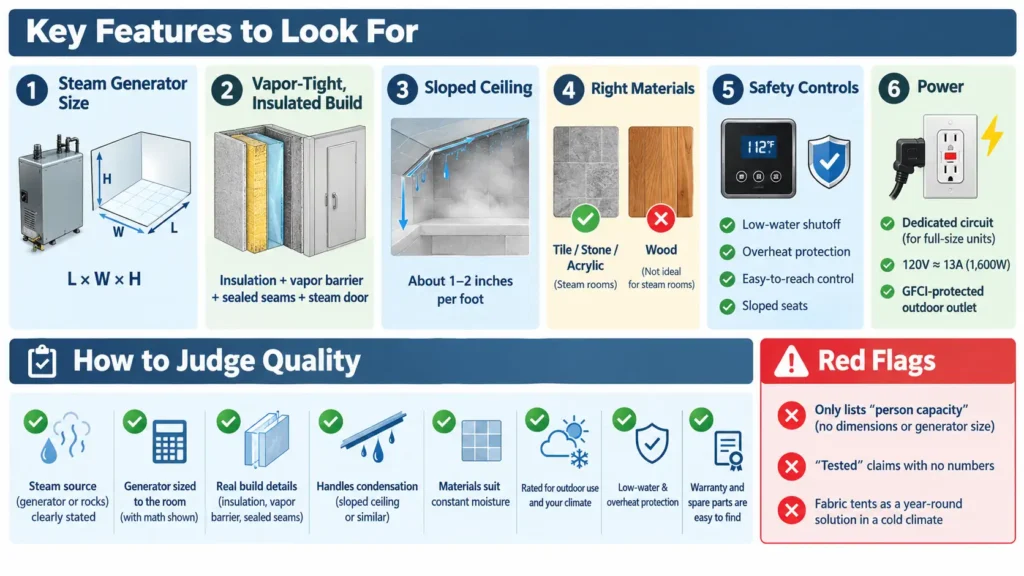
Steam generator size
This is the spec that makes or breaks the experience. Too small, and the generator runs flat out and never gets the room comfortable.
Start with the room’s volume: length × width × height, in feet. Many manufacturers add extra for ceilings over 8 feet, and roughly 10% for each exterior wall. An outdoor room has every wall exposed, so expect to size up. Then use the maker’s calculator for the final answer.
Quick example: a 5 ft × 6 ft room with a 7 ft ceiling is 210 cubic feet before any adjustments. Because all four walls face the weather, your real number will be higher. Don’t go wildly oversized either. A generator that’s too big can switch on and off too often and waste power.
Vapor-tight, insulated build
Steam finds every gap. Look for a continuous vapor-retarding layer, insulated walls and ceiling, sealed seams and a tight steam-rated door. Manufacturer guides also advise against ceiling vents, skylights and exterior windows in a steam room.
Sloped ceiling
Steam turns to water on the ceiling. A flat ceiling drips on your head. A sloped one sends the water down the wall. Guidance ranges from about 1 inch to about 2 inches per foot, so use the number in your generator’s instructions.
Materials
Wood soaks up moisture. In a room that sits at near 100% humidity, constant condensation wears wood down faster. That’s why true steam rooms usually use tile, stone or steam-rated acrylic.
Wood shines in a traditional sauna, where the air is drier and the wood gets a chance to dry out. If a seller shows a bare-wood interior and calls it a steam room, ask how it holds up over time.
Safety controls
Check for automatic shutoff when water runs low, overheat protection and a control you can reach safely. Sloped seats help water run off too.
Power
Most full-size generators need a dedicated circuit installed by a licensed electrician. Portable steamers plug into a regular outlet, but some pull a lot. A 1,600-watt unit on a 120-volt outlet draws around 13 amps, so don’t share that circuit with other big appliances. Use a GFCI-protected outdoor outlet.
How to Judge Quality
Good sellers make it easy to see what you’re buying. Use this as a quick checklist:
- They say plainly whether the steam comes from a generator or from rocks
- The generator is sized to the room, and the math is shown
- The build is described in real terms: insulation, vapor barrier, sealed seams
- It handles condensation with a sloped ceiling or similar design
- Interior materials suit constant moisture
- It’s rated for outdoor use and your climate
- It has low-water and overheat protection
- The warranty and spare parts are easy to find
And a few red flags. Be wary of listings that only list “person capacity” with no dimensions or generator size. Be wary of “tested” claims with no numbers. And be careful with fabric tents sold as a year-round solution in a cold climate.
Benefits of an Outdoor Steam Sauna
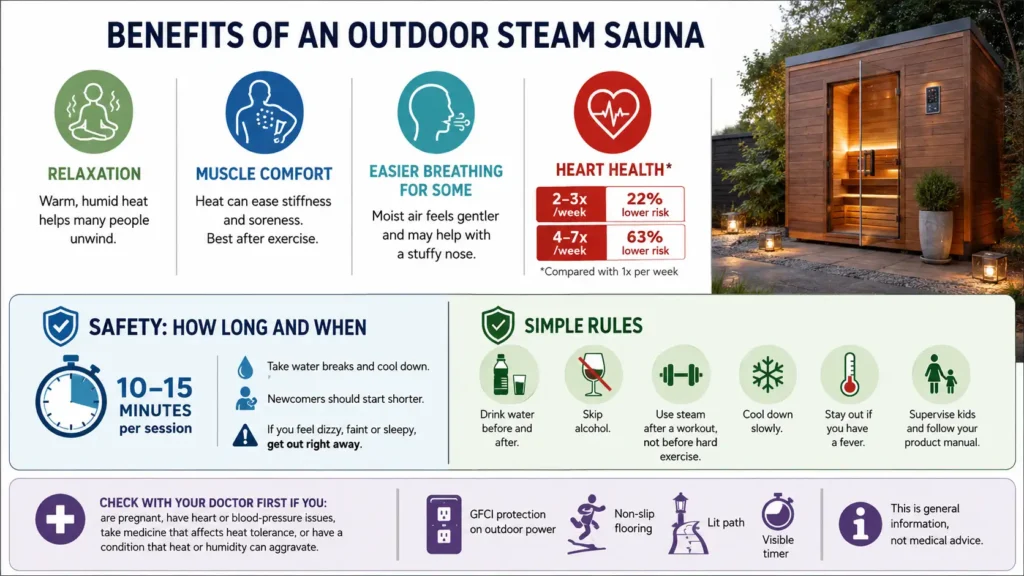
Steam feels good, and some benefits are well supported for saunas in general. Just don’t stretch them.
Relaxation. Warm, humid heat helps many people unwind after a long day. It’s the benefit users mention most, and the easiest to believe.
Muscle comfort. Heat can ease stiffness. Retailers often promise faster recovery, but treat that as a comfort effect rather than a proven training boost. Steam works best after exercise, not before.
Easier breathing for some. Moist air feels gentler than dry heat to many people, and some find it helps a stuffy nose.
Heart health, with a big caution. The most-quoted research is a Finnish study published in JAMA Internal Medicine in 2015. It followed 2,315 middle-aged men. Compared with men who used a sauna once a week, those who used one four to seven times a week had a 63% lower risk of sudden cardiac death, and those who used one two to three times a week had a 22% lower risk.
Here’s what that doesn’t tell you. It was observational, so it shows a link, not proof. It studied Finnish men in traditional dry saunas, not steam rooms. And the authors said more research was needed. I didn’t find a comparable long-term study for steam rooms, so don’t promise the same results.
Also skip the “detox” and fat-loss claims. Your liver and kidneys handle detox, and the weight you lose in a session is water that comes back when you drink.
Safety: How Long to Stay and Who Should Be Careful
For healthy adults, most sources suggest about 10 to 15 minutes per session, with water breaks and a cool-down. Newcomers should start shorter. If you feel dizzy, faint or sleepy, get out right away.
A few simple rules go a long way:
- Drink water before and after.
- Skip alcohol.
- Use steam after a workout, not before hard exercise.
- Cool down slowly.
- Stay out if you have a fever.
- Supervise kids, and follow your product manual. One generator manual says no one under 16 should use its steam room alone.
Check with your doctor first if you’re pregnant, have heart or blood-pressure issues, take medicine that affects heat tolerance, or have a condition that heat or humidity can aggravate.
Outdoors, add a few extras: GFCI protection on outdoor power, non-slip flooring, a lit path and a timer you can see. This is general information, not medical advice.
Setup: Where and How to Install
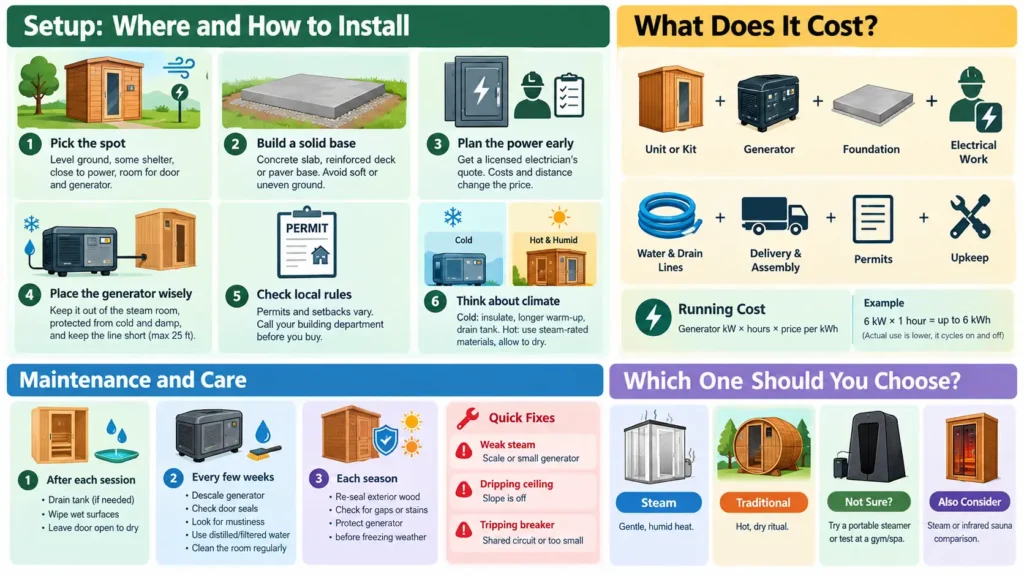
- Pick the spot. Level ground, some shelter from wind and heavy rain, and a short walk from power. Leave room to open the door and reach the generator.
- Build a solid base. A concrete slab, reinforced deck or paver base works. Soft or uneven ground shifts over time and cracks seals.
- Plan the power early. Electrical work often costs more than people expect, and distance from your panel changes the price. Get a licensed electrician’s quote before you buy.
- Place the generator wisely. Keep it out of the steam room, protected from freezing and damp, and close enough that the steam line stays short. One guide caps the line at 25 feet, so check your manual.
- Check local rules. Permits and property-line setbacks vary by town. A quick call to your building department can save you a headache.
- Think about climate. In the cold, insulate the generator space, expect a longer warm-up and drain the tank if anything could freeze. In hot, humid places, use steam-rated materials and make sure the area can dry out between sessions.
What Does It Cost?
There’s no single honest number, because a tent and a custom room live in different worlds. Instead, budget for the whole list: the unit or kit, the generator, a foundation, electrical work, water and drain lines, delivery and assembly, permits, and upkeep.
Running cost is easy to estimate. Multiply the generator’s kilowatts by hours of use and your price per kilowatt-hour. A 6 kW generator running a full hour uses up to 6 kWh. It cycles on and off, so real use is lower, but that gives you a safe ceiling.
Maintenance and Care
A little routine keeps a steam room fresh.
- After each session, drain the tank if the manual says so, wipe wet surfaces and leave the door open briefly so the room dries.
- Every few weeks, descale the generator, check door seals and sniff for mustiness. Hard water builds scale faster, so distilled or filtered water helps. It also helps to clean the room on a regular schedule so mold never gets a start.
- Each season, re-seal exterior wood, look for gaps or water stains, and protect the generator before freezing weather.
Quick fixes: weak steam usually means scale or an undersized generator. A dripping ceiling means the slope is off. A tripping breaker means the circuit is shared or too small.
Which One Should You Choose?
Start with how you like to feel. If you want gentle, humid heat, go with steam. If you want a hot, dry ritual, a traditional barrel or cabin is usually the better outdoor match. If you’re not sure, try a portable steamer in a sheltered spot first, or try each type at a gym or spa.
If you’re also weighing a gentler, low-humidity option, here’s a helpful comparison of steam or infrared sauna so you can decide with confidence.
FAQs
What is an outdoor steam sauna?
It’s a sealed, heated space outside your home that holds moist heat. A true steam room runs about 110°F to 120°F at near 100% humidity. Some sellers also use the term for traditional saunas that make steam from hot rocks.
Is a steam sauna the same as a regular sauna?
No. Steam rooms are cooler and far more humid. Finnish saunas are hotter and drier. They use different heat sources and different materials.
Can you put a steam room outside?
Yes, if it’s built for it. It needs a vapor-tight, insulated enclosure, steam-rated surfaces, a sloped ceiling and a protected generator.
Do outdoor steam saunas work in winter?
They can, with good insulation and a generator protected from freezing. Expect a longer warm-up. Thin fabric tents often struggle.
How big a steam generator do I need?
Start with the room’s cubic feet, then add for ceilings over 8 feet and for exterior walls. Outdoors, size up and use the manufacturer’s calculator.
Can I use wood in a steam sauna?
Wood absorbs moisture and wears faster at constant 100% humidity. Most true steam rooms use tile, stone or acrylic. Wood works well in a traditional sauna.
Final Thoughts
An outdoor steam sauna can be a lovely addition to your yard. The catch is that the name covers very different products. Decide first whether you want gentle, humid steam or hot, dry heat. Then match the build to your weather.
If you go with true steam, three things matter most: a properly sized generator, a vapor-tight sloped enclosure and a safe, protected power setup. Get those right and the rest is easy. Skip them and you’ll fight condensation, cold and weak steam for years.
Your next step is simple. Pick your type, call your building department and get an electrician’s quote. Then compare sellers on warranty, spare parts and outdoor ratings.
This article is general information and not medical advice. Talk to your doctor before using a steam sauna if you have a health condition or are pregnant.