
An outdoor infrared sauna sounds like the easy route to backyard wellness. Plug it in, step inside, sweat, done. Honestly, that’s close to the truth, as long as you buy the right one. The catch is that plenty of infrared saunas were designed for a spare bedroom, not a rainy patio in January. Put the wrong one outside and you can end up with swollen wood, a foggy door, and a warranty claim that goes nowhere.
This guide covers what separates a good outdoor infrared sauna from an expensive mistake. We’ll look at how it works, what quality really means, which features are worth paying for, what power and space you need, what it costs, and the safety basics. No hype, just the stuff worth knowing before you spend a dollar.
What Is an Outdoor Infrared Sauna?
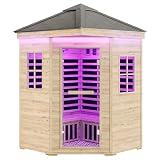
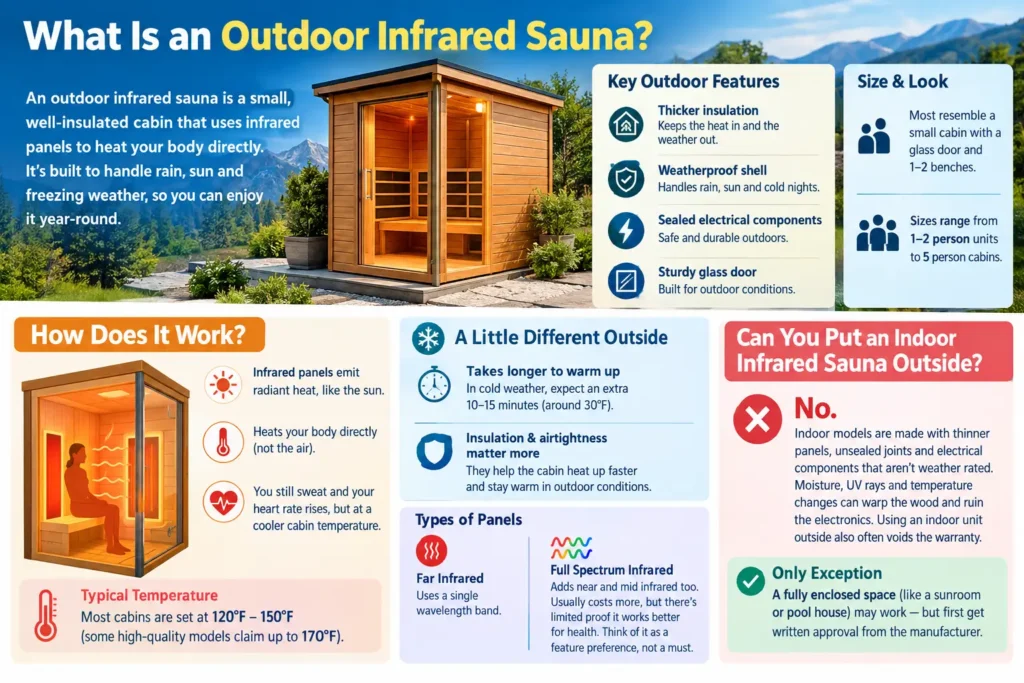
Consider it a miniature home designed for year-round living. It doesn’t use hot stones and a stove to heat the air, but rather infrared panels that heat your body directly. Everything around the panels makes it “outdoor”: thicker insulation, sealed electrical components, sturdier glass, and a shell that can withstand rain, sun, and freezing nights.


Paid Links - As an Amazon Associate, I earn from qualifying purchases.
The majority resemble a small cabin with a glass door and one or two benches. Sizes range from small one or two person units to five person cabins.
How Does an Outdoor Infrared Sauna Work?
Infrared panels emit radiant heat, similar to the warmth of the sun on a cold day. According to Mayo Clinic, a traditional sauna heats the air, whereas an infrared sauna heats the body without heating the air as much.
You still sweat, your heart rate still rises, but at a cooler cabin temperature. Most infrared cabins are set at a temperature of 120°F to 150°F, with some high-quality models claiming temperatures of up to 170°F.
One thing changes outside. The radiant heat still reaches you on a cold morning, but the cabin itself takes longer to warm up. One retailer states an additional 10 to 15 minutes at approximately 30°F. Hence, insulation and airtightness are more important in the outdoors than in a spare room.
There are also two types of panels. Far infrared uses a single wavelength band. A full spectrum infrared sauna adds near and mid infrared too, and it usually costs more. Independent head-to-head evidence that full spectrum works better for health is limited, so think of it as a feature preference rather than a guaranteed upgrade.
Can You Put an Indoor Infrared Sauna Outside?
The answer is no because indoor models are made with thinner panels, unsealed joints and electrical components that are not weather rated. In months, moisture, UV rays and temperature fluctuations can cause the wood to warp and ruin the electronics.



Paid Links - As an Amazon Associate, I earn from qualifying purchases.
Using an indoor unit outside also often voids the warranty. The only exception to this is a fully enclosed space such as a sunroom or pool house. Even so, first obtain the manufacturer’s written approval.
What Makes an Outdoor Infrared Sauna High Quality?
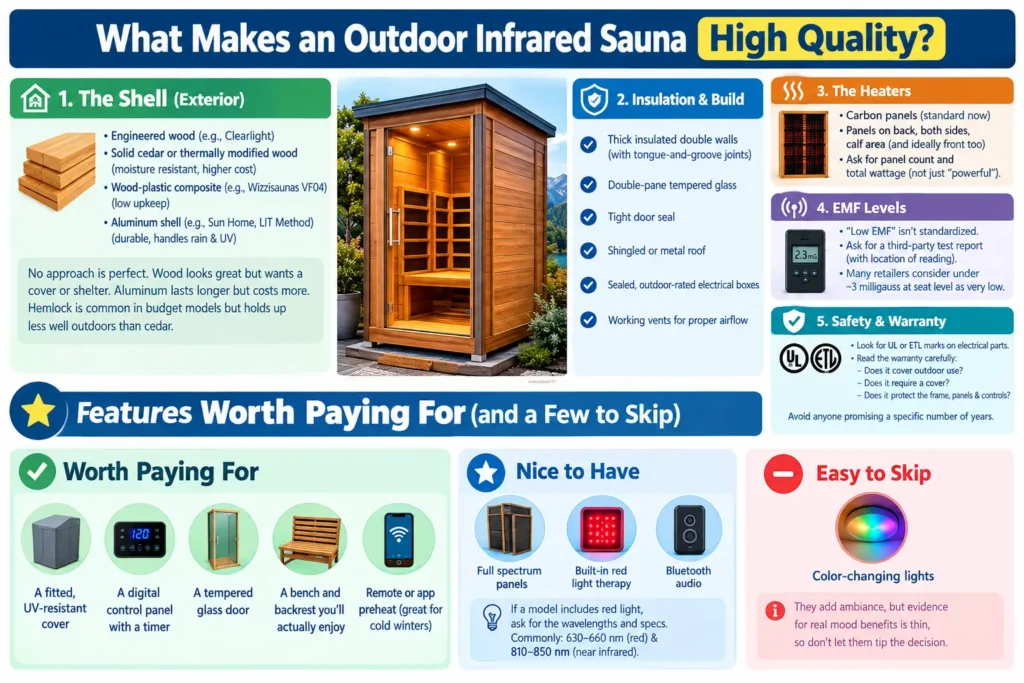
Start with the shell, because that’s what fights the weather every day. Makers go different ways. Clearlight is an engineered wood exterior with a hardwood interior. Others use solid cedar or thermally modified wood, which resists moisture well but costs more.
Wizzisaunas uses a wood-plastic composite on its VF04 for low upkeep, while Sun Home and LIT Method use aluminum shells with wood interiors that shrug off rain and UV. These are the makers’ own descriptions. No approach is perfect.
Wood looks great but wants a cover or some shelter, and aluminum lasts but usually costs more. Hemlock shows up in budget models, and two retailers say it holds up less well outdoors than cedar.
Next, look at how the heat stays in. A well-built cabin has thick insulated double walls with tongue-and-groove joints, double-pane tempered glass, a tight door seal, a shingled or metal roof, and sealed, outdoor-rated electrical boxes. Working vents matter too, so air can keep moving.
Then check the heaters. Carbon panels are the standard now. You want panels on the back wall, both sides, and the calf area, ideally the front too, so the heat feels even instead of patchy. Ask for the panel count and total wattage, not just the word “powerful.”
EMF deserves a question as well. Labels like “low EMF” aren’t standardized, so ask for a third-party test report that says where the reading was taken. Some retailers treat readings under about 3 milligauss at seat level as very low.
Finally, look for a UL or ETL mark on the electrical parts, then read the warranty closely. Does it cover outdoor use? Does it require a cover? Does it protect the frame, the panels, and the controls? Makers publish warranties, not lifespans, so be wary of anyone promising a specific number of years.
Features Worth Paying For (and a Few to Skip)
Once the build checks out, the extras come down to taste and budget. Here’s a simple way to sort them.
Worth paying for:
- A fitted, UV-resistant cover
- A digital control panel with a timer
- A tempered glass door
- A bench and backrest you’ll actually enjoy sitting on
- Remote or app preheat if your winters are cold, since you can warm the cabin before you step outside
Nice to have: full spectrum panels, built-in red light therapy, and Bluetooth audio. If a model includes red light, ask for the wavelengths and specs. Sellers commonly cite 630 to 660 nm for red and 810 to 850 nm for near infrared.
Easy to skip: color-changing lights. They add ambiance, but evidence for real mood benefits is thin, so don’t let them tip the decision.
Outdoor Infrared vs. Traditional Sauna
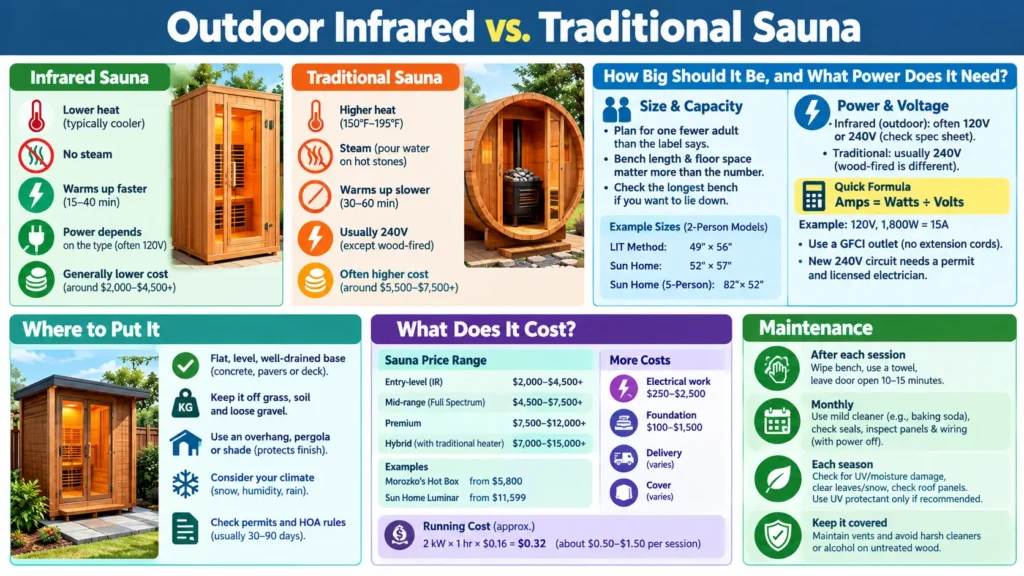
If you’re still torn between infrared and traditional heat, here’s the short version. Traditional saunas heat the air with a stove and stones, usually to somewhere around 150°F to 195°F, and they let you pour water on the rocks for steam. Infrared cabins run cooler and skip the steam entirely. Warm-up is often quicker with infrared, roughly 15 to 40 minutes versus 30 to 60, though cold weather stretches both.
Power differs too. Most traditional saunas require a 240V circuit, except for wood-fired saunas, and infrared saunas depend on the type of cabin. On price, the guides disagree.
One estimates that budget barrel kits can be as low as $2,000 to $4,000, and another estimates that traditional barrel kits begin at $5,500 to $7,500. Look at the total package (with the heater) not the headline price.
So who picks what? If you’re looking for a less intense heat, an easier set up, or just a less overwhelming sauna experience, infrared is the way to go. If you want steam and the classic high-heat ritual, go traditional.
How Big Should It Be, and What Power Does It Need?
Person ratings are a ceiling, not a promise. One buying guide suggests planning for one fewer adult than the label says, which matches common sense. Bench length and floor space matter more than the number on the box, and if you want to lie down, check the longest continuous bench. For a sense of scale, LIT Method lists its two-person outdoor cabin at 49 by 56 inches. Sun Home lists its two-person at 52 by 57 and its five-person at about 82 by 52.
Power is where sources clash. According to Clearlight, the standard voltage for outdoor infrared saunas is 240V. Haven of Heat says most one- to three-person outdoor models run on standard 120V.
One high-end model, the Sun Home Luminar, is said to require a separate 240V circuit. So don’t guess. Check the specification sheet for voltage, amps and watts.
A simple formula to remember is amps = watts / volts. A 120V, 1,800 watt sauna uses 15 amps and can overload an entire household circuit. Use a GFCI protected outdoor outlet within reach of the cord and avoid extension cords and power strips.
A new 240V circuit typically requires a permit and a licensed electrician. Install it according to the manufacturer’s directions and local regulations, and have your electrician verify.
Where to Put It
Give it a flat, level, well-drained base. A concrete slab or pavers on compacted gravel work well. A deck can work too, but have someone qualified check that it can carry the weight. One retailer lists 300 to 550 pounds for typical infrared models, before you add people. Keep it off grass, soil, and loose gravel.
Shelter helps more than most people expect. An overhang, a pergola, or partial shade protects the finish from sun and rain. Keep it reasonably close to your outlet, leave room for the door to swing fully open, and follow your manual’s clearance rules for airflow.
Climate matters, too. In snowy areas, prioritize insulation, remote preheat, and clearing snow from the roof and base. In humid or coastal spots, look for mold-resistant materials and rust-proof hardware. In rainy regions, drainage and a good cover make the biggest difference.
Before you order, call your building department. Freestanding plug-in units often skip a building permit, but not always, and new electrical work usually needs one. A common accessory-structure threshold is 120 square feet, though yours may differ. If you have an HOA, check its rules. One guide notes approvals can take 30 to 90 days.
What Does an Outdoor Infrared Sauna Cost?
Retailer guides put outdoor infrared saunas at roughly $2,000 to $4,500 for entry-level far infrared cabins, $4,500 to $7,500 for mid-range full spectrum models, and $7,500 to $12,000 or more for premium builds. Hybrids that add a traditional heater run higher, around $7,000 to $15,000 plus.
Those numbers come from sellers, so treat them as ballparks. Brand examples from a 2026 roundup include Morozko’s Hot Box from $5,800 and the Sun Home Luminar from $11,599.
The sticker price isn’t the whole bill. Electrical work ranges from about $250 to $2,500 depending on distance, panel capacity, and local labor. A foundation runs roughly $100 to $1,500. Add delivery and a fitted cover.
Then there’s running cost. It comes down to kilowatts times hours times your electric rate, so it helps to know how much electricity an infrared sauna uses before you commit. As an illustration, 2 kW for an hour at $0.16 per kWh is about 32 cents. Retailers estimate roughly $0.50 to $1.50 per session.
Maintenance: Low Effort, Not No Effort
After each session, wipe the bench, use a towel, and leave the door open about 10 to 15 minutes so moisture can escape. Once a month, wipe the interior with a mild cleaner (a retailer suggests baking soda and water), check the door seals, and visually inspect the panels and wiring with the power off.
Each season, look for UV or moisture damage, clear leaves and snow, and check the roof panels. Apply a UV protectant only if the manufacturer recommends one, and skip alcohol-based or harsh cleaners on untreated wood. Keep vents clear and the cover on when the sauna isn’t in use.
Health Benefits and Safety: The Honest Version
Research has investigated the use of infrared saunas for high blood pressure, heart failure, dementia, headache, type 2 diabetes, and arthritis, according to Mayo Clinic, and some studies indicate that infrared saunas may be beneficial.
However, it also states that more extensive and accurate research is required, and one of those studies was of frequent sauna usage. Many of the well-known figures for population data are from traditional Finnish saunas, not infrared saunas. Putting the sauna outdoors doesn’t appear to change the physical effect. It simply alters the experience.
Two claims deserve caution. Sweat is mostly water, and your liver and kidneys do the real detox work. And weight lost in a sauna is mostly water that returns when you rehydrate.
Sauna use is considered safe for most people, though infrared sauna safety depends on your health. Pregnancy, unstable heart conditions, low or unstable blood pressure, fever, alcohol, and medications like diuretics or beta blockers are common red flags. Implanted devices need a check with the maker and your doctor.
Sessions that run too long can cause overheating or dehydration. Start short (retailers commonly suggest 20 to 30 minutes at most), drink water, skip alcohol, and leave if you feel dizzy. This is general information, not medical advice.

Common Mistakes to Avoid
A few errors show up again and again:
- Buying an indoor model for outdoor use
- Skipping the cover
- Assuming the voltage without reading the spec sheet
- Setting the sauna on grass or an unchecked deck
- Paying for lights and speakers before checking build quality
- Ignoring permits or HOA rules until delivery day
- Forgetting to budget for power, foundation, and a cover
Frequently Asked Questions
Can you put an infrared sauna outside?
Only if it’s rated for outdoor use. Indoor models aren’t built for rain, UV, or temperature swings, and using one outside often voids the warranty.
Do outdoor infrared saunas work in winter?
Yes, if they’re well insulated. Just expect a longer warm-up, often 10 to 15 extra minutes in freezing weather.
Do they need 240V?
Not always. Some plug into a standard 120V outlet and others need 240V. Check the spec sheet for voltage, amps, and wattage.
How long does one take to heat up?
Sources range from about 10 to 40 minutes, depending on the model, its size, and the outside temperature.
Does an outdoor infrared sauna need a cover?
It’s strongly recommended. A fitted, UV-resistant cover protects the finish, even on outdoor-rated models.
Is full spectrum worth the extra money?
It’s a personal call. Independent evidence that it outperforms far infrared is limited, so choose it for features you like, not for promised extra benefits.
Final Thoughts
A good outdoor infrared sauna isn’t the one with the most features. It’s the one built to handle your weather, fits your power and space, and comes with a warranty that covers outdoor use. Start with the build, confirm the power, and budget for the extras. Then pick features that match how you’ll really use it.
Before you buy, run through the quality checks above, call your building department, and ask any seller for the spec sheet, the EMF report, and the warranty in writing. If you have a health condition, talk to your doctor before your first session.