
If you have asthma, the idea of sitting in a heated cabin on purpose probably sounds either wonderfully relaxing or a little risky, depending on how your lungs have treated you lately.
So let’s slow down and actually answer of the Infrared Sauna for Asthma Relief honestly: can an infrared sauna help someone with asthma breathe easier, or is this just another wellness trend riding on borrowed science?
The short answer is this. Infrared sauna use may offer some indirect respiratory benefits, mostly through relaxation, lower stress hormones, and possibly a reduced risk of respiratory infections with regular use over time.
But there’s no solid clinical evidence that it treats asthma directly or reduces the airway inflammation that medication is designed to control. And for a meaningful number of people, heat and dry air aren’t soothing at all. They’re a trigger. So this isn’t a simple yes or no. It depends on your body, your triggers, and how you use it.


Paid Links - As an Amazon Associate, I earn from qualifying purchases.
Key Takeaways
- Infrared sauna is not a treatment for asthma. It doesn’t replace inhalers, controller medication, or your action plan.
- Direct evidence linking infrared sauna use to asthma improvement is limited. Most of the supporting research is about general sauna bathing and respiratory infection risk, not asthma specifically.
- Heat can help some people relax tense airway muscles, but it can just as easily trigger symptoms in others, especially if your asthma is heat- or exercise-sensitive.
- Infrared saunas run cooler and drier than traditional saunas or steam rooms, which is part of why many asthmatics tolerate them better.
- Start small: short, low-heat sessions, with your rescue inhaler always within reach.
- Skip the sauna entirely during an active flare-up, a fever, or any period when your asthma feels unstable.
- Talk to your doctor first, particularly if your asthma is moderate to severe, exercise-triggered, or you’re taking medication that affects how your body handles heat.
Does Infrared Sauna Help Asthma? What the Research Actually Says
This is the part where a lot of infrared sauna marketing quietly overreaches, so let’s separate what’s reasonably supported from what’s just repeated often enough that it starts sounding true.
What holds up reasonably well:
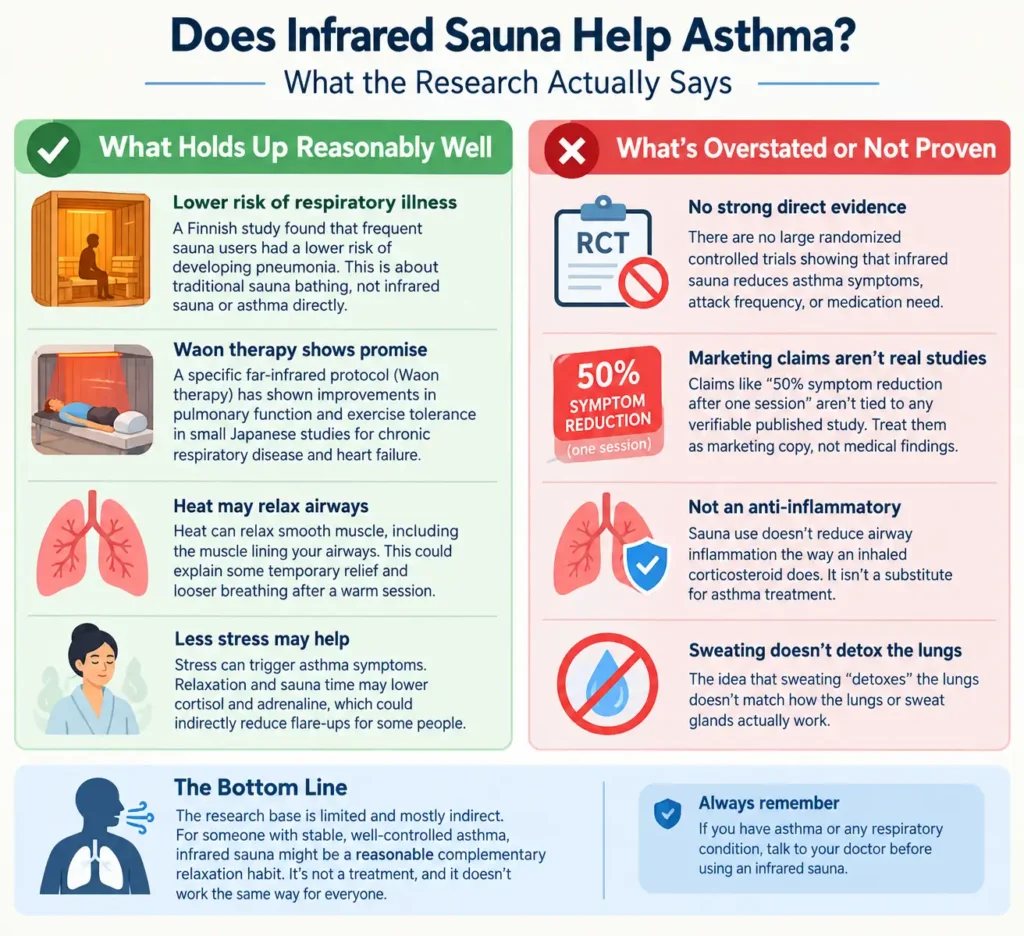
Frequent sauna bathing, in general, not infrared specifically, has been linked to lower rates of respiratory illness. A long-running Finnish cohort study followed middle-aged men for more than two decades and found that frequent sauna users had a noticeably lower risk of developing pneumonia.



Paid Links - As an Amazon Associate, I earn from qualifying purchases.
That’s a real, peer-reviewed finding. But it’s describing traditional sauna bathing and pneumonia risk, not infrared sauna curing asthma, and it’s important not to blur those two things together the way several competing articles do.
There’s also a specific clinical protocol called far-infrared “Waon therapy,” which has shown improvements in pulmonary function and exercise tolerance among patients with chronic respiratory disease and heart failure, in small Japanese studies.
These results are legitimate, but they’re limited in scale, and Waon therapy is a supervised medical protocol, not the same thing as a 15-minute session in a home infrared cabin after work.
Heat, generally speaking, relaxes smooth muscle, and that includes the muscle lining your airways. That’s a plausible mechanism behind why some people feel a bit of temporary relief and looser breathing after a warm session.

Paid Links - As an Amazon Associate, I earn from qualifying purchases.
And then there’s stress. Cortisol and adrenaline swings are a documented asthma trigger for a lot of people, and relaxation practices, sauna time included, can lower that stress load. If your flare-ups tend to follow stressful periods, this indirect pathway might matter more for you than the heat itself.
What’s overstated or simply not proven:
There is no strong, direct clinical evidence, meaning no large randomized controlled trials, showing that infrared sauna use reduces asthma symptoms, cuts down attack frequency, or lowers medication need.
You’ll come across claims like “50% symptom reduction after one session” on some sauna retailer blogs, and it’s worth knowing that these numbers aren’t tied to any verifiable published study. Treat them as marketing copy, not medical findings.
Sauna use also doesn’t reduce airway inflammation the way an inhaled corticosteroid does. It isn’t functioning as an anti-inflammatory treatment for asthma, no matter how good you feel afterward.
And the idea that sweating “detoxes” the lungs shows up constantly in this space, but it doesn’t line up with how the lungs or sweat glands actually work.
The honest summary is that the research base here is genuinely limited and mostly indirect. For someone with stable, well-controlled asthma, infrared sauna might be a reasonable complementary relaxation habit. It’s not a treatment, and it doesn’t work the same way for everyone.
Potential Benefits for People With Asthma
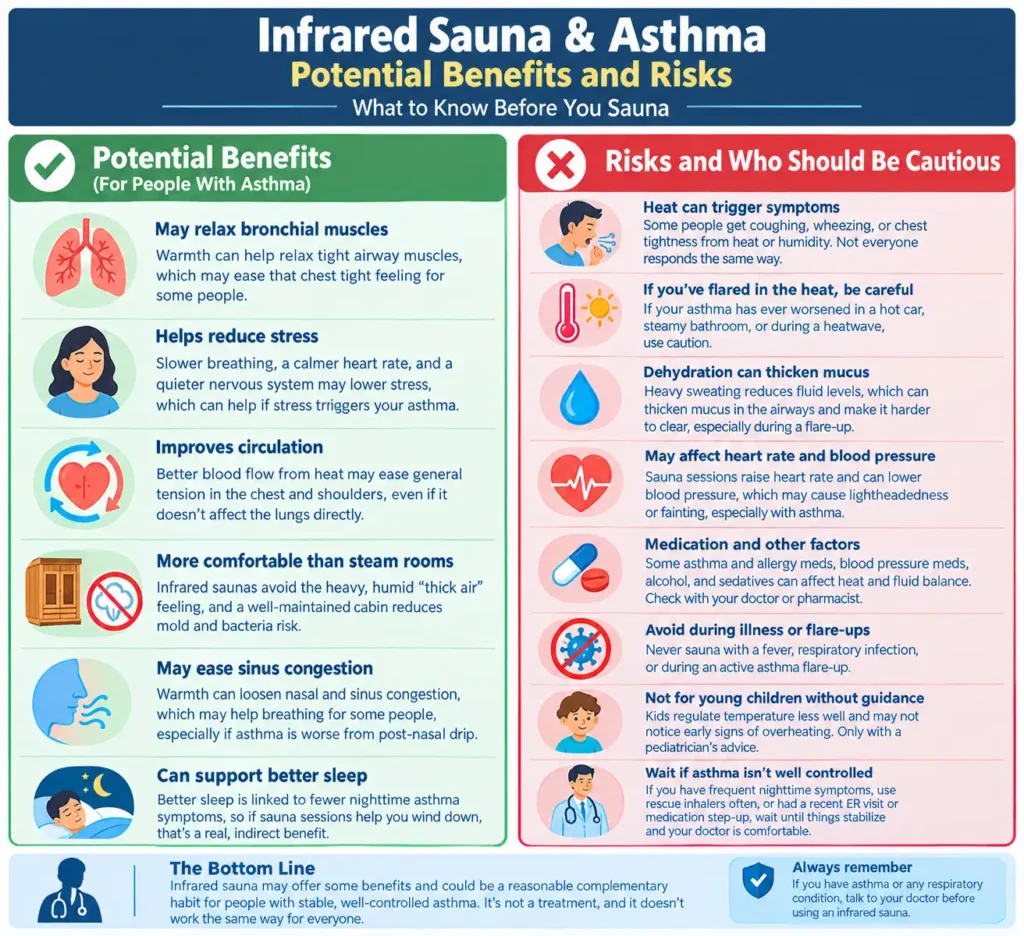
Assuming your asthma is stable and your doctor has no concerns, here’s what a sauna habit might realistically offer. Warmth can help relax bronchial smooth muscle, which may ease that tense, tight feeling in the chest for some people. This is a temporary comfort effect rather than anything that touches the underlying inflammation, but comfort still matters day to day.
There’s also the stress angle again. Slower breathing, a calmer heart rate afterward, and a generally quieter nervous system can add up over time if stress is one of your known triggers.
Better circulation from the heat exposure can also ease general tension around the chest and shoulders that sometimes accompanies breathing difficulty, even if it’s not doing anything to your lungs directly.
Compared with a steam room, infrared saunas avoid that heavy, humid “thick air” feeling that a lot of asthmatics find harder to breathe through, and a well-maintained infrared cabin sidesteps the mold and bacteria risk that poorly kept steam rooms sometimes carry.
Warmth can also loosen nasal and sinus congestion, which occasionally eases breathing for people whose asthma gets worse from post-nasal drip or sinus pressure. Again, that’s comfort, not lung treatment.
And finally, sleep. Better sleep is tied to fewer nighttime asthma symptoms for a lot of people, so if a sauna session genuinely helps you wind down and sleep better, that’s a real, if indirect, benefit worth counting.
Risks and Who Should Be Cautious
This is the section most competing articles either skip entirely or bury at the bottom, and it deserves just as much attention as the benefits list.
Heat and humidity genuinely trigger asthma symptoms in some people. Not everyone responds the same way. For some, even dry heat can bring on coughing, wheezing, or chest tightness, in the same way cold air triggers symptoms for someone else.
If your asthma has ever flared in a hot car, a steamy bathroom, or during a summer heatwave, that’s a signal to approach sauna use carefully.
Heavy sweating also reduces fluid levels in your body, and dehydration can thicken mucus in the airways, which makes it harder to clear, especially during a flare-up when you’re already dealing with excess mucus.
Sauna sessions raise your heart rate and can lower blood pressure, and combined with the extra breathing effort that comes with asthma, this raises the risk of feeling lightheaded or even fainting in a hot, enclosed space.
Some asthma and allergy medications, including certain antihistamines and blood pressure medications often prescribed alongside asthma care, can also affect how your body regulates heat or fluid balance. Alcohol and sedatives make this worse. It’s worth a quick check with your doctor or pharmacist if you’re on regular medication before you start.
Never sauna during an active flare-up, a fever, or a respiratory infection. Adding heat stress on top of already inflamed airways just isn’t a safe combination.
Children regulate body temperature less efficiently than adults, and they don’t always recognize or communicate early signs of overheating. Sauna use for kids with asthma should only happen with direct guidance from a pediatrician, not as a home remedy someone tries on their own.
And if your asthma isn’t currently well controlled, meaning frequent nighttime symptoms, frequent rescue inhaler use, or a recent ER visit or medication step-up, sauna use should wait until things stabilize and your doctor is comfortable with you trying it.
How to Use an Infrared Sauna for Asthma Relief and Is It Safe?
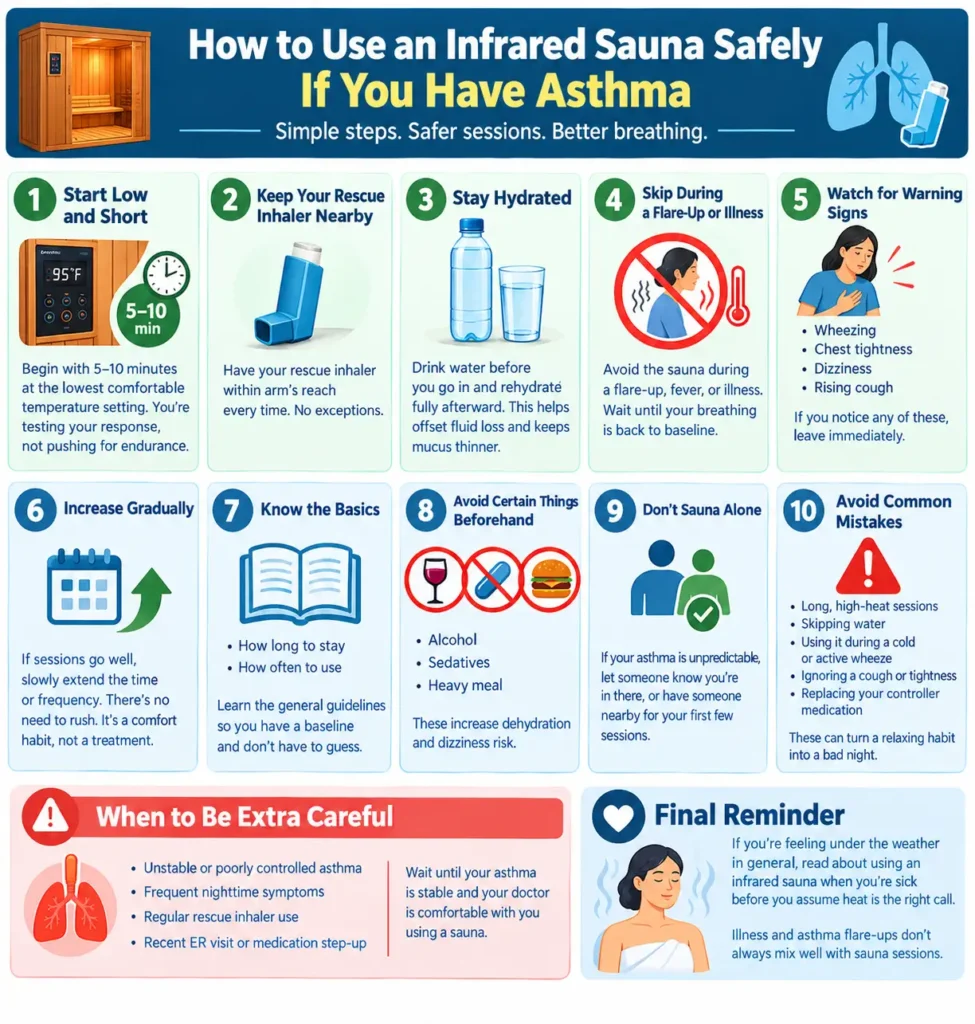
If you’ve gotten the green light from your doctor, here’s a practical, step-by-step way to approach it. Start low and short. Begin with five to ten minutes at the lowest comfortable temperature setting.
You’re testing your own response here, not pushing for endurance. Keep your rescue inhaler within arm’s reach every single time, no exceptions. Drink water before you go in and rehydrate fully afterward, since that helps offset fluid loss and keeps mucus thinner.
Skip the sauna entirely during a flare-up, fever, or illness, and wait until your breathing is fully back to baseline. Pay attention to warning signs like wheezing, chest tightness, dizziness, or a rising cough, and treat any of those as your cue to leave immediately rather than trying to push through it.
If several sessions go smoothly, you can gradually extend the time or frequency, but there’s no need to rush. This is a comfort habit, not a treatment with a target dose to hit.
It also helps to know roughly how long to stay in an infrared sauna in general, so you have a baseline to compare against once you’re building tolerance, and to get a sense of how often you should use an infrared sauna rather than guessing.
Avoid alcohol, sedatives, or a heavy meal right before a session, since all three increase your dehydration and dizziness risk. And if your asthma tends to be unpredictable, don’t sauna alone, at least not for your first few sessions. Let someone know you’re in there, or have someone nearby.
A few common mistakes are worth calling out specifically: starting with a long, high-heat session just to “see what it’s like,” skipping water before and after, using the sauna during a cold or active wheeze on the assumption that heat will clear it out, ignoring an early tickly cough or slight tightness, and assuming any of this can replace a prescribed controller medication. None of those assumptions hold up, and they’re the fastest way to turn a relaxing habit into a bad night.
If you’re feeling under the weather in general, it’s also worth reading about using an infrared sauna when you’re sick before you assume heat is the right call, since illness and asthma flare-ups don’t always mix well with sauna sessions, even when the temptation to “sweat it out” is strong.
Myth vs. Fact
| Myth | Fact |
|---|---|
| “Infrared sauna cures or treats asthma.” | It’s not a treatment. It may offer comfort and relaxation for some people with well-controlled asthma, alongside, never instead of, medical care. |
| “Sweating detoxes your lungs.” | Sweat glands aren’t connected to lung function. Sweating doesn’t clear airway inflammation or mucus from the lungs. |
| “Heat is always safe for asthma because cold air is the real trigger.” | Heat and humidity can trigger symptoms in some people, just as cold air does in others. Triggers are individual. |
| “Infrared sauna is always gentler than a steam room for asthma.” | It’s usually better tolerated because of lower humidity, but if your asthma actually responds well to moist air, a steam room might suit you better. |
| “More sessions means more benefit.” | There’s no established “dose” for asthma. Overdoing heat exposure raises dehydration and dizziness risk without adding any respiratory benefit. |
Buying Considerations If You’re Shopping for a Home Infrared Sauna
If you’ve already gotten medical clearance and you’re thinking about trying this at home, a few practical details matter more for asthma than they would for the average buyer.
Look for low-VOC materials. Cheaper cabins can off-gas volatile organic compounds when they heat up, and that’s exactly the kind of thing that can irritate sensitive airways. You’ll also want fine control at the lower end of the temperature range, somewhere around 100°F to 130°F, rather than a unit built only for high-heat endurance sessions. Good ventilation matters too, even something as simple as a vent or the option to crack the door open if you need quick airflow.
Some people also look for low-EMF panels, mostly out of a preference to minimize additional electromagnetic exposure, even though current research doesn’t show a direct link between EMF and asthma specifically. It’s worth being aware, too, that some units and usage patterns come with their own hidden infrared sauna dangers that have nothing to do with asthma but are still worth knowing before you buy or install one at home.
None of this matters nearly as much as medical clearance and safe usage habits, though. The specific sauna model is a secondary consideration next to how you actually use it.
Infrared Sauna vs. Traditional Sauna vs. Steam Room for Asthma
| Feature | Infrared Sauna | Traditional Sauna | Steam Room |
|---|---|---|---|
| Typical temperature | 120–140°F | 150–195°F | 110–120°F |
| Humidity | Low | Low to moderate | Very high (near 100%) |
| How it heats you | Direct infrared radiation to the body | Heated air filling the room | Steam and water vapor |
| Tolerability for asthma | Often easier to tolerate because of lower air temperature | Can feel harsher; heat and dryness may irritate some airways | Helps some by loosening mucus; triggers others through the humidity-heat combination |
| Best suited for | People sensitive to intense heat but not moisture | People who handle dry heat comfortably | People whose asthma responds well to humid air, not heat |
There’s no single “correct” answer here, no matter how confidently some sauna retailers frame it. It genuinely comes down to what sets your asthma off. That’s exactly why blanket recommendations, which you’ll see all over the internet, aren’t responsible advice.
Frequently Asked Questions
Is infrared sauna safe for people with asthma?
It can be safe for some people with stable, well-controlled asthma, but it isn’t automatically safe for everyone. Heat and dry air relax airway muscles for some people and trigger symptoms in others. Get medical clearance first, and start with short, low-heat sessions.
Can an infrared sauna trigger an asthma attack?
Yes, it’s possible. Heat, exertion from sweating, and dehydration can all act as triggers for some asthmatics, similar to how cold air, exercise, or humidity trigger symptoms in others. If you notice wheezing, tightness, or coughing, leave immediately.
How long should I stay in an infrared sauna if I have asthma?
Most guidance suggests starting with 5 to 10 minutes at a low temperature setting and only increasing gradually if your body tolerates it well over several sessions.
Is infrared sauna better than a traditional sauna for asthma?
Often yes, because infrared saunas run at a lower air temperature and humidity, which many people with sensitive airways tolerate better. But this isn’t universal. It depends on your specific triggers.
Can infrared sauna replace my asthma inhaler or medication?
No. There’s no clinical evidence that infrared sauna treats asthma or replaces prescribed medication. It should only ever be used alongside your existing asthma management plan, never instead of it.
Is infrared sauna good for exercise-induced asthma?
There’s no strong direct evidence either way. Some people find gentle warmth before or after exercise soothing, but heat exposure can also be a trigger for others. This is worth raising with your doctor if exercise is a known trigger for you.
Can children with asthma use an infrared sauna?
Only with direct guidance from a pediatrician. Children regulate heat less efficiently than adults and may not recognize early signs of overheating.
What temperature is safe for an infrared sauna if you have asthma?
Many people with asthma tolerate the lower end of the infrared range, roughly 100°F to 130°F, better than higher settings. Start low and adjust based on how your body responds.
Does sweating in a sauna help clear mucus from the lungs?
No. Sweating is a skin-level process and isn’t connected to mucus clearance in the airways. Staying hydrated, drinking water rather than sweating it out, is what actually helps keep mucus thin.
Can infrared sauna help with allergies as well as asthma?
Some people report temporary sinus and congestion relief from warmth, which may ease allergy-related breathing discomfort, but that’s not the same as treating the underlying allergic or asthmatic inflammation.
Is it safe to use an infrared sauna during a cold or respiratory infection?
No. Avoid sauna use during any active illness, fever, or respiratory infection, since added heat stress on inflamed airways isn’t safe.
How often can someone with asthma use an infrared sauna?
A cautious starting point is one to two sessions per week, increasing frequency gradually only if sessions are well tolerated and your doctor has no concerns.
What are the warning signs to stop a sauna session immediately?
Wheezing, chest tightness, a rising cough, dizziness, light headedness, or unusual shortness of breath. Any of these means it’s time to exit the sauna right away and use your rescue inhaler if needed.
Do infrared saunas help with COPD as well as asthma?
Small studies on far-infrared “Waon therapy” have shown some improvement in pulmonary function and exercise tolerance for people with chronic respiratory conditions, including COPD, but that involved a supervised clinical protocol, not casual home sauna use.
Should I talk to a doctor before trying an infrared sauna for asthma?
Yes, always, particularly if your asthma is moderate to severe, exercise-induced, poorly controlled, or if you’re on medications that affect heat or fluid regulation.
Final Thoughts
Infrared sauna isn’t a cure for asthma, and no honest article should tell you otherwise. What it can be, for some people with stable, well-controlled asthma, is a gentle relaxation habit that may ease tension-related tightness, support better sleep, and take some of the edge off stress, all of which can indirectly help with day-to-day management. For others, particularly those whose asthma reacts to heat, it simply isn’t worth the risk, no matter how many blog posts insist otherwise.
The real answer to “should I try this” isn’t something you’ll find in a blog post, including this one. It’s found in a conversation with your doctor, who actually knows your specific triggers, your medications, and how well controlled your asthma currently is. If you get that green light, go in slow, stay hydrated, keep your inhaler within reach, and treat it as one small piece of a much bigger asthma management plan, not a replacement for any part of it.