
Acne-prone skin and heat don’t have an obvious relationship, and that’s exactly why so many people ask can infrared sauna treat acne. You’ve probably seen the claims: sweating “detoxes” your pores, infrared light “heals” breakouts, and regular sessions leave skin clearer within weeks.
Infrared sauna acne treatment isn’t backed by a single dedicated clinical trial — but the heat, sweat, and circulation changes it triggers are real, and they can genuinely support clearer-looking skin when you use them the right way.
This guide breaks down exactly what happens to acne-prone skin in an infrared sauna, what the research actually says, where the evidence runs thin, and how to protect your skin so a session helps instead of backfires.
Quick answer: Infrared sauna heat can support clearer-looking skin by boosting circulation and softening sebum in the follicle, but there’s no dedicated clinical study showing infrared sauna use, on its own, treats acne. It works best as a supportive habit alongside — not instead of — a proper skincare or dermatology routine.


Paid Links - As an Amazon Associate, I earn from qualifying purchases.
Key Takeaways
- No published study has tested “infrared sauna” alone as an acne treatment — the evidence comes from related research on heat, sweat, and infrared light.
- A small 2010 study (10 patients) found near-infrared LED pretreatment improved results of a medical acne procedure (ALA-photodynamic therapy) — it did not test sauna heat by itself.
- Sweating can loosen surface debris and sebum, but sweat left sitting on skin can also re-clog pores if you don’t cleanse afterward.
- Hormonal and cystic acne are driven by internal factors a sauna cannot reach.
- People with rosacea, active herpes simplex, sunburn, or peeling retinoid skin should avoid or limit heat exposure.
Can Infrared Sauna Treat Acne?
No study has directly tested infrared sauna sessions as a stand-alone acne treatment. What exists instead is a patchwork of adjacent research:
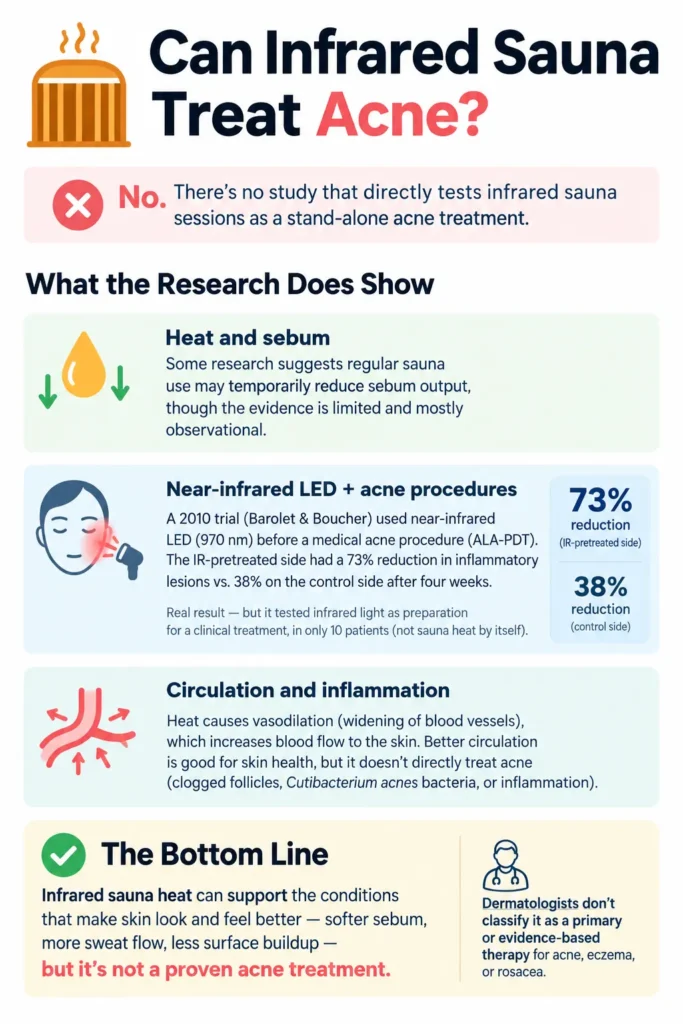
- Heat and sebum: Some research suggests regular sauna use may temporarily reduce sebum output, though the evidence base here is still limited and mostly observational.
- Near-infrared LED and acne procedures: A small 2010 trial by Barolet and Boucher pretreated one side of patients’ faces with near-infrared LED light (970 nm) before a medical acne procedure called photodynamic therapy (ALA-PDT), then compared it to PDT alone. The IR-pretreated side showed a 73% reduction in inflammatory lesions versus 38% on the control side after four weeks. This is a real, peer-reviewed result — but it tested infrared light as preparation for a clinical treatment, in only 10 patients, not infrared sauna heat used by itself for acne.
- Circulation and inflammation: Heat causes vasodilation (blood vessel widening), which temporarily increases blood flow to the skin. Better circulation is generally good for skin health, but “better circulation” is not the same as “resolves acne,” which involves clogged follicles, Cutibacterium acnes bacteria, and inflammation — none of which heat directly treats.
So the fair summary is: infrared sauna heat can support the conditions that make skin look and feel better — softer sebum, more sweat flow, less surface buildup — without qualifying as a proven acne treatment. Dermatologists don’t classify it as a primary or evidence-based therapy for acne, eczema, or rosacea. For the fuller picture of what it can and can’t do, see is infrared sauna good for you and is infrared sauna good for skin.



Paid Links - As an Amazon Associate, I earn from qualifying purchases.
How Infrared Sauna Heat Affects Acne-Prone Skin
1. Sweating and Pore Congestion
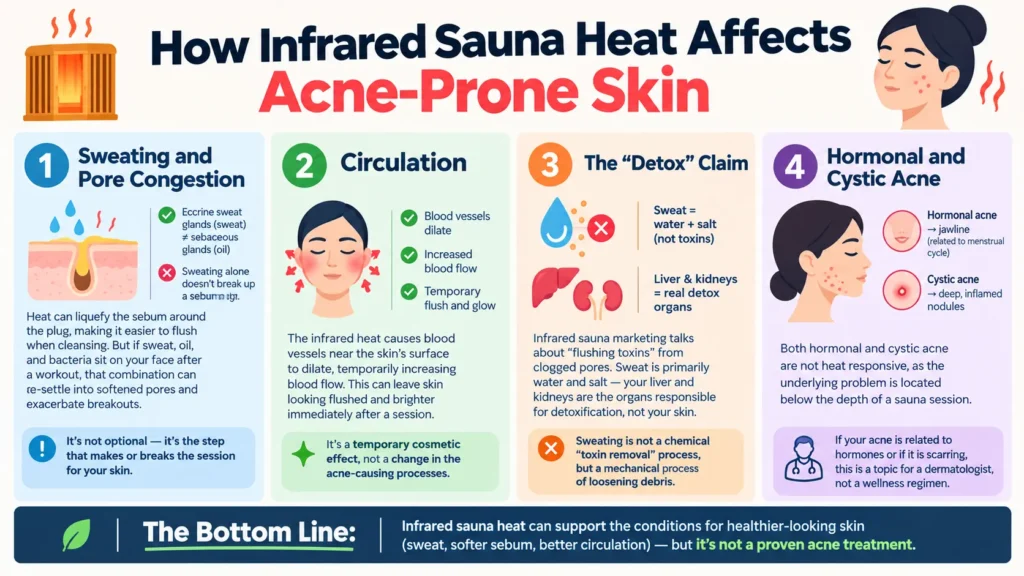
When you get hot, your eccrine sweat glands get activated, which are not the same glands that get clogged with acne (sebaceous glands). Sweating alone does not break up a sebum plug, but the heat that causes the sweating also liquefies the sebum around the plug, making it easier to flush when cleansing.
The problem is that when sweat, oil, and bacteria sit on your face after a workout, that combination can re-settle into softened pores and exacerbate breakouts. It’s not optional — it’s the step that makes or breaks the session for your skin.
2. Circulation
The infrared heat causes the blood vessels near the skin’s surface to dilate, temporarily increasing blood flow. This can leave skin with a flushed and brighter look immediately after a session, which is one reason why some people also wonder about infrared sauna skin tightening or inflammation. It is a temporary cosmetic effect, not a change in the acne causing processes.
3. The “Detox” Claim
Infrared sauna marketing talks about “flushing toxins” from clogged pores. Sweat is primarily composed of water and salt – your liver and kidneys are the organs responsible for detoxification, not your skin. Sweating is not a chemical “toxin removal” process, but a mechanical process of loosening debris that can then be washed away.


Paid Links - As an Amazon Associate, I earn from qualifying purchases.
4. Hormonal and Cystic Acne
Hormonal acne tends to occur along the jawline, and is related to the menstrual cycle, which means it is caused by internal hormonal changes. Cystic acne is characterized by deep, inflamed nodules. Both are not heat responsive, as the underlying problem is located below the depth of a sauna session. If your acne is related to hormones or if it is scarring, this is a topic for a dermatologist, not a wellness regimen.
Can Infrared Sauna Treat Acne? Pros and Cons
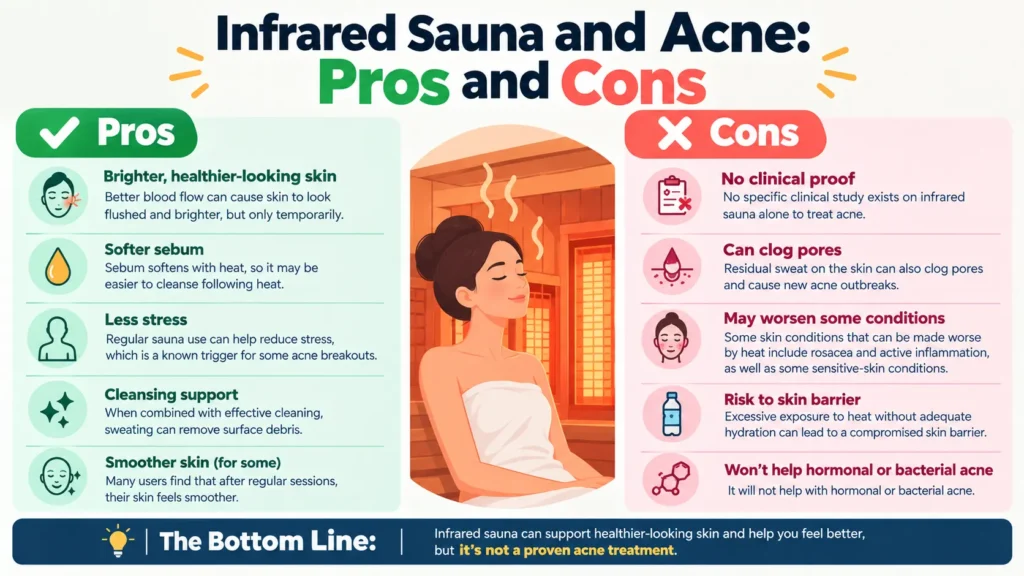
Pros
Better blood flow can cause skin to look flushed and brighter, but only temporarily. Sebum softens with heat, so it may be easier to cleanse following heat. Regular sauna use can help to reduce stress, which is a known trigger for some acne breakouts. When combined with effective cleaning, sweating can remove surface debris. Many users find that after regular sessions, their skin feels smoother.
Cons
No specific clinical study exists on infrared sauna alone to treat acne. Residual sweat on the skin can also clog pores and cause new acne outbreaks. Some skin conditions that can be made worse by heat include rosacea and active inflammation, as well as some sensitive-skin conditions. Excessive exposure to heat without adequate hydration can lead to a compromised skin barrier. It will not help with hormonal or bacterial acne.
Risks and Who Should Be Cautious
| Condition or Situation | Why It Matters | What to Do |
|---|---|---|
| Rosacea | Heat is a documented flare trigger; one survey found over half of rosacea patients cited indoor heat as a trigger | Avoid or keep sessions very short; consult a dermatologist first |
| Active cystic or inflamed acne | Heat and sweat can aggravate already-inflamed skin | Skip sauna use during active flares |
| Sunburned or peeling skin (e.g., from retinoids) | Heat stresses already-compromised skin barrier | Wait until skin has fully healed |
| Active cold sores (herpes simplex) | Heat can trigger reactivation | Avoid sauna use during an outbreak |
| Pregnancy | Overheating raises safety concerns for both parent and baby | Get physician clearance before use |
| Dry or dehydration-prone skin | Heat and sweating increase water loss | Hydrate before/after and limit frequency |
| Eczema | Heat and sweat can worsen itching and irritation | Use cautiously, moisturize immediately after |
How to Use an Infrared Sauna Safely for Acne-Prone Skin
For general session mechanics, our how to use an infrared sauna guide covers the basics — here’s what to layer on top of that for acne-prone skin:
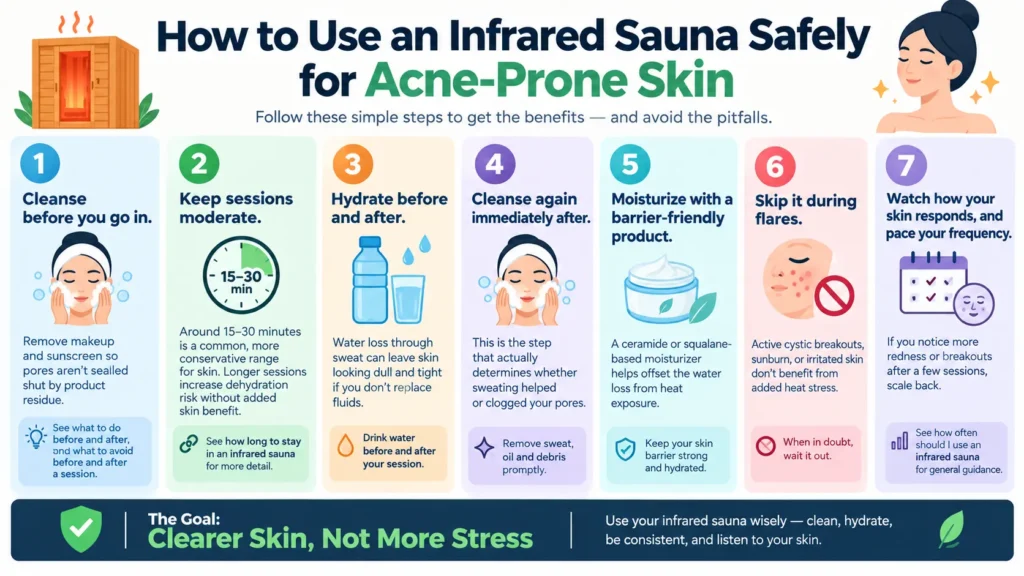
- Cleanse before you go in. Remove makeup and sunscreen so pores aren’t sealed shut by product residue. See what to do before and after an infrared sauna and what to avoid before and after a session.
- Keep sessions moderate. Around 15–30 minutes is a common, more conservative range for skin — see how long to stay in an infrared sauna for more detail, since longer sessions increase dehydration risk without added skin benefit.
- Hydrate before and after. Water loss through sweat can leave skin looking dull and tight if you don’t replace fluids.
- Cleanse again immediately after. This is the step that actually determines whether sweating helped or clogged your pores.
- Moisturize with a barrier-friendly product. A ceramide or squalane-based moisturizer helps offset the water loss from heat exposure.
- Skip it during flares. Active cystic breakouts, sunburn, or irritated skin don’t benefit from added heat stress.
- Watch how your skin responds, and pace your frequency. If you notice more redness or breakouts after a few sessions, scale back — see how often should I use an infrared sauna for general guidance.
If you’re using a wrap-style device rather than a cabin, our how to use an infrared sauna blanket safely guide covers the same principles adapted for blankets.
Infrared Sauna vs. Traditional Sauna for Skin
| Factor | Infrared Sauna | Traditional Sauna |
|---|---|---|
| Air temperature | ~120–140°F | ~160–190°F |
| Heating method | Direct infrared penetration | Heated ambient air |
| Typical session length | Often longer (20–45 min) | Often shorter (10–20 min) |
| Sweat onset | Gradual, at lower air temp | Faster, at higher air temp |
| Rosacea/sensitive skin risk | Still a heat trigger, but potentially more tolerable for some | Higher heat load, generally a stronger trigger |
Neither type is a proven acne treatment. The main practical difference for skin is that infrared saunas let some people tolerate longer sessions at lower air temperatures, which can matter for those managing dehydration or heat sensitivity. If you’re weighing heat style more broadly.
Myth vs. Fact
Myth: Infrared sauna “detoxes” acne out of your skin. Fact: Sweat is mostly water and salt. It may be able to mechanically remove debris, but it is not removing toxins that cause acne.
Myth: The more sessions, the clearer the skin. Fact: Excessive heat exposure can dry and irritate skin, contributing to acne.
Myth: Infrared sauna can treat hormonal or cystic acne. Fact: These types of acne are a result of hormones, inflammation, and bacteria, and none of these are solved by surface heat.
Myth: If sauna use helps some people, it’s safe for everyone. Truth: Rosacea sufferers, those who have an active rosacea flare, sunburn, or some skin conditions are recommended to reduce or avoid heat exposure.
Frequently Asked Questions
Does infrared sauna help with acne?
No. There’s no clinical evidence that infrared sauna alone cures or reliably treats acne. It can be used as a part of a skin care regimen for clearer-looking skin, but it is not a replacement for dermatological treatment.
Does infrared sauna help hormonal acne?
Not directly. Hormonal acne is driven by internal hormone shifts that heat exposure doesn’t address. A dermatologist can offer treatments targeted at the actual hormonal cause.
Is sweating good or bad for acne-prone skin?
It can be either. If you cleanse immediately after, sweating will soften the sebum and loosen the debris. Sweat combined with oil and bacteria can exacerbate acne if left on the skin.
How often should I use an infrared sauna for skin benefits?
No specific frequency is studied for skin in particular. A typical starting point is one to three sessions per week, depending on the skin’s reaction.
Does infrared sauna lead to acne?
Yes, both can cause new breakouts in some people if they are not washed off after the session or if the session is too long and dries out the skin.
Infrared sauna for cystic acne – is it safe?
Use caution. Cystic acne is already inflamed and added heat can make it worse. If you want to incorporate saunas into your current cystic acne treatment, consult a dermatologist first.
What is the recommended duration of a session for acne prone skin?
It is recommended to begin with about 15-30 minutes and to tailor the duration to comfort, hydration and skin response instead of trying to achieve the longest possible session.
Before or after infrared sauna, should I wash my face?
Both. Cleanse before to get rid of make up and product buildup, and cleanse after to eliminate sweat, oil, and dislodged debris before it settles in your pores.
Can infrared sauna help acne scars?
There is no direct proof that infrared sauna heat can help to improve acne scarring. Some near-infrared light devices are examined for skin healing and collagen support, but this is a different technology from whole-body sauna heat.
Is infrared sauna better than a traditional sauna for acne?
Both are unproven treatments for acne. Infrared saunas might be more comfortable for longer periods at lower air temperatures, but the risks and benefits to the skin are the same.
Who should not use infrared saunas for skin problems?
People with active rosacea, cystic flares, sunburn, peeling retinoid-treated skin, active cold sores, or who are pregnant should avoid or get medical clearance before use.
Does infrared light (LED) therapy work differently than infrared sauna heat?
Yes. Targeted near-infrared LED devices deliver specific wavelengths at the skin’s surface and are studied in clinical settings, often alongside other treatments. Whole-body infrared saunas deliver broader far-infrared heat mainly for sweating and relaxation — the two aren’t interchangeable.
Final Thoughts
Infrared sauna isn’t a scam, and it isn’t a cure. The honest picture is somewhere in between: heat and sweat can support the conditions for clearer-looking skin — better circulation, softer sebum, an opportunity to cleanse more thoroughly — but there’s no clinical study showing infrared sauna sessions alone treat acne. The one piece of light-based research often cited (Barolet & Boucher, 2010) tested near-infrared LED as preparation for a medical acne procedure in just 10 patients, not sauna heat on its own.
If you enjoy infrared sauna for relaxation or general wellness, there’s little reason to stop using it for acne-prone skin, as long as you cleanse before and after, hydrate, moisturize, and skip sessions during active flares or with conditions like rosacea. But if acne is persistent, cystic, hormonal, or scarring, a sauna session isn’t a substitute for seeing a dermatologist who can treat the actual cause.