
Does infrared sauna cause hair loss? No, not through any mechanism the current research supports. Normal infrared sauna sessions don’t raise your core body temperature anywhere near the level associated with heat-triggered shedding. What you might notice instead is a drier scalp or slightly frizzier hair, which is a comfort issue, not a sign of follicle damage.
If you’ve spotted a few extra strands in the drain after a sauna session and started to panic, take a breath. Let’s look at what actually causes hair loss, what the heat-and-hair research really shows, and how to keep your hair in good shape if you’re a regular sauna user.
Key Takeaways
- Hair loss from heat typically requires fever-level body temperature (around 102.5°F/39.2°C) to trigger telogen effluvium a normal sauna session doesn’t come close to that.
- The most common cause of hair thinning, androgenetic alopecia, is driven by genetics and hormones (DHT), not heat exposure.
- Infrared saunas run at lower ambient air temperatures than traditional saunas, so if anything, they put less direct heat stress on your scalp.
- Sauna heat can dry out your scalp and hair cuticle a real, manageable issue but that’s different from causing actual hair loss.
- Infrared sauna heat panels and red-light hair-growth devices are not the same technology, even though marketing sometimes blurs the line.
What Actually Causes Hair Loss?
Before getting into sauna-specific research, it helps to know what’s actually behind most hair loss, since heat is rarely the real culprit.
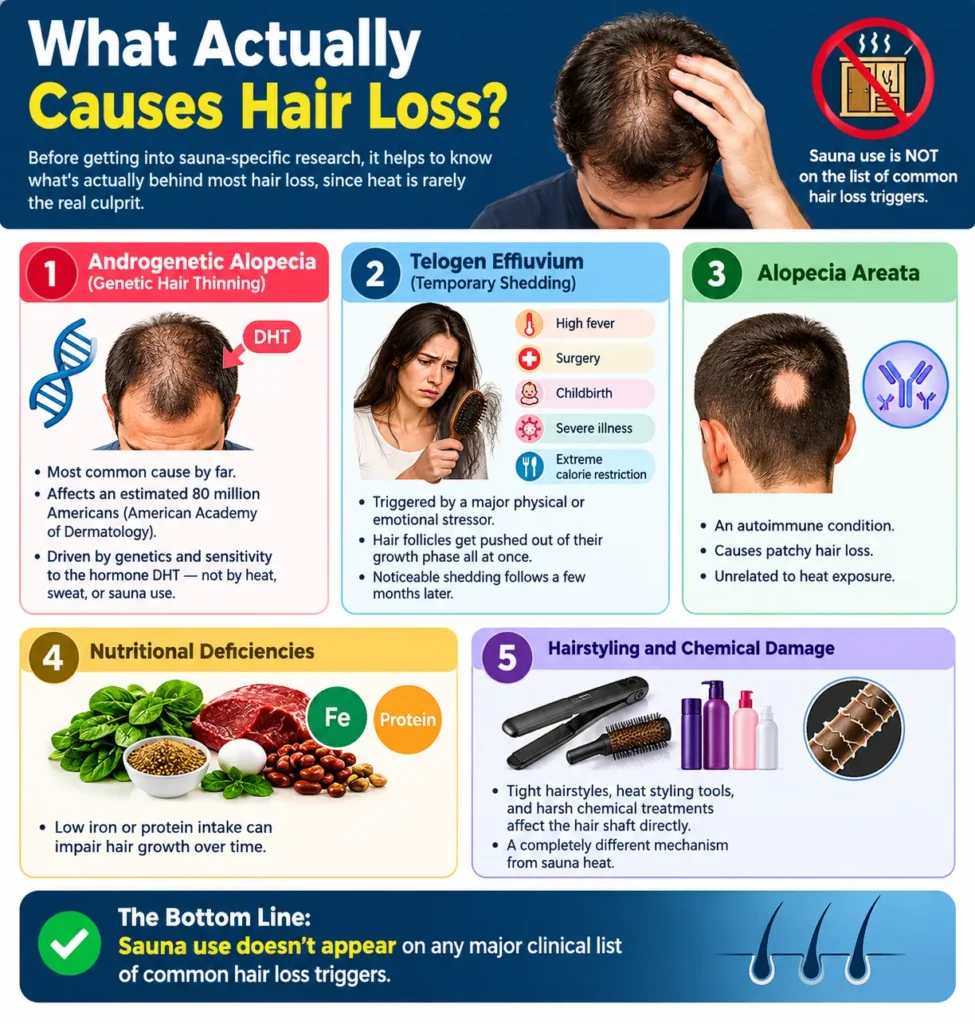
- Androgenetic alopecia (genetic hair thinning): The most common cause by far, affecting an estimated 80 million Americans according to the American Academy of Dermatology. It’s driven by genetics and sensitivity to the hormone DHT not by heat, sweat, or sauna use.
- Telogen effluvium: A temporary, diffuse shedding triggered by a major physical or emotional stressor think a high fever, major surgery, childbirth, severe illness, or extreme calorie restriction. Hair follicles get pushed out of their growth phase all at once, and noticeable shedding follows a few months later.
- Alopecia areata: An autoimmune condition causing patchy hair loss, unrelated to heat exposure.
- Nutritional deficiencies: Low iron or protein intake can impair hair growth over time.
- Hairstyling and chemical damage: Tight hairstyles, heat styling tools, and harsh chemical treatments affect the hair shaft directly a completely different mechanism from sauna heat.
Sauna use doesn’t appear on any major clinical list of common hair loss triggers. That alone is telling.


Paid Links - As an Amazon Associate, I earn from qualifying purchases.
Does Sauna Heat Really Cause Hair Loss?
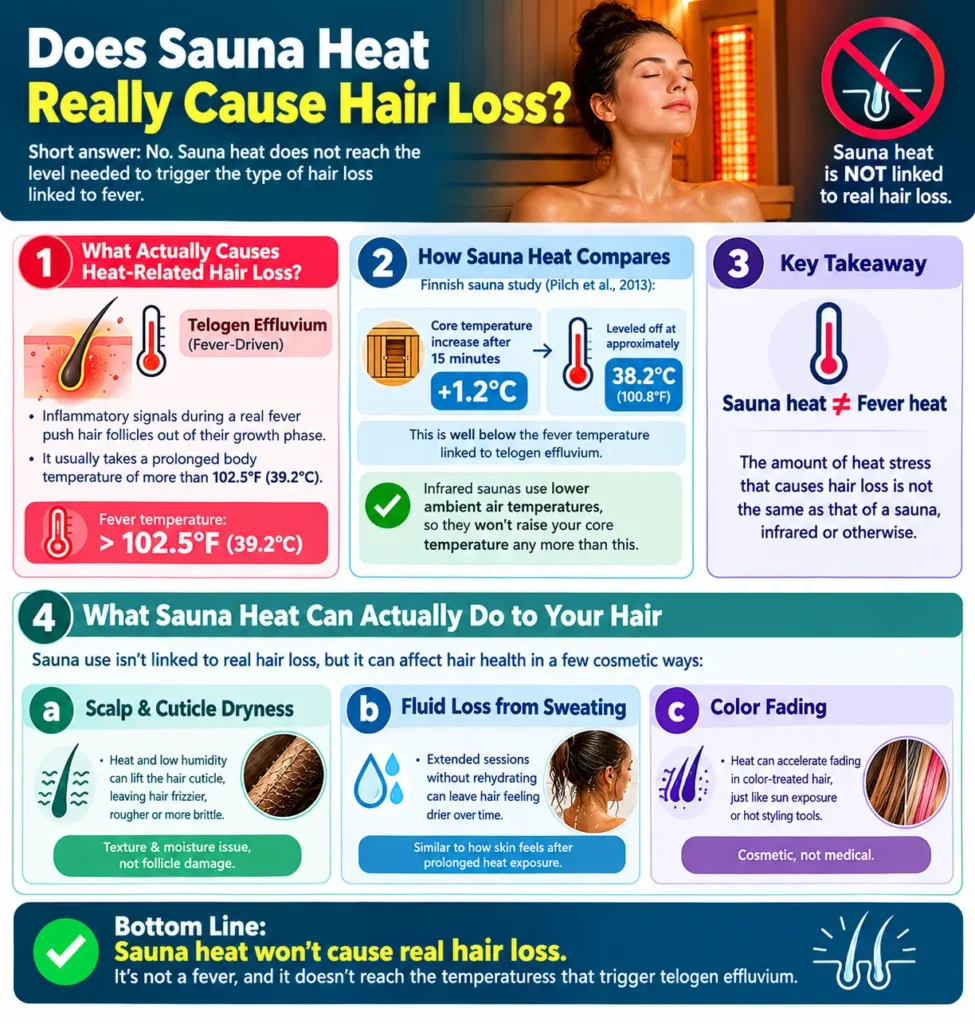
This is where the research becomes specific and really useful. The type of shedding most commonly attributed to heat is referred to as Telogen effluvium, and it is well documented that it is a fever-driven process.
Inflammatory signals during a real fever push hair follicles out of their active growth phase. However, it usually takes a prolonged body temperature of more than about 102.5°F (39.2°C).


Paid Links - As an Amazon Associate, I earn from qualifying purchases.
Compare that to what an actual sauna session does to your core temperature. A study on Finnish sauna bathing (Pilch et al., 2013) showed that the core body temperature increased by approximately 1.2°C after 15 minutes of bathing, and then leveled off at approximately 38.2°C (about 100.8°F) well below the fever temperature associated with telogen effluvium.
Infrared saunas are usually set to lower ambient air temperatures than traditional saunas (because they heat you, not the air around you), so there’s no evidence that they would raise your core temperature any more than that.
To put it simply, the amount of heat stress that causes hair loss is not the same as that of a sauna, infrared or otherwise.
What Sauna Heat Can Actually Do to Your Hair
While sauna use isn’t linked to real hair loss, it’s not entirely without effects on hair health:

Paid Links - As an Amazon Associate, I earn from qualifying purchases.
- Scalp and cuticle dryness. Heat and low humidity can lift the hair cuticle the outer protective layer leaving hair feeling frizzier, rougher, or more brittle. This is a texture and moisture issue, not follicle damage.
- Fluid loss from sweating. Extended sessions without rehydrating can leave hair feeling drier over time, similar to how skin feels after prolonged heat exposure.
- Color fading. Heat can accelerate fading in color-treated hair, the same way sun exposure or hot styling tools can.
None of these amount to hair loss. They’re cosmetic and manageable, not medical concerns.
The Red-Light Therapy Confusion
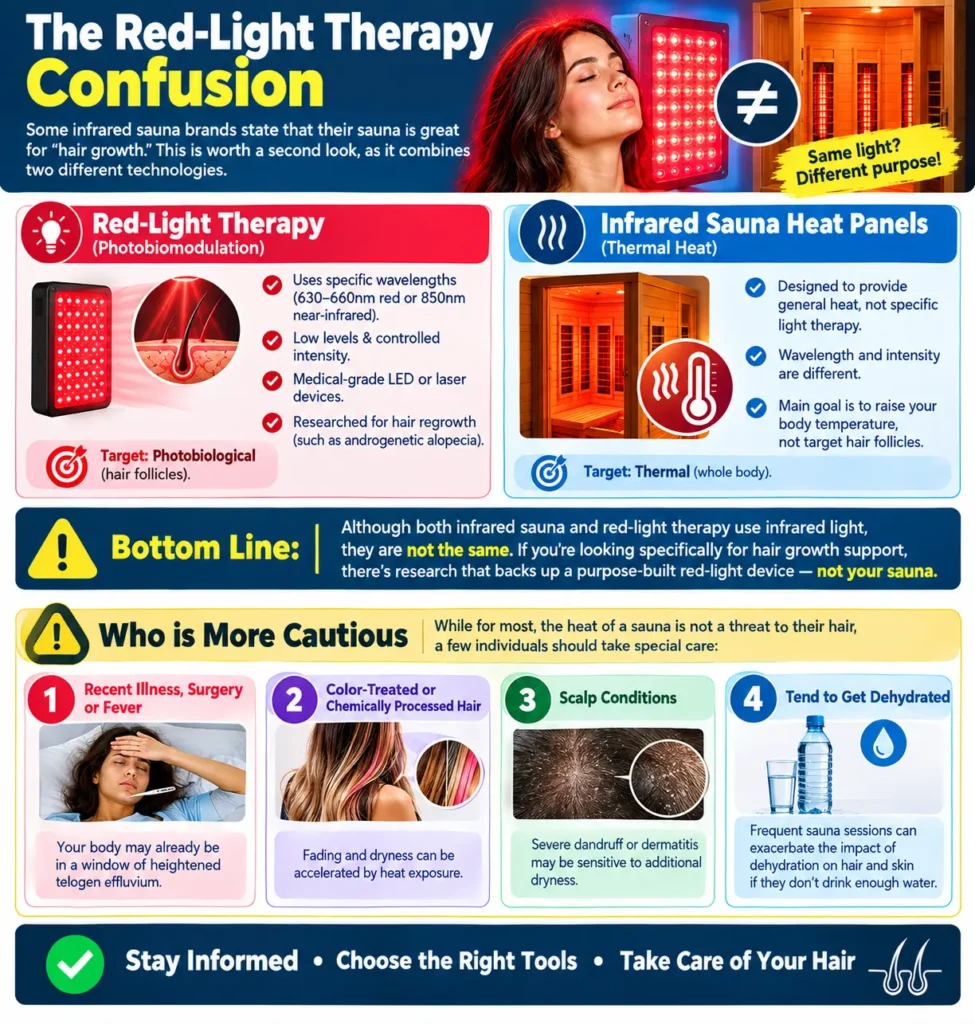
Some infrared sauna brands state that their sauna is great for “hair growth. This is worth a second look, as it combines two different technologies.
Red light therapy, also known as photobiomodulation, for hair growth is a therapy that employs very specific wavelengths of light, often in the red light spectrum (630-660nm) or near-infrared spectrum (850nm), that are emitted at low levels and in a controlled manner from medical-grade LED or laser devices. This is actually researched for hair regrowth support in conditions like androgenetic alopecia.
Infrared sauna heat panels, on the other hand, are designed to provide general heat and raise the temperature of your body, not to provide a specific and therapeutic amount of light to your scalp. Wavelength and intensity are different and the target is thermal, not photobiological.
Although both infrared sauna and red-light therapy caps or panels use infrared light, they are not the same. If you’re looking specifically for hair growth support, there’s research that backs up a purpose-built red-light device not your sauna.
Who is More Cautious
While for most, the heat of a sauna is not a threat to their hair, a few individuals should take special care:
- Anyone who has recently had a serious illness, surgery, or fever, because your body may already be in a window of heightened telogen effluvium that has nothing to do with the sauna.
- Color-treated or chemically processed hair: fading and dryness can be accelerated by heat exposure.
- People who already have a scalp condition, such as severe dandruff or dermatitis, and who may be sensitive to additional dryness.
- People who tend to get dehydrated: Frequent sauna sessions can exacerbate the impact of dehydration on hair and skin in general if they don’t drink enough water.
How to Protect Your Hair During Infrared Sauna Sessions
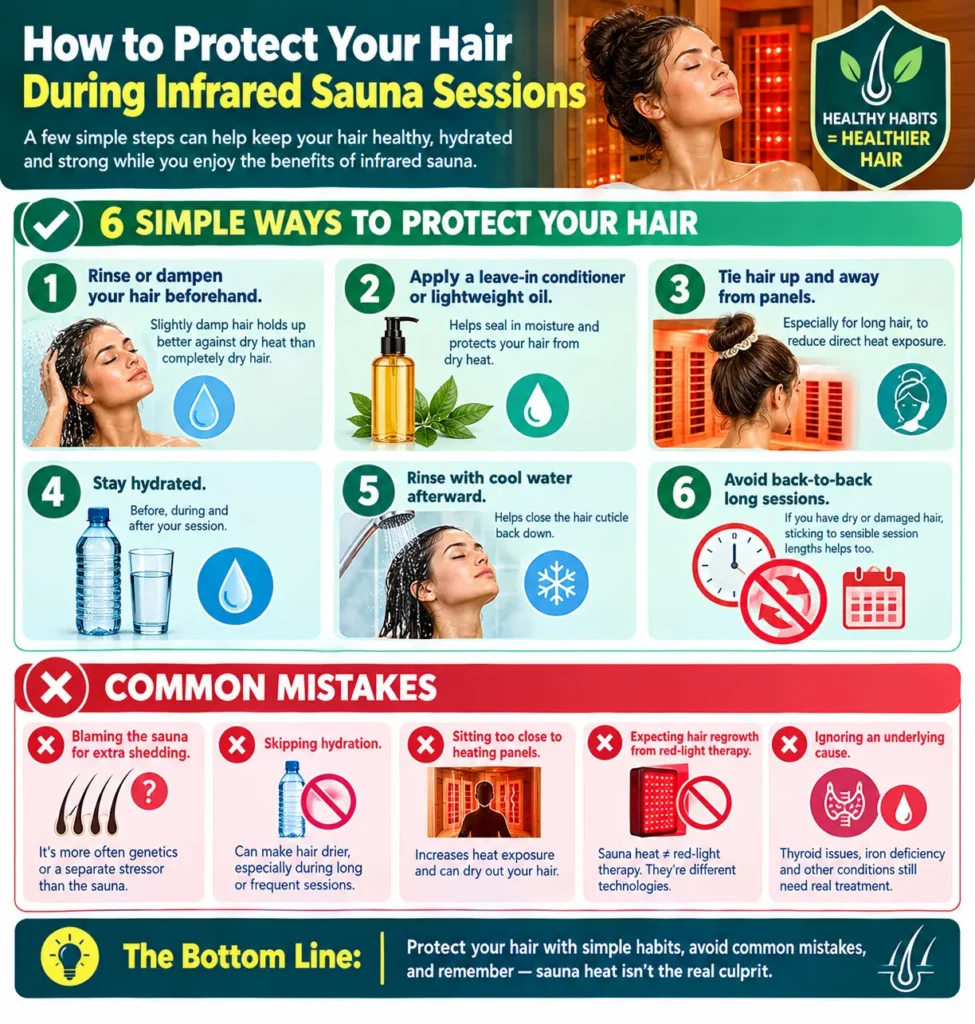
- Rinse or dampen your hair beforehand. Slightly damp hair holds up better against dry heat than completely dry hair.
- Apply a leave-in conditioner or lightweight oil before your session to help seal in moisture.
- Tie hair up and away from panels, especially if you have long hair, to reduce direct heat exposure these small habits make a bigger difference than most people expect.
- Stay hydrated before, during, and after your session.
- Rinse with cool water afterward to help close the hair cuticle back down.
- Avoid back-to-back long sessions if you already have dry or damaged hair sticking to sensible session lengths helps here too.
Common Mistakes
- Assuming any extra shedding noticed after a sauna session must be caused by the sauna, when the far more common explanation is unrelated genetics or a separate stressor.
- Skipping hydration during long or frequent sessions.
- Sitting too close to heating panels with hair unprotected.
- Confusing sauna heat with red-light hair-growth therapy and expecting hair regrowth results a sauna isn’t designed to deliver.
- Not addressing an actual underlying cause (like thyroid issues or iron deficiency) because “the sauna” seemed like an easier explanation.
Myth vs. Fact
| Myth | Fact |
|---|---|
| “Sauna heat causes hair loss.” | No — the heat stress from a typical sauna session falls far short of the threshold linked to heat-triggered shedding. |
| “Infrared saunas help hair grow back.” | Not through the heat itself. Hair-growth benefits are associated with specific red-light therapy devices, a different technology entirely. |
| “Sweating in a sauna ‘detoxes’ your scalp and prevents hair loss.” | There’s no credible evidence sweating prevents hair loss or meaningfully detoxes the scalp. |
| “If your hair feels drier after a sauna, it’s falling out.” | Dryness affects hair texture and appearance, not the follicle itself — it’s a different issue from actual shedding. |
| “Traditional saunas are safer for hair than infrared.” | If anything, infrared saunas typically run at lower ambient air temperatures, meaning less direct heat exposure to the scalp. |
Infrared Sauna vs. Traditional Sauna: Which Puts More Stress on Hair?
| Factor | Traditional (Finnish) Sauna | Infrared Sauna |
|---|---|---|
| Typical ambient temperature | 150–195°F (65–90°C) | 120–150°F (49–65°C) |
| How it heats you | Warms the air, which warms your body | Heats your body directly with infrared light |
| Core temperature increase (per session) | Modest, well under fever threshold | Generally similar or lower |
| Scalp heat exposure | Higher due to hot air surrounding the head | Lower, especially if you sit away from panels |
| Dryness risk | Present | Present, though often less due to lower air temp |
FAQs
Does infrared sauna cause hair loss?
There is no reliable study that has correlated normal infrared sauna use with hair loss. This heat is not near the level that can cause heat-induced shedding (telogen effluvium).
Why does my hair fall out more after using a sauna?
If a few more strands are noticed after toweling off or brushing, it is likely that it is just normal day-to-day shedding, not because of the sauna. If the shedding is ongoing and heavy, it may be worth talking with a doctor instead of blaming the sauna.
Does heat cause TE?
Yes, but usually only at fever temperature (around 102.5°F/39.2°C for a prolonged period), which is not achieved by a regular sauna.
Does infrared sauna benefit or harm hair more than a regular sauna?
Infrared saunas typically have lower ambient air temperatures, which could result in slightly less direct heat stress on the scalp than a traditional high-heat sauna.
Can infrared sauna promote hair growth?
Not directly by its heat. Specific red-light therapy wavelengths that are provided by a dedicated device, not a sauna’s heating panels, are associated with hair growth support.
Does sauna use cause dry or frizzy hair?
Yes. Low humidity levels can cause the hair cuticle to rise, causing dryness and frizziness. This is a texture problem and not a balding problem.
Is it advisable to cover hair during infrared sauna?
It’s not required, but tying hair back and away from heating panels, along with a leave-in conditioner beforehand, can help minimize dryness.
Does the use of sauna have an impact on the health of the hair?
While it can cause dehydration to the hair over time, one sauna session followed by adequate rehydration shouldn’t be a problem.
Final Thoughts
If you’ve been worried that your sauna habit is behind your hair thinning, the research is genuinely reassuring: normal infrared sauna sessions don’t generate anywhere near the heat stress needed to trigger hair loss.
What you might actually be noticing is dry, frizzier-feeling hair from heat and low humidity a real but entirely manageable issue, not a sign your follicles are in trouble.
If persistent shedding is genuinely bothering you, the more useful next step isn’t cutting out your sauna sessions it’s looking at the far more common causes, like genetics, stress, thyroid function, or iron levels, ideally with a dermatologist’s input.
In the meantime, a little hydration and a leave-in conditioner before your next session will do more for your hair than skipping the sauna ever would.