
Walk into any sauna showroom and you’ll hear the phrase “full spectrum infrared sauna” thrown around like it’s obvious. It isn’t. Most infrared saunas only use one type of infrared light. A full spectrum infrared sauna uses three, and that difference actually changes how deep the heat reaches into your body, what it does once it gets there, and how much you’ll pay for it. Here’s what a full spectrum infrared sauna really is, stripped of the marketing gloss.
What Is a Full Spectrum Infrared Sauna?
A full spectrum infrared sauna is an infrared sauna that emits all three infrared wavelength bands — near, mid, and far — in the same session. Most infrared saunas use only far infrared. A full-spectrum model adds near- and mid-infrared emitters on top of that, so three different depths of heat reach your body at once instead of just one.
Each wavelength does a different job. Near infrared works at the skin’s surface. Mid infrared reaches into muscles and joints. Far infrared goes deepest, driving the heavy sweat and core-temperature rise most people associate with sauna use in general. “Full spectrum” simply means you get all three, rather than choosing one.
Types of Full-Spectrum Infrared Saunas
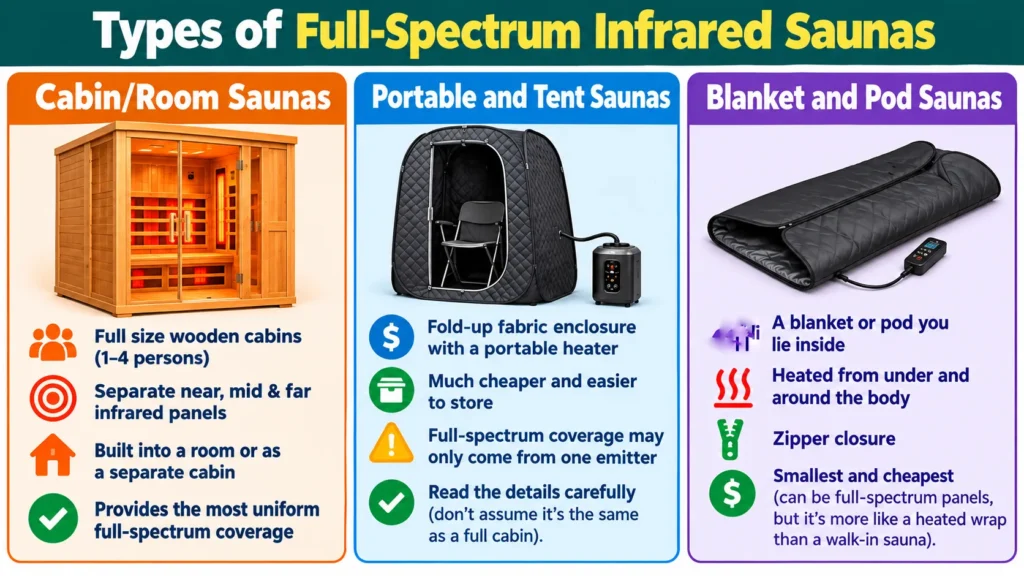
Cabin/Room Saunas
Full size wooden cabins, usually accommodating 1-4 persons, either built into a room or as a separate cabin. These provide the most uniform full-spectrum coverage as there is space for separate near, mid, and far infrared panels.


Paid Links - As an Amazon Associate, I earn from qualifying purchases.
Portable and Tent Saunas
A fold-up fabric enclosure with a portable heater, usually placed over a chair. These are much cheaper and more convenient to store, but full-spectrum coverage may only be available from one portable emitter, so read the details carefully and don’t assume that full-spectrum is the same as full-cabin.
Blanket and Pod Saunas
A blanket or pod you lie inside, heated from under and around the body with a zipper. These are the smallest and cheapest, and can be full-spectrum panels, but it’s more like a heated wrap than a walk-in sauna.



Paid Links - As an Amazon Associate, I earn from qualifying purchases.
How Infrared Saunas Work (The Basics)
Infrared is a band of light that sits just past the red end of the visible spectrum. You can’t see it, but you can feel it as heat. Infrared saunas use electric heating panels, usually made from carbon or ceramic, that give off this light directly at your body instead of heating the air in the room.
That’s the core difference from a traditional sauna. A wood-burning or electric rock sauna heats the air around you to a very high temperature, often 170–195°F, and your body absorbs heat mostly through that hot air. An infrared sauna instead sends radiant heat straight into your skin and tissue, so the cabin air itself can stay much cooler, typically 100–140°F, while you still work up a sweat.
Infrared Heat vs. Traditional Sauna Heat
| Traditional Sauna | Infrared Sauna | |
|---|---|---|
| How it heats you | Heats the surrounding air | Heats your body directly with light |
| Typical air temperature | 170–195°F | 100–140°F |
| Heat-up time | 30–60 minutes | 10–20 minutes |
| Humidity | Often high (especially with a löyly/steam element) | Low |
| Feel | Intense, dry or steamy heat | Gentler, more tolerable heat |
| Typical session length | 5–20 minutes | 20–45 minutes |
What are the Three Infrared Wavelengths?
Full spectrum” is not a marketing term; it is a measurable spectrum of the infrared spectrum. The three bands are defined by the approximate location on the microns scale. These boundaries vary slightly between different sources, but the ranges below are the most consistent values found among sauna manufacturers and in clinical literature.
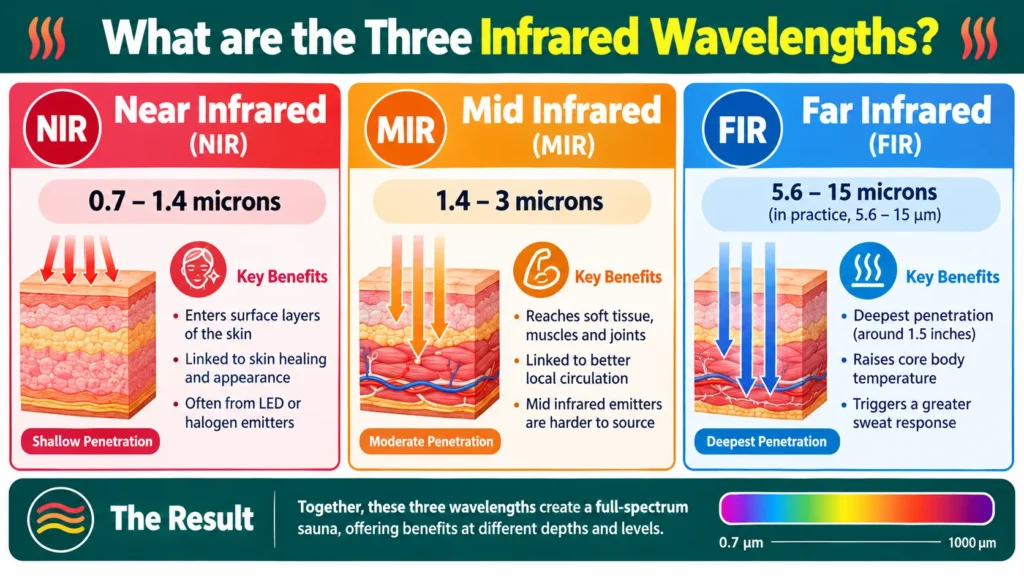
1. Near Infrared (NIR)
Roughly 0.7–1.4 microns. This is the smallest of the three wavelengths and the one that is closest to visible light. It enters the surface layers of the skin and is the wavelength most commonly linked to skin level effects such as wound healing and skin appearance studies in photobiomodulation. Near infrared is typically produced by LED or halogen-type emitters in a sauna, as opposed to the carbon panels that produce far infrared.



Paid Links - As an Amazon Associate, I earn from qualifying purchases.
2. Mid Infrared (MIR)
Roughly 1.4–3 microns. Mid infrared falls in between the other two and goes deeper than near infrared, into soft tissue, muscles, and joints. It’s the wavelength most often linked to improved local circulation. One reason why “full spectrum” saunas are more expensive than far-infrared-only saunas is that mid infrared emitters are the most difficult to source.
3. Far Infrared (FIR)
The range is about 3-1000 microns, but in practice, sauna heaters typically use the 5.6-15 micron range. This is the longest wavelength and the deepest penetrating into the body, which is often quoted as being around 1.5 inches. Far infrared is the wavelength that is used in standard, single-band infrared saunas, because it is the most effective at raising core body temperature and inducing a greater sweat response.
Wavelength Comparison Table
| Wavelength | Approx. Range (microns) | Penetration Depth | Primary Association | Common Emitter Type |
|---|---|---|---|---|
| Near infrared (NIR) | 0.7–1.4 | Skin surface | Skin health, photobiomodulation | LED / halogen |
| Mid infrared (MIR) | 1.4–3 | Soft tissue, muscles, joints | Circulation | Specialized carbon/ceramic blends |
| Far infrared (FIR) | 3–1000 (practically ~5.6–15) | Deepest (~1.5 in.) | Core heating, heavy sweat, detox pathways | Carbon or ceramic panels |
Quick fact: exact micron cutoffs vary slightly between manufacturers and studies, so don’t be alarmed if you see numbers that differ by a few tenths of a micron from one brand’s spec sheet to another. The three-band concept is what matters more than the decimal point.
Full Spectrum vs. Far-Infrared-Only Saunas
A far-infrared-only sauna employs only one kind of heating panel and provides just one wavelength band. It’s easier to construct, easier to maintain, and is often less expensive and operates at a lower and more steady temperature (which some prefer, particularly heat-sensitive users).
A full-spectrum sauna has near and mid-infrared emitters in addition to the far-infrared panels. All three levels of penetration in one session rather than one or the other. The downside is a more complicated heater, a higher cost, and — since there are more electrical parts running close to your body — more things to consider when it comes to EMF (more on that below).
There is no objective basis for deciding which is “better. If you are looking for deep heat, sweating and relaxation, then far infrared is the more tried and tested and simple choice. If you are looking for the skin and circulation benefits of near and mid infrared, and you can afford it, then full spectrum is the more complete choice.
The advantages of Full-Spectrum Infrared Sauna.
Sauna marketing pages tend to present benefits as facts. The truth is that the quality of the evidence is highly variable from claim to claim. Below, benefits are listed by the strength of the current research, so you can consider the claims with an appropriate level of confidence.
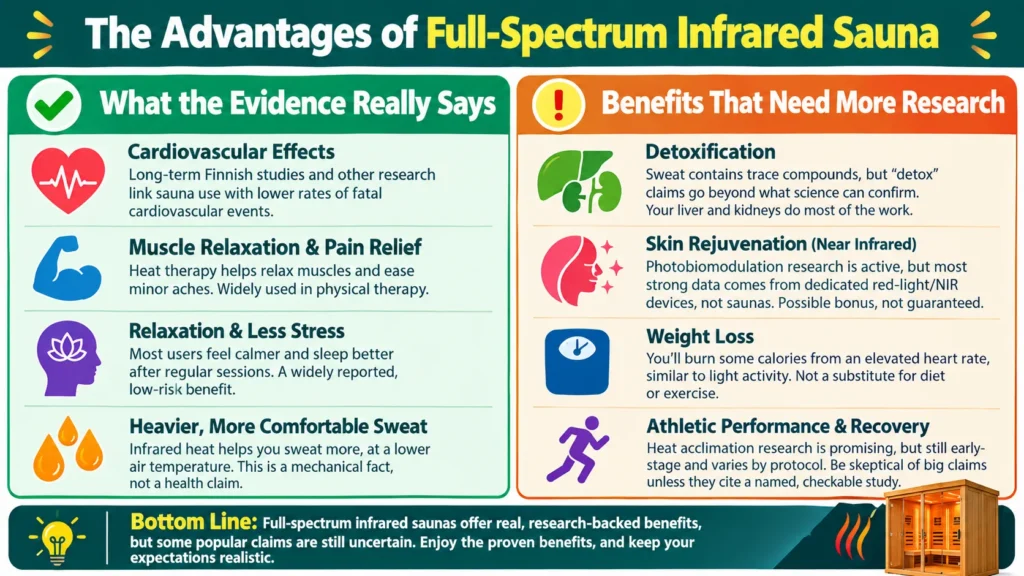
What the Evidence Really Says
- Cardiovascular effects. The best-established research on infrared and heat-based saunas comes from long-running Finnish cohort studies (including data from the University of Eastern Finland, published in JAMA Internal Medicine) linking frequent sauna use with lower rates of fatal cardiovascular events. A 2009 review in Canadian Family Physician also found supportive evidence specifically for far-infrared sauna use in people with congestive heart failure and coronary risk factors, though the same review noted the overall body of published evidence was still limited at the time.
- Muscle relaxation and short-term pain relief. Heat therapy in general, including infrared, is well documented to help relax muscles and ease minor aches, which is why infrared is commonly used in physical therapy settings.
- Relaxation and perceived stress reduction. Most users report feeling calmer and sleeping better after regular sessions. This is a widely reported, low-risk benefit, even where the underlying mechanism isn’t fully mapped out.
- A heavier, more comfortable sweat at a lower air temperature. This is a mechanical fact of how infrared heat works, not a health claim — infrared saunas are simply easier for many people to tolerate for longer than a traditional high-heat sauna.
Benefits That Need More Research
- Detoxification. Sweat does contain trace amounts of certain compounds, but “detox” claims tied to infrared sauna use go further than the current science can confirm. Your liver and kidneys do the vast majority of that work regardless of sauna use.
- Skin rejuvenation from near infrared. Photobiomodulation research on near-infrared light is a genuinely active research area, but most of the strongest data comes from dedicated red-light/NIR devices used at specific doses, not from sitting in a sauna cabin. Expect this as a possible bonus, not a guaranteed outcome.
- Weight loss. You’ll burn some calories from the elevated heart rate during a session, similar to light physical activity, but a sauna is not a substitute for diet or exercise for meaningful weight loss.
- Athletic performance and recovery. Heat acclimation research is promising and infrared is used by some athletes for recovery, but findings are still early-stage and vary by protocol, so treat specific performance numbers you see quoted online with some skepticism unless they cite a named, checkable study.
Is a Full Spectrum Infrared Sauna Safe?
Yes, for most healthy adults. Infrared saunas are employed in physical therapy and wellness centers and are regarded as non-ionizing radiation, which is radiation that does not harm DNA like ionizing radiation (such as X-rays).
However, there are real caveats to “safe”: dehydration and overheating are the primary practical concerns, particularly during extended sessions or in warmer climates. Manufacturers agree on the same safety rules: drink water, don’t sauna when intoxicated or very tired, leave if you feel dizzy or sick, and never sleep in the sauna.
EMF – What It Is and What to Look For
All electric heaters, including infrared sauna panels, emit a certain amount of electromagnetic field (EMF). While there is no one “safe number” that all regulators agree on, other organizations such as the International Commission on Non-Ionizing Radiation Protection (ICNIRP) have guidelines for public exposure, and infrared saunas are well below that. To put it into perspective, the EMF experienced in a sauna session is usually much lower than the short bursts received from a hair dryer or electric shaver, but the duration of exposure is longer, resulting in a higher cumulative exposure.
Practical guidance if EMF is a concern for you:
- Look for saunas with independently tested EMF numbers measured at seated body distance, not just at the wall or floor.
- A commonly cited target among manufacturers is under 3 milligauss (mG) at seating position, with some premium models advertising well under 1 mG.
- Be skeptical of “zero EMF” marketing claims — every electric heater produces some field; the honest claim is “very low” or “ultra-low,” not zero.
- If EMF is a major concern, a wood-burning traditional sauna produces effectively none, though you lose the infrared-specific benefits and lower operating temperature.
Who Should Avoid or Check With a Doctor First
- Pregnant individuals
- People with a pacemaker or other implanted electronic device
- Anyone with uncontrolled cardiovascular conditions, low blood pressure, or a history of fainting
- People who are acutely ill, dehydrated, or under the influence of alcohol or sedating medication
- Young children, without direct supervision and shortened session times
This list isn’t exhaustive. If you have an existing health condition, ask your doctor before starting regular sauna use, especially at higher heat settings or longer session lengths.
How to Use a Full-Spectrum Infrared Sauna (Session Guide)
- Hydrate first. Drink a glass of water before you start.
- Start low and short. First-timers should begin around 100–120°F for 15–20 minutes rather than jumping to a full 45-minute session.
- Build up gradually. Once you know how your body responds, most regular users settle into 20–45-minute sessions, 3–5 times per week, at 120–140°F.
- Listen to your body. Dizziness, nausea, or a racing heartbeat means it’s time to step out, not push through.
- Rehydrate after. Replace fluids (and electrolytes, if you sweat heavily) once you’re done.
- Cap it at 45 minutes. Longer isn’t automatically better and raises the risk of dehydration and overheating.
- Clean the sauna regularly. Wipe down surfaces after each use and disinfect weekly, especially in a multi-person household, to prevent bacterial buildup on wood and seating surfaces.
How Much Does a Full Spectrum Infrared Sauna Cost?
Exact pricing varies a lot by brand, size, and build quality, so treat any specific number as a rough starting point rather than a fixed rule:
- Portable/tent full-spectrum saunas: generally the least expensive entry point.
- Blanket/pod full-spectrum saunas: a step up from portable tents, still far below cabin pricing.
- 1–2 person cabin saunas: a meaningfully larger investment than far-infrared-only models of the same size, because of the added near- and mid-infrared emitters.
- Larger multi-person cabins with full-spectrum coverage: the highest price tier, often with added features like red light therapy or chromotherapy.
As a rule of thumb, expect full-spectrum models to cost noticeably more than an equivalent far-infrared-only sauna of the same size and build quality, since mid-infrared emitters in particular are more expensive to source and install.
Full Spectrum vs. Far Infrared: Which One Should You Buy?
| Choose Far Infrared If… | Choose Full Spectrum If… | |
|---|---|---|
| Budget | You want the lower-cost option | You’re willing to pay more for broader wavelength coverage |
| Heat sensitivity | You prefer a gentler, more consistent heat | You don’t mind slightly higher perceived heat |
| Goals | Deep heat, sweating, relaxation are your main goals | You also want the skin/circulation angle from NIR and MIR |
| Simplicity | You want fewer components and less to maintain | You’re comfortable with a more complex heater system |
| Extra features | Not a priority | You’re interested in add-ons like red light therapy, common on full-spectrum models |
Common Mistakes First-Time Buyers Make
- Assuming “full spectrum” always means equal coverage of all three wavelengths. Some budget models include a token near-infrared bulb that adds little real output. Ask for wavelength and irradiance specs, not just the label.
- Ignoring EMF specs entirely. Even if it’s not a top priority, it costs nothing to ask for the seated-position mG reading.
- Jumping straight to long, hot sessions. This is the most common cause of a bad first experience and dehydration.
- Buying based on interior square footage alone. Panel placement and heater quality matter more to your actual experience than cabin size.
- Not checking warranty coverage on heating panels specifically, since panels are the most expensive component to replace.
Myth vs. Fact
| Myth | Fact |
|---|---|
| “Full spectrum” is just a marketing term with no real meaning. | It refers to a specific, measurable combination of near, mid, and far infrared wavelengths. |
| Infrared saunas “flush out toxins” that your body couldn’t otherwise remove. | Your liver and kidneys handle the vast majority of detoxification; sweat plays a minor supporting role at best. |
| More heat and longer sessions always mean better results. | Sessions beyond 45 minutes mainly raise dehydration risk without added benefit for most healthy users. |
| Infrared radiation is the same category as X-rays or UV, so it’s automatically risky. | Infrared is non-ionizing radiation — the same general category as the heat you feel from sunlight, and distinct from damaging ionizing radiation. |
| A “zero EMF” sauna claim means there’s truly no electromagnetic field. | Every electric heater produces some EMF; “zero EMF” is a marketing overstatement, and “ultra-low EMF” is the more honest claim to look for. |
FAQs What Is a Full Spectrum Infrared Sauna?
What does a full spectrum infrared sauna mean?
A full-spectrum infrared sauna is an infrared sauna that emits all three infrared wavelength bands — near, mid, and far — during each session, rather than just the far infrared band as is the case with standard infrared saunas.
What is the difference between full spectrum and far infrared?
Far-infrared-only saunas are heated with a single type of heating panel and a single wavelength band. Full-spectrum saunas feature near and mid-infrared emitters in addition to far infrared and typically cost more.
Is a full-spectrum infrared sauna better than a regular infrared sauna?
Not necessarily “better” — it depends on what you want to do. Far infrared is simpler, gentler, and less expensive, while full spectrum includes skin and circulation related wavelengths at a higher price and more complicated heater system.
How does a full-spectrum infrared sauna work?
Electric heating panels radiate near, mid and far infrared light directly to your body. Each wavelength has a different depth of penetration – near infrared at the skin surface, mid infrared into soft tissue and far infrared deepest into the body, where it heats you directly and not the surrounding air.
Is it safe to use full spectrum infrared saunas?
Yes, for most healthy adults, as long as they take the usual precautions: drink plenty of water, limit sessions to 45 minutes or less, and leave if they feel dizzy or unwell. Pregnant women, those with pacemakers and those with uncontrolled cardiovascular conditions should consult a physician before use.
So, does a full spectrum infrared sauna emit more EMF than a far infrared sauna?
It can, simply because there are more electrical heating components involved. This is why it is more crucial to check independently tested, seated-position EMF specs for full-spectrum models than for simpler far-infrared models.
What is the recommended time for sitting in a full spectrum infrared sauna?
For first time use, begin at a lower temperature (100-120°F) for 15-20 minutes. Regular users may exercise for 20-45 minutes at 120-140°F several times weekly.
How many times should you use an infrared sauna?
Most people who use infrared saunas regularly do so 3-5 times per week, although this should be adapted to how your body reacts and what your doctor suggests.
Can full spectrum infrared saunas really aid in detox?
Some substances are present in sweat in very small quantities. Your liver and kidneys do the majority of detoxification regardless of sauna use, so “detox” is better thought of as a minor, unproven bonus rather than a primary, evidence-backed benefit.
Does a full spectrum infrared sauna aid in weight loss?
It can increase your heart rate to the same level as light exercise, burn some calories during the session, but is not a substitute for diet and exercise for real and lasting weight loss.
What’s the difference between near, mid, and far infrared?
The shortest wavelength is near infrared, which only penetrates the surface of the skin; the mid infrared penetrates deeper into soft tissue and muscle; and the far infrared penetrates deepest, resulting in the heaviest sweat response and core-temperature increase.
Final Thoughts
“Full spectrum” isn’t just a premium label — it’s a real, measurable difference in which infrared wavelengths a sauna delivers. Near infrared works at the skin’s surface, mid infrared reaches soft tissue and muscle, and far infrared goes deepest, driving the sweat and core-heat response most people associate with saunas in general.
Whether the upgrade is worth it comes down to your goals and budget. If you mainly want deep heat, a solid sweat, and relaxation, a well-built far-infrared sauna covers that at a lower price. If you specifically want the added skin and circulation angle that near and mid infrared bring, and you’re comfortable paying more for a more complex heater system, full spectrum is the more complete option.
Either way, don’t take wavelength or health claims at face value. Ask for real specs — micron ranges, irradiance data, and seated-position EMF readings — and separate the well-supported benefits (cardiovascular support, muscle relaxation, stress relief) from the ones still waiting on stronger research (detox, weight loss, skin rejuvenation). That’s how you buy based on facts instead of marketing copy.