
Is an infrared sauna good for bronchitis? If you’re asking this question mid-cough, with a sauna sitting right there in your garage or spare room, you want a straight answer not a wall of maybes. So here’s the honest version: it depends on what kind of bronchitis you have, how you’re feeling in this exact moment, and a couple of health factors most articles on this subject never mention.
Used the right way, an infrared sauna can offer real comfort for some bronchitis symptoms. Used the wrong way say, with a fever, or during a flare-up you’re brushing off as “not that bad” it can genuinely make things worse.
This guide walks through what the science actually supports, what’s just sauna-brand marketing dressed up as health advice, and how to tell, in your specific situation, which side of that line you’re on.
The Short Answer
If your bronchitis is mild and you don’t have a fever just a lingering cough, some tightness in your chest, a bit of congestion a short, moderate infrared sauna session is generally low-risk for a healthy adult, and it may bring some temporary relief through muscle relaxation and loosened mucus.


Paid Links - As an Amazon Associate, I earn from qualifying purchases.
If you have a fever, or your bronchitis is the contagious, virus-driven kind, skip it for now. Heating up an already-feverish body adds strain your cardiovascular system doesn’t need, and if you share a sauna with anyone, you risk passing the infection along.
The long-term outlook is more hopeful, however, regular sauna use has been associated with a reduced prevalence of chronic respiratory disease in some relatively large studies of chronic bronchitis or bronchitis associated with COPD. That, however, is traditional, hot-air saunas, not infrared cabins specifically, and if you suffer from COPD, it is a discussion you should have with your doctor before you add it to your routine.



Paid Links - As an Amazon Associate, I earn from qualifying purchases.
What Is Bronchitis, Exactly?
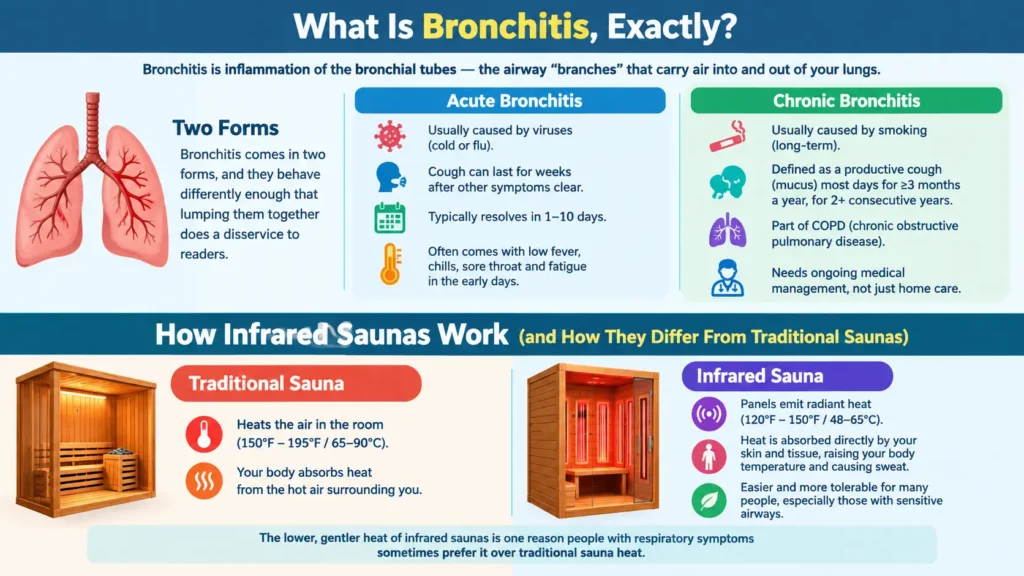
Bronchitis is inflammation of the bronchial tubes the airway “branches” that carry air into and out of your lungs. It shows up in two forms, and they behave differently enough that lumping them together does readers a disservice.
Acute Bronchitis
Acute bronchitis, the kind most people mean when they say “chest cold,” is usually caused by the same viruses behind a regular cold or the flu. It tends to follow a respiratory infection, brings a cough that can hang around for weeks after everything else clears up, and typically resolves on its own within a week to ten days. In the early days, it’s common to also have a low fever, chills, a sore throat, and that heavy, worn-out feeling that comes with any viral illness.
Chronic Bronchitis
Chronic bronchitis is a different situation altogether. It’s a long-term inflammation of the airway lining, most often driven by smoking, and it’s defined medically as a productive cough one that brings up mucus on most days for at least three months a year, across two or more consecutive years. It falls under the umbrella of chronic obstructive pulmonary disease (COPD), and it needs ongoing medical management, not just home comfort measures.
Why does this distinction matter here? Because acute bronchitis is often a short illness that can come with a fever and can be contagious. Chronic bronchitis is a stable, long-running condition where someone might feel more or less normal most days, with occasional flare-ups. The sauna questions and the honest answers look different depending on which one you’re actually dealing with.



Paid Links - As an Amazon Associate, I earn from qualifying purchases.
How Infrared Saunas Work (and How They Differ From Traditional Saunas)
A traditional Finnish sauna heats the air in the room, usually somewhere between 150°F and 195°F (65–90°C), and your body absorbs that heat from the hot air surrounding you.
Infrared saunas work differently. Instead of heating the air first, infrared panels emit radiant heat that’s absorbed directly by your skin and the tissue underneath it. That’s the reason infrared cabins can run at noticeably lower ambient temperatures typically 120°F to 150°F (48–65°C) while still raising your body temperature and getting you to sweat. It’s also why infrared saunas get marketed as the gentler, more tolerable option for people who find traditional sauna heat overwhelming, including some people whose airways are a little more sensitive than average.
That lower, gentler heat is genuinely one reason people with respiratory symptoms sometimes prefer infrared over traditional sauna heat it’s easier to sit through when you’re already not feeling your best.
Infrared vs. Traditional Sauna at a Glance
| Feature | Infrared Sauna | Traditional (Finnish) Sauna |
|---|---|---|
| Typical temperature | 120–150°F (48–65°C) | 150–195°F (65–90°C) |
| Heat delivery | Radiant heat absorbed by skin | Hot air heats the body |
| Humidity | Low (dry heat) | Low to moderate; can add steam |
| Session length | Often 20–40 minutes | Often 10–20 minutes |
| How it feels | Milder, more tolerable for many | More intense, harder to sit still in |
| Respiratory research base | Very limited, mostly small studies | Larger long-term cohort studies exist |
| Good starting point if heat-sensitive | Usually yes | Often more of a challenge |
Neither type wins outright for bronchitis. The lower temperature of an infrared cabin can be easier on someone who’s already feeling weak or drained from being sick but ironically, the bulk of the actual respiratory research out there was done on people using traditional saunas, not infrared ones. Which brings us to the part of this article most competitors skip entirely.
What the Research Actually Shows
This is where a lot of sauna-and-bronchitis articles get hand-wavy. They’ll say something like “studies show sauna use benefits your respiratory system” and move on without telling you which studies, what kind of sauna, or what the numbers actually were. Let’s not do that.
The Finnish Sauna Studies
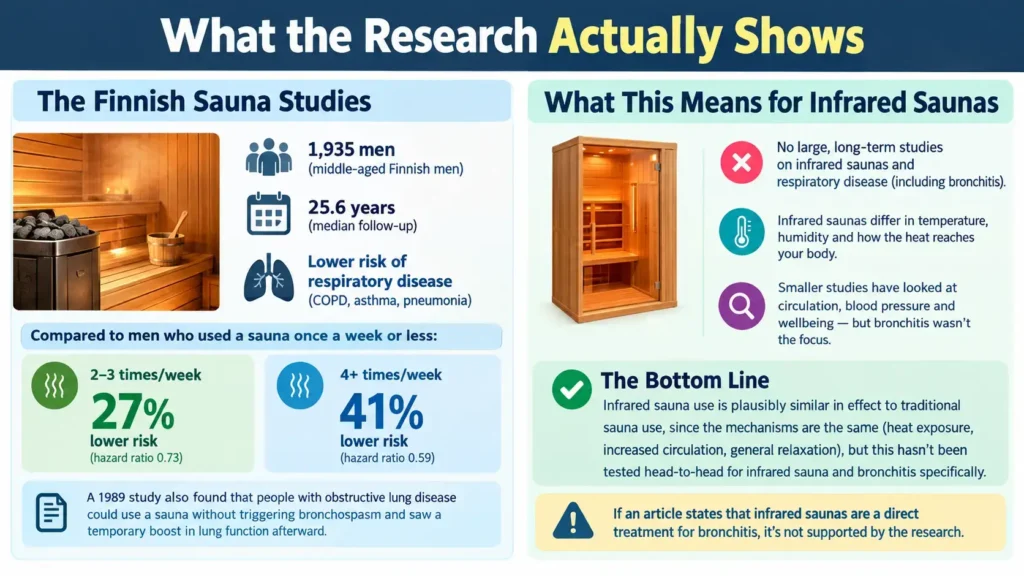
The best studies linking sauna bathing to respiratory health are from the Kuopio Ischaemic Heart Disease Risk Factor Study (KIHD), a long-term cohort study of middle-aged Finnish men. In a 2017 analysis published in the European Journal of Epidemiology, 1,935 men were followed for a median of 25.6 years and hospital-diagnosed respiratory disease was a composite of COPD, asthma, and pneumonia. Compared with men who used a sauna once a week or less, the researchers found:
- Men who used a sauna 2 to 3 times a week had roughly a 27% lower risk of developing a respiratory disease (hazard ratio 0.73).
- Men who used a sauna 4 or more times a week had roughly a 41% lower risk (hazard ratio 0.59).
A companion analysis from the same research group, published in Respiratory Medicine, found a similar pattern for pneumonia risk specifically. And going back further, a smaller 1989 study published in the Archives of Physical Medicine and Rehabilitation found that patients with obstructive lung disease could go through a sauna program without triggering bronchospasm and in fact saw a temporary bump in lung function measurements afterward.
It’s worth noting: This is association research, not evidence that sauna use directly results in improved lung health. Perhaps healthier individuals are just more likely to maintain a regular sauna practice to begin with. The researchers did make statistical adjustments for smoking, weight, alcohol consumption and physical activity, and the correlation remained despite the adjustments, but this is still an observational study, not a controlled trial of sauna as a bronchitis treatment.
What This Does and Doesn’t, Tell Us About Infrared Saunas
Here’s the catch that almost never makes it into competitor articles: every single one of the studies above used traditional Finnish saunas. None of them tested infrared units.
That gap matters, because infrared saunas differ from traditional ones in temperature, humidity, and how the heat actually reaches your body and there isn’t a large, long-term study specifically testing infrared sauna use against respiratory disease outcomes.
A handful of smaller studies have looked at infrared sauna effects on circulation, blood pressure, and general wellbeing, but bronchitis hasn’t been the focus.
The fair, evidence-based answer: infrared sauna use is plausibly similar in effect to traditional sauna use, since the mechanisms are the same (heat exposure, increased circulation, general relaxation), but this hasn’t been tested head-to-head for infrared sauna and bronchitis specifically. If an article states that infrared saunas are a direct treatment for bronchitis, based on the Finnish studies, then that’s an exaggeration.
Potential Benefits of Sauna Use for Bronchitis Symptoms
With that context locked in, here’s what sauna use can reasonably offer someone dealing with bronchitis symptoms right now:
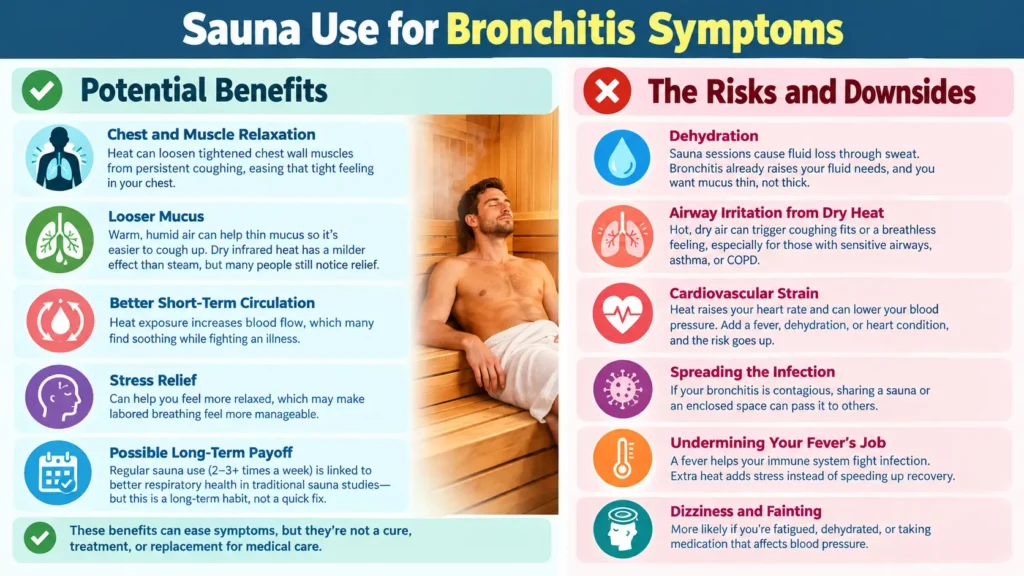
- Temporary chest and muscle relaxation. Heat can loosen up tightened chest wall muscles from persistent coughing, which may ease that squeezed, tight feeling in your chest.
- Looser mucus. Warm, humid air has long been used as a home remedy for thinning mucus so it’s easier to cough up. Dry infrared heat has a milder version of this effect than steam, but a fair number of people still notice some relief.
- Better short-term circulation. Heat exposure increases blood flow, and plenty of people find that generally soothing while fighting an illness, even though it isn’t a bronchitis-specific benefit.
- A bit of stress relief, which can make labored breathing feel more manageable even when it hasn’t actually changed your lung function.
- A possible long-term payoff if you use a sauna consistently and often, based on the traditional-sauna cohort data above though that’s a benefit tied to years of regular habit, not a single session during an active flare-up.
None of that adds up to a cure, a treatment, or a replacement for medical care. It’s worth staying skeptical of any sauna brand that implies otherwise, and it’s part of the reason asking whether an infrared sauna helps a specific respiratory condition like asthma deserves the same “yes, but” answer as bronchitis does.
The Risks and Downsides You Shouldn’t Skip
- Dehydration. Sauna sessions cause meaningful fluid loss through sweat. Bronchitis already raises your fluid needs, you want mucus thin, not thick, so dehydration works directly against you here.
- Airway irritation from dry heat. For some people, especially those with sensitive airways, asthma, or COPD, hot dry air triggers coughing fits or a breathless feeling instead of relief. It can go either way, and you won’t always know in advance which way it’ll go for you.
- Cardiovascular strain. Heat raises your heart rate and can lower your blood pressure. Stack that on top of a fever, dehydration, or an existing heart condition, and you’ve got a real risk, not a theoretical one.
- Spreading the infection. If your bronchitis comes from a contagious virus, sharing a sauna, or even just the enclosed airspace, risks passing it on to whoever’s in there with you.
- Undermining your fever’s job. A fever is part of how your immune system fights infection. Piling artificial heat on top of a fever adds physiological stress instead of speeding up your recovery.
- Dizziness and fainting, particularly if you’re already fatigued, dehydrated, or taking medication that affects blood pressure.
When You Should NOT Use a Sauna
Treat this as a stop list, not a set of gentle suggestions:
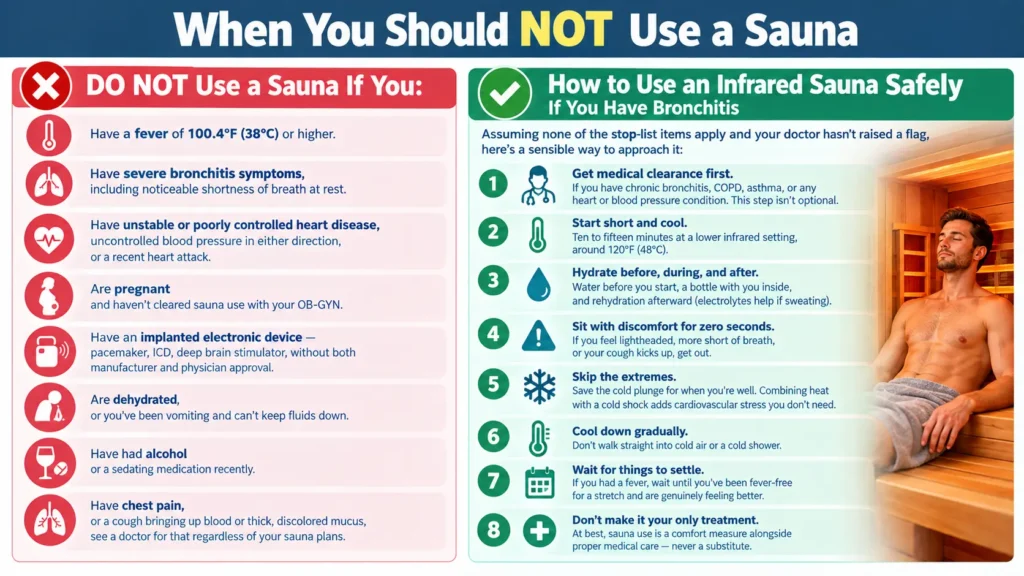
- You currently have a fever of 100.4°F (38°C) or higher
- Your bronchitis symptoms are severe, including noticeable shortness of breath at rest
- You have unstable or poorly controlled heart disease, uncontrolled blood pressure in either direction, or a recent heart attack
- You’re pregnant and haven’t cleared sauna use with your OB-GYN
- You have an implanted electronic device — pacemaker, ICD, deep brain stimulator, without both manufacturer and physician approval
- You’re dehydrated, or you’ve been vomiting and can’t keep fluids down
- You’ve had alcohol or a sedating medication recently
- You have chest pain, or a cough bringing up blood or thick, discolored mucus, see a doctor for that regardless of your sauna plans
If any of those apply to you right now, the sauna can wait. None of these are “just be a little careful” situations. They’re reasons to skip the session entirely, and if any of this sounds familiar, it’s worth reading through what actually happens when infrared sauna use goes wrong before you talk yourself into “just this once.”
How to Use an Infrared Sauna Safely If You Have Bronchitis
Assuming none of the stop-list items apply and your doctor hasn’t raised a flag, here’s a sensible way to approach it:
- Get medical clearance first if you have chronic bronchitis, COPD, asthma, or any heart or blood pressure condition. This step isn’t optional caution — it’s the difference between an informed decision and a guess.
- Start short and cool. Ten to fifteen minutes at a lower infrared setting, around 120°F (48°C), beats jumping straight into a full-length, high-heat session. If you’re unsure what counts as “long enough” versus “too long” while you’re feeling under the weather, it helps to look at general guidance on how long a session should run and then scale it down further for how you’re actually feeling.
- Hydrate before, during, and after. Water before you start, a bottle with you inside, and rehydration afterward — plain water works fine, and electrolyte drinks help if you’re sweating heavily.
- Sit with discomfort for zero seconds. If you feel lightheaded, more short of breath, or your cough kicks up, get out. This isn’t a session to push through out of stubbornness.
- Skip the extremes. Save the cold plunge for when you’re well. Combining sauna heat with a cold shock while you’re sick adds cardiovascular stress you don’t need right now.
- Cool down gradually afterward instead of walking straight into cold air or a cold shower.
- Wait for things to settle before going back to your normal sauna routine if you had a fever — most guidance points toward waiting until you’ve been fever-free for a stretch and are genuinely feeling better, not just “better enough.”
- Don’t make it your only treatment. At best, sauna use is a comfort measure alongside proper medical care — never a substitute for it, especially with chronic bronchitis or COPD in the picture.
Infrared Sauna vs. Steam Room vs. Traditional Sauna for Bronchitis
| Option | Humidity | Best for | Watch out for |
|---|---|---|---|
| Infrared sauna | Low (dry) | Lower ambient heat, general relaxation | Dry air can irritate sensitive airways |
| Traditional (Finnish) sauna | Low to moderate | Higher heat tolerance; longest research track record | Higher temperatures mean more cardiovascular demand |
| Steam room | High (wet heat) | Loosening thick mucus and congestion | Humidity plus heat can feel harder to breathe in for some with asthma/COPD |
There’s genuinely no universal winner here. Some people with heavy congestion swear by steam for loosening things up, while others with heat sensitivity do better with the milder, drier air of an infrared cabin. If you’re experimenting, pay attention to how your own body responds instead of assuming one option is objectively superior — because, honestly, the research doesn’t back a clean winner either.
Myth vs. Fact
Myth: “Sweating it out” flushes the infection out of your body. Fact: Sweat is mostly water, salt, and a small amount of waste products. It doesn’t meaningfully clear a respiratory virus or bacteria — your immune system handles that, not your sweat glands.
Myth: Infrared saunas are proven to treat bronchitis. Fact: The strongest respiratory research involves traditional saunas used consistently over years, not infrared saunas treating an active case of bronchitis. No sauna type treats bronchitis.
Myth: If a little heat helps, more heat helps more. Fact: Longer or hotter sessions ramp up dehydration and cardiovascular strain without necessarily buying you more symptom relief. Moderation does more work here than intensity.
Myth: Sauna use is risk-free because it’s “natural.” Fact: Heat exposure has real, measurable effects on your body, and specific groups — pregnant women, people with heart conditions, anyone running a fever — face genuine, documented risks.
Expert Tips for Getting the Most Benefit, Safely
Pair sauna sessions with proper hydration and rest; sauna use complements recovery, it doesn’t replace it. If your main goal is loosening mucus, a warm shower or a humidifier alongside your regular illness care might do just as much for you with less risk than a full sauna session while you’re acutely sick. If you’re using sauna bathing for its long-term respiratory association — the kind the Finnish research actually supports — consistency over months and years is what the data backs, not one session squeezed in during a flare-up.
Pay attention to how you feel during and after sessions. If sauna use consistently makes your cough or breathing worse, that’s information — stop and mention it to your doctor instead of pushing through on principle. And if you have chronic bronchitis or COPD, ask your pulmonologist directly whether sauna use has a place in your specific treatment plan. Lung function varies enough person to person that a one-size-fits-all answer just isn’t honest.
Frequently Asked Questions
Is an infrared sauna good for bronchitis?
It may offer temporary comfort for mild, non-feverish bronchitis symptoms like chest tightness, but it isn’t a treatment for bronchitis and isn’t appropriate during a fever or with severe symptoms.
Can sauna use cure bronchitis?
No. Bronchitis comes from a virus, bacteria, or long-term irritation (in the case of chronic bronchitis), and no sauna type addresses the underlying cause. Sauna use, at most, eases some symptoms temporarily.
Is it safe to use a sauna with a fever from bronchitis?
No. A fever means your body’s already working hard to fight off infection. Adding external heat on top of that increases cardiovascular strain and isn’t recommended until the fever breaks.
Can children with bronchitis use an infrared sauna?
This is a conversation for a pediatrician first. General sauna safety guidance already calls for close supervision and shorter sessions with kids, and an active respiratory illness adds one more layer of caution on top of that.
Does sweating help clear mucus from the lungs?
Not directly. Warm, humid air can help loosen mucus in the upper airways, but sweating itself doesn’t clear mucus sitting in your lungs.
Can infrared sauna use make bronchitis worse?
Yes, in some cases. Dry heat can irritate sensitive airways, dehydration can thicken mucus, and heat strain can worsen symptoms for anyone with underlying heart or lung conditions.
Can I use a sauna if I have chronic bronchitis or COPD?
Possibly, with medical clearance. Some traditional-sauna research suggests long-term respiratory benefits, but COPD affects everyone differently, which is exactly why a pulmonologist’s input matters here.
Should I combine a sauna session with cold exposure if I have bronchitis?
No. Skip contrast therapy — sauna followed by a cold plunge or cold shower — while you’re dealing with an active respiratory illness. That rapid temperature swing adds cardiovascular stress you don’t need right now.
When can I go back to my normal sauna routine after bronchitis?
Most safety guidance suggests waiting until your fever has resolved and you’re genuinely feeling better, then easing back in with shorter, cooler sessions before returning to your usual routine.
Is it better to use a humidifier or a sauna for bronchitis congestion?
A humidifier gives you more sustained, lower-risk humidity for congestion relief, without the dehydration or cardiovascular load that comes with a full sauna session. It’s a reasonable first choice while congestion is active.
How long should I stay in an infrared sauna if I have bronchitis symptoms?
Ten to fifteen minutes at a lower setting is a reasonable, cautious starting point. Going longer than that raises your dehydration risk right when your body’s already fighting an illness.
Final Thoughts
The honest answer to “is an infrared sauna good for bronchitis” was never going to be a flat yes or no, it’s “sometimes, cautiously, and not as a treatment.” Mild, non-feverish bronchitis symptoms might feel a little better after a short, moderate sauna session, mostly thanks to muscle relaxation and loosened mucus.
But the strongest research tying sauna use to fewer respiratory diseases comes from people using traditional saunas consistently over years, not from one infrared session squeezed in during an active illness. That distinction gets lost in nearly every other article on this topic, and it’s the one thing worth remembering after you close this tab.
If you’ve got a fever, severe symptoms, a heart condition, or you’re pregnant, the sauna can wait, it’s not going anywhere. If your bronchitis is chronic or tied to COPD, bring your doctor into the conversation before sauna use becomes part of your routine.
And whichever category you fall into, treat a sauna session as a comfort measure at best, never a substitute for rest, hydration, and the medical care your body actually needs right now.