Trying to know which is better far or near infrared sauna for your home wellness routine can be like going through a maze of conflicting scientific terms and marketing jargon. You aren’t alone in this.
With the growing popularity of heat therapy, everyone from biohackers to individuals suffering from chronic pain are asking the question.
The brief answer is: It depends on what your health goals are. Far Infrared (FIR) is better for deep sweating, detoxification and cardiovascular health, and mimics a traditional sauna experience, however at lower temperatures.
Near Infrared (NIR), however, penetrates to a greater depth into the tissue to promote cellular repair, skin health and wound healing but doesn’t cause as much sweat.


Paid Links - As an Amazon Associate, I earn from qualifying purchases.
In this depth guide, we will Discover which is better far or near infrared sauna. Explore benefits, risks, full spectrum options, and expert tips to choose the right sauna for detox, pain relief, and skin health.
And Also help you determine which is right for you far or near infrared sauna so you can make the best investment for your body.



Paid Links - As an Amazon Associate, I earn from qualifying purchases.
Disclaimer: The information provided in this article is for educational and informational purposes only and is not intended as a substitute for professional medical advice. Always consult with a qualified healthcare provider before starting any new health regimen or therapy.
Key Takeaways
- Wavelength Matters: Near Infrared (NIR) uses shorter wavelengths (700nm–1400nm) for skin and cellular health, while Far Infrared (FIR) uses longer wavelengths (3000nm–1mm) for deep heat and detox.
- Primary Benefit: Choose FIR for relaxation and heavy sweating; choose NIR for skin rejuvenation and pain management.
- Safety Check: Always look for Low EMF or Ultra Low EMF ratings, especially when building or buying a unit.
- Full Spectrum: If you can’t decide, full spectrum infrared saunas offer the best of both worlds by combining NIR, Mid, and FIR wavelengths.
Understanding the Spectrum: What is the Difference?
To understand the debate, we first have to take a look at the physics. Infrared light comes under the electromagnetic spectrum. It is not visible to human eyes, but is felt as heat.
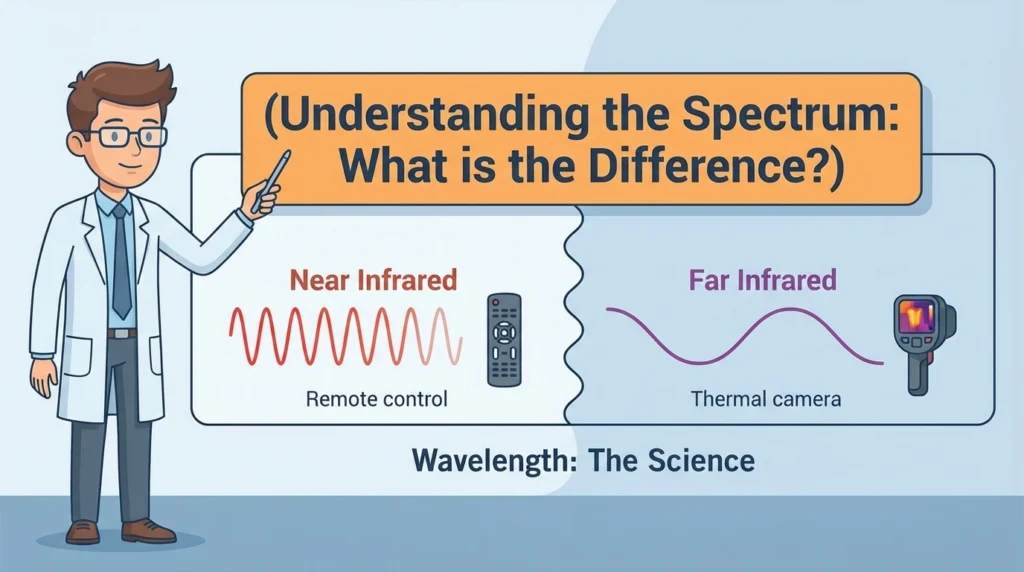
Near vs Far Infrared Wavelength: The Science
The basic difference is in the near vs far infrared wavelength.
- Near Infrared (NIR): These wavelengths range from about 700 nanometer to 1400 nanometer. They are closest to the visible light on the spectrum. Because they are shorter, they do not heat up the air around you as much-as much-and rather they penetrate deeply into the tissues of the body.
- Far Infrared (FIR): These wavelengths are between 3,000 nanometers and 1 millimeter. They are “far” from the visible light. These longer wavelengths oscillate at a frequency that interacts strongly with the water molecules in your body to produce an intense heating effect that triggers a heavy sweat.
What is a Near Infrared Sauna?
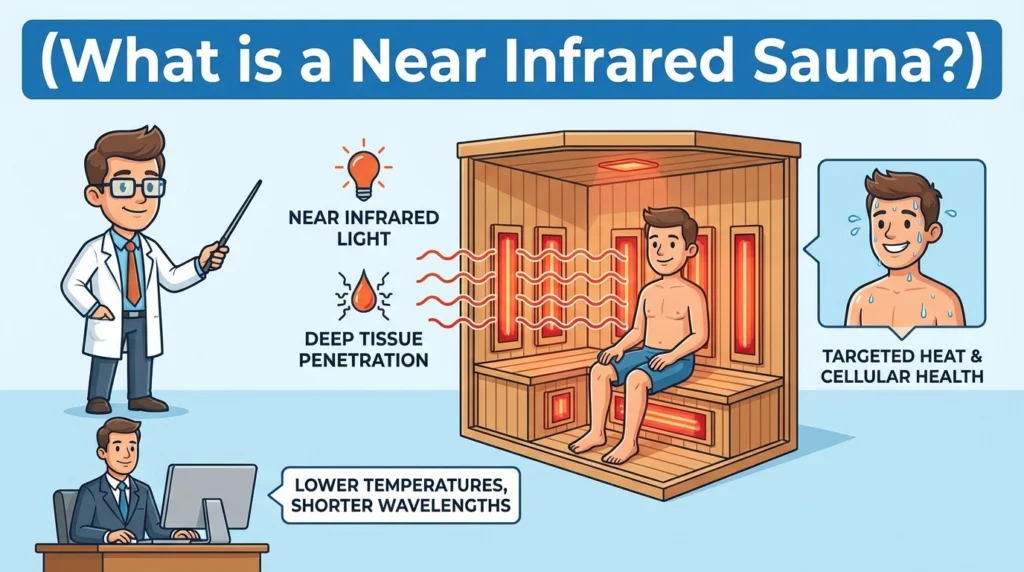
When people ask, “what is a near infrared sauna“, what they are often asking about is a specific type of heat therapy that often uses incandescent bulbs or specialized LED panels.



Paid Links - As an Amazon Associate, I earn from qualifying purchases.
Unlike traditional saunas that heat the air, a NIR sauna is focused on light therapy. The heat is direct – you feel it closest where the light strikes your skin. This is why NIR saunas are frequently smaller, occasionally only being a reflecting dome or comprising a set of red lights.
Near Infrared Sauna Benefits
The benefits of NIR are unique from FIR due to the interaction of the light with your cells.
- Cellular Regeneration: NIR light activates the mitochondria in your cells (powerhouse of the cell) to create more ATP (Adenosine Triphosphate energy): This is why near and far infrared light therapy is often used when trying to recover.
- Skin Health: NIR is widely used in dermatology. It can help to increase collagen production, minimize wrinkles, and treat acne or scarring.
- Wound Healing: Since it stimulates the energy of cells, it accelerates wound healing.
Near Infrared Sauna Dangers: What You Need To Know
While relatively safe, there are some specific considerations of the dangers of using near infrared saunas. Since the NIR is commonly done using bright incandescent bulbs, eye protection is important.
Staring directly at high intensity NIR bulbs can destroy the retina. Additionally, because the heat is concentrated it is easier to accidentally burn yourself should you get too close to the source.
What is a Far Infrared Sauna?
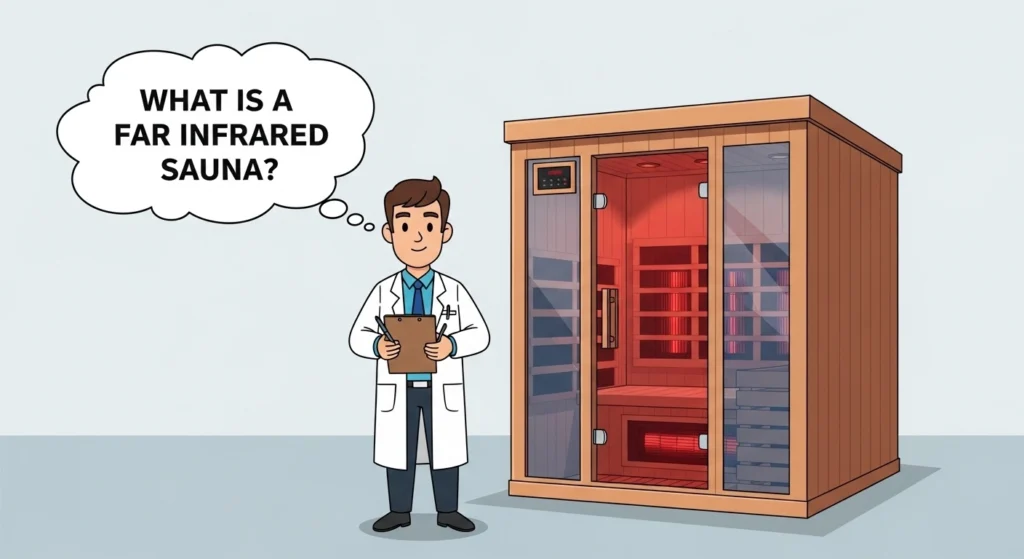
If you step into a wooden cabin at a spa you are likely to be using a Far Infrared sauna. What is a far infrared sauna? It is an enclosed cabin with ceramic (or carbon) heaters that emit FIR waves.
What does far infrared sauna mean for the user experience? It means a “wet heat” sensation, though you may not be pouring water on rocks.
The FIR waves resonate with the water in your body and make you sweat a lot at lower temperatures (typically between 120 degrees F and 140 degrees F) compared to traditional steam saunas.
How Does a Far Infrared Sauna Work?
How does a far infrared sauna actually work? The heaters release radiant heat and this is absorbed by the body’s surface. Instead of heating the air to suffocating temperatures the energy is transferred directly to the body.
This process is known as what is far infrared sauna therapy and increases your internal body temperature, setting up an artificial fever state, which improves the immune system and ramps up cardiovascular circulation.
What are the Benefits of Far Infrared Sauna?
When researching what are the benefits of far infrared sauna, three main pillars stand out:
- Detoxification: The deep sweat is widely believed to help remove heavy metals and toxins such as mercury and lead, though there is still a developing scientific consensus on the extent of the heavy metal detox by the sweat of the body.
- Cardiovascular Health: This maintenance and frequent use can lower blood pressure and get the heart rate in a better condition, serving as a slight cardio exercise.
- Relaxation: The heat promotes the release of cortisol hormones that helps to alleviate stress and promote a better sleep.
Near vs Far Infrared Sauna Benefits: Head to Head
If you are seeking near vs far infrared sauna benefits to make a decision of use, look at your primary objectives for your health.
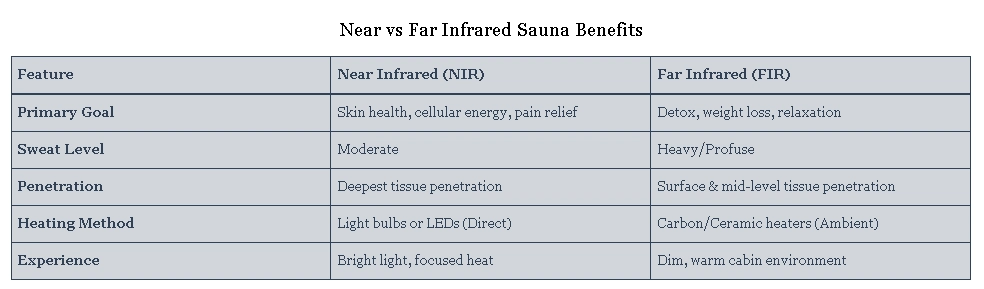
Near vs Far Infrared Sauna Benefits
| Feature | Near Infrared (NIR) | Far Infrared (FIR) |
|---|---|---|
| Primary Goal | Skin health, cellular energy, pain relief | Detox, weight loss, relaxation |
| Sweat Level | Moderate | Heavy/Profuse |
| Penetration | Deepest tissue penetration | Surface & mid-level tissue penetration |
| Heating Method | Light bulbs or LEDs (Direct) | Carbon/Ceramic heaters (Ambient) |
| Experience | Bright light, focused heat | Dim, warm cabin environment |
Near Infrared vs Far Infrared For Cancer
This is an issue that is sensitive and heavily researched. When looking for the near infrared vs far infrared for cancer, it is important to distinguish fact from fiction.
Current research indicates that hyperthermia (raising the body temperature) can be a supportive therapy to cancer treatment since often cancer cells are more sensitive to the heat than normal cells. FIR saunas are great for delivering whole body hyperthermia.
Conversely, NIR is being researched for Photobiomodulation (PBM) which uses light to create stimulation of cellular function. Some research indicates that PBM may assist in the management of side effects of chemotherapy.
However, neither sauna can be considered as a solution for cancer alone. Always seek the advice of an oncologist before use.
EMF Safety: What Is Low EMF and Ultra Low EMF
One of the largest concerns that buyers have is Electromagnetic Fields (EMF). When you are asking what is emf far infrared sauna, you are probably concerned with the invisible radiation emitted by electrical devices.
- What is low Emf far infrared Sauna? This normally means that the sauna has been tested to make sure the EMF levels are below 10 milligauss (mG) at the point of contact.
- What is Ultra low emf far infrared sauna? These units are also designed to produce even less, typically less than 3-5 mG and are virtually non-detectable.
NIR saunas using LED panels generally have negligible Emf. However, older NIR lamps or poorly wired FIR saunas may give off large levels. When purchasing it is always good to check the third party of the brand to see their EMF testing.
How To Build Your Own Near infrared Sauna
Many DIY enthusiasts search the internet for the question of how to build near infrared sauna plans as NIR saunas are mechanically simpler. You do not need a wooden cabin, you just need a space for the lamps.
Steps:
- Buy 4-6 250Watt red incandescent heat bulbs.
- Construct a reflective shield or place them on a board.
- Be sure to make the wiring safe (consult an electrician if you are not sure).
- Set-up a chair and move your body in the session.
If you are looking for a near infrared sauna onhow to make near infrared sauna setups safe, make sure to use GFCI (Ground Fault Circuit Interrupter) Outlets so that you avoid a shock.
How to Use a Far Infrared Sauna
Knowing how to use a far infrared sauna is very important in getting the most benefits.
- Hydrate: Drink 8-16 oz of water before you go in.
- Pre-heat: Switch on 10-15 minutes early.
- Session: Sit for 20-45 minutes.
- Cool Down: Allow your body to cool down naturally, and shower.
Far infrared sauna how often to use it, it depends on your tolerance. For beginners an exercise of 2-3 times a week is ideal. Enthusiasts may use it daily. As far as how long to stay in Far infrared sauna, however, aim for 25 minutes and work your way up.
Which Is Right For You: Far or Near Infrared Sauna?
If you look around which is right for you far or near infrared sauna reddit threads, you will notice a common theme which is to say that users have a strong preference based on their lifestyle.
- Choose Near Infrared if: You would like the option of a portable, budget friendly model; you are concerned with skin problems (acne, aging); you would like to build your own unit; you would like to enjoy a quieter environment (no fans need to be used).
- Choose Far Infrared if: You love the “spa” experience; your objective is deep relaxation and intense perspiration; you want to replicate the traditional Finnish experience; or you have space for a dedicated wooden cabin.
The Full Spectrum Infrared Sauna Solution
If you are still torn to milk, then the full spectrum infrared sauna is the modern answer. These units have heaters that emit Near, Mid and Far infrared wavelengths simultaneously.
This is so that you get the cellular benefits of NIR combined with the detoxifying sweat of FIR. While more expensive, they do away with choosing.
You May Also Like To Read:
FAQs
What is near infrared sauna therapy good for?
Near infrared sauna therapy is mainly good for skin rejuvenation, wound healing and cellular energy making. It stimulates collagen production and can aid in lessening inflammation in certain parts of the body.
Can I take a far infrared sauna daily?
Yes, you can use a far infrared sauna daily, as long as you keep hydrated and follow your body. Most experts recommend doing 2-3 sessions a week to begin with and work your way up to doing daily sessions for 20-30 minutes.
Why are far infrared Saunas superior to traditional steam saunas?
Why use a far infrared sauna? It has a lower temperature (120-150 degrees Fahrenheit) than steam saunas (180-200 degrees Fahrenheit) and is therefore more tolerable for people who cannot tolerate extreme heat. It also encourages deeper and more profuse perspiration at these lower temperatures.
Is near infrared safe for eyes?
The direct exposure to high intensity near infrared bulbs can be harmful to the eyes. It is highly recommended to wear protective goggles or close the eyes and keep them from directly looking at the bulbs during a session.
How to use far infrared sauna for weight loss How often to use sauna of far infrared?
For weight loss, far infrared sauna 3-4 times a week can help to increase metabolism. While this immediate weight loss is water weight the increased heart rate mimics cardio which can aid in burning calories over time.
Final Thoughts so which is better far or near infrared sauna
The debate on which is better far or near infrared sauna is not about one technology beating the other, it is about matching the tool to your unique health goals.
If one of your main objectives is to relax after a stressful day, to rid your body of toxins by rendering it in a good sweat and for your cardiovascular health, then you are better off investing in a Far Infrared sauna. It provides that traditional “spa” experience that promotes deep relaxation and systemic detoxification.
On the other hand, if you are interested in skin rejuvenation, or speeding up injury recovery, or boosting cellular energy, Near Infrared technology has unique therapeutic benefits that FIR simply cannot match. Its ability to go deeper into the tissue makes it a powerhouse at targeted healing.
For people who want the ultimate in their health, a full spectrum infrared sauna eliminates the need to compromise and provides the full spectrum of benefits in one session.
After all, the “better” sauna is the one that works seamlessly in your routine. The secret sauce of sauna therapy is consistency. Whether you opt for the soft ambient heat of Far Infrared or the focused and healing light of Near Infrared, the most important step is just to step inside. Choose the technology that resonates to your body’s needs, and enjoy the journey towards better health.