Infrared sauna for muscle recovery uses far-infrared heat to gently raise your core temperature, increase circulation and promote muscle relaxation after exercise.
Unlike traditional saunas that heat the air, infrared saunas heat the body directly, which may assist in reducing muscle soreness, support circulation and improve recovery time when used properly.
Many athletes and fitness enthusiasts perform infrared sessions after a workout to relieve stiffness, inflammation, and improve overall recovery.
Disclaimer: Medical Disclaimer The information contained in this article is for educational and informational purposes only and is not intended as a substitute for professional medical advice, diagnosis or treatment. Always consult with your physician or other qualified health provider with any questions that you may have regarding a medical condition or health objectives.


Paid Links - As an Amazon Associate, I earn from qualifying purchases.
Key Takeaways
- Deep Penetration: Unlike traditional saunas, infrared heat penetrates deep into the muscles promoting cellular repair and increased circulation where it is needed most.
- Reduced DOMS: Regular use can significantly reduce Delayed Onset Muscle Soreness (DOMS), which means you can train harder and more often.
- Growth Hormone Boost: Studies have shown that heat therapy can help to boost the release of Human Growth Hormone (HGH), which can help to promote muscle growth and recovery.
- Optimal Timing: For optimal results, wait 15-20 minutes after exercise before going in the sauna to let your heart rate settle a bit.
- Duration Matters: A session of 15 to 30 minutes, 3 to 4 times a week, is generally thought to be the sweet spot for infrared sauna for muscle recovery.
Understanding Infrared Saunas: How it Works for Athletes
In order to understand just how an infrared sauna can help in muscle recovery, first we have to understand what makes it unique. When you walk into a gym or a spa, you may see two options, a traditional steam room or sauna, or an infrared sauna.
While traditional saunas heat up the air around you (to temperatures of 180°F+), infrared saunas use light waves to heat up your body directly. Think of it like the sun on a cold day – you feel the heat on your skin even if the air is cold.



Paid Links - As an Amazon Associate, I earn from qualifying purchases.
This direct heat is absorbed into your body for roughly 1.5 inches, which increases the internal temperature and causes you to work up a deep, detoxifying sweat at much lower ambient temperatures (typically between 120°F and 140°F).
This makes the experience much more tolerable for many athletes and you will be able to stay in longer to reap the rewards of extended heat exposure.
Science Behind Infrared Sauna to Muscle Recovery Benefits
Is infrared sauna good for muscle recovery? Science says yes. Let’s break down exactly what happens to your physiology when you sit in that warm wooden box.

1. Increased Blood Circulation and Oxygenation
One of the biggest benefits of infrared sauna to muscle recovery is the dramatic increase in blood flow. The heat causes vasodilation (widening of blood vessels) which helps improves circulation.



Paid Links - As an Amazon Associate, I earn from qualifying purchases.
This means that the oxygen-rich blood is shuttled more efficiently to the damaged muscle tissues, bringing in the materials needed to repair the tissues, all while flushing out the metabolic waste.
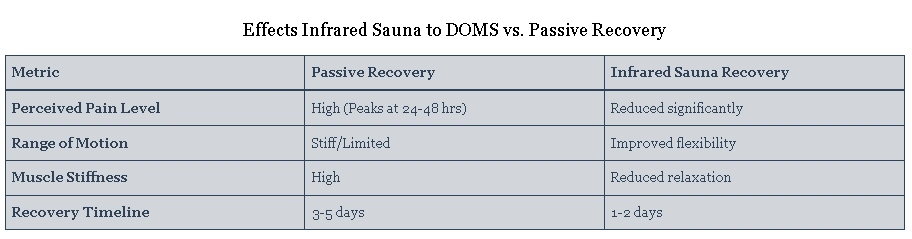
2. Does Infrared Sauna Help Muscular Pain and DOMS?
We have all been there with that stiff achy feeling 24 to 48 hours after a heavy leg day – Delayed Onset Muscle Soreness (DOMS).
Effects Infrared Sauna to DOMS vs. Passive Recovery
| Metric | Passive Recovery | Infrared Sauna Recovery |
|---|---|---|
| Perceived Pain Level | High (Peaks at 24-48 hrs) | Reduced significantly |
| Range of Motion | Stiff/Limited | Improved flexibility |
| Muscle Stiffness | High | Reduced relaxation |
| Recovery Timeline | 3-5 days | 1-2 days |
Using a sauna for muscle soreness helps relax tight muscle fibers, acting almost like a deep tissue massage from the inside out. This leads to improved range of motion and less pain during your next workout.
3. Infrared Sauna and Lactic Acid Elimination
While you exercise hard, your body will produce lactic acid which is part of that burning feeling. While the body is good at clearing up the buildup of lactic acid, increased circulation allows the process to take place more quickly.
An infrared sauna acts like a catalyst, in a sense, and assists you in metabolizing waste products much faster than you would by just sitting.
4. Sauna; is it Good for Muscle Growth?
Here is where things get interesting for bodybuilders. While sitting a sauna isn’t going to be the same as lifting weights it creates an environment of “heat stress”.
Studies have shown that heat shock proteins (HSPs) are released as a result of sauna use. These proteins help repair damaged proteins in your muscles which also helps protect against future damage.
Furthermore, heat exposure has been found to be associated with a spike in Human Growth Hormone (HGH). Elevated HGH levels are crucial for muscle repair speed and hypertrophy.
So, if you are checking into infrared sauna for bodybuilding recovery then this boost to your hormones is a big plus.
Infrared vs Traditional Sauna for Muscle Recovery
This is a popular debate in the fitness community. While they both have benefits, the mechanism of action is different.
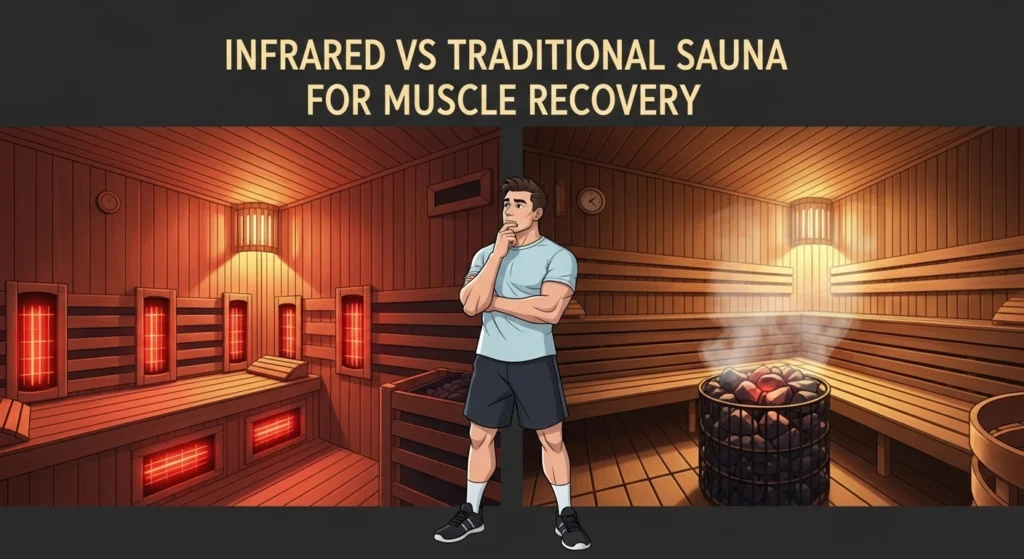
- Traditional Sauna: High heat – high humidity (if a steam room). Great for mental relaxation and cardiovascular conditioning however the intense heat can be exhausting right after a workout.
- Infrared Sauna: Lower heat, deeper penetration. Better for targeted muscle healing, longer sessions
Many athletes find infrared saunas to be better for recovery as the lower ambient temperature means a longer amount of time is possible, maximising the benefits of increased blood flow without causing excessive dehydration or even heat exhaustion.
Infrared Sauna vs. Ice Bath Recovery
You need to heat it up or freeze it out? Both have their placement in the recovery routine of a gym.

- Ice Baths (Cryotherapy): Best for acute inflammations and immediate pain relief. They constrict the blood vessels so that swelling is reduced. However, there are some studies which suggest that icing too frequently may retard the muscle building signal (hypertrophy).
- Infrared Sauna (Thermotherapy): Best for relaxation, blood flow and long term tissue repair. It stimulates the inflammatory response required to have the muscles adapt, instead of suppressing it.
Verdict: If you are injured or have severe swelling, ice first. If you are looking more for general support in recovery and muscle growth, then the infrared sauna is the better choice.
How to Use an Infrared Sauna to Recover Muscles: Best Practices
It is just as important to know how to use sauna for recovery as it is to do it. Here is a step by step guide to achieving the best session optimization.

1. How Long to Sit in Infrared Sauna Gym After Exercise?
You might be tempted to jump right in after your last rep but patience is the key.
- Cool Down First: The first thing you should do after your workout is to wait 15-20 minutes. Let your heart rate subside to semi normal.
- Duration: 15 to 20 minutes should be your aim if you are a beginner. The experienced can stretch this to 30 minutes.
- Frequency: For infrared sauna recovery frequency per week, 3 to 4 is standard for athletes.
2. Infrared Sauna temp for muscle recovery
Set the temperature from 120 degrees Fahrenheit to 130 degrees Fahrenheit. This range is hot enough to make you start to sweat but it is cool enough to give your body the opportunity to regulate its temperature without having to work too hard. You don’t need to crank it to 150oF+.
3. Hydration is Non-Negotiable
You will sweat—a lot. Weigh yourself before and after your session. Drink that much water back, as well as electrolytes. Dehydration will ruin your gains from training.
Specific Protocols for Athletes
Infrared Sauna for Recovery of Runner
Runners put an immense repetitive strain on their legs. The deep heat helps the loosen hamstrings, quads, and calves which helps reduce the risk of injury. Focus on stretching lightly in the sauna while the heat is radiating in order to get the maximum flexibility gains.
Infrared Sauna to Body Building Recovery
So the objective for bodybuilders is maximum muscle repair. Use the sauna on rest days or after training. Consider adding in compression therapy / foam rolling after for flushing out any metabolic waste that remains.
Choosing the Best Infrared Sauna for Muscle Recovery
If you are searching “sauna recovery near me” you may be able to find some local gyms or wellness centers that offer these services. However, in order to have consistent results, having a unit at home is ideal.
Cabin vs. Blanket
- Infrared Sauna Blanket for Muscle Recovery: These are cost-effective and are less space consuming. They go around you like a sleeping bag. They are very effective in heat and are great for home use where the space is limited.
- Cabin Saunas: These are the wooden things that you walk into. They offer a better experience for users who do not suffer from claustrophobia, and often offer better full-body coverage.
When looking for the best infrared sauna for muscle recovery look for models that have low EMF (Electromagnetic Field) ratings as well as full-spectrum infrared (Near, Mid and Far) capabilities for complete therapy.
Safety and Risks
While the benefits are immense, safety is first.
- Avoid Alcohol: Never mix alcohol and sauna.
- Listen to Your Body: If you feel dizzy, feeling nauseous or lightheaded get out immediately.
- Medical Conditions: If one has heart conditions, low blood pressure or is pregnant, consult a doctor before use.
You May Also Like To Read:
FAQs
Is steam room good for muscles recovery?
Yes, steam rooms are beneficial to muscle recovery but they are mainly through hydration of the skin and loosening of mucus. However, infrared saunas penetrate deeper into the muscle tissue making them generally superior for deep tissue repair and circulation improvement compared the superficial heat of a steam room.
How long in infrared sauna for muscle recovery.
For best results, try to do a session that lasts from 20 to 30 minutes. This length of time is long enough to increase the core body temperature and to trigger the deep sweating needed to produce therapeutic effects without taxing the body’s hydration levels.
Does infrared sauna help to reduce muscle inflammation?
Yes. The deep heat stimulates the blood flow and the activation of heat shock proteins involved in lowering oxidative stress and inflammation of muscle tissues. This is why it is effective for conditions such as arthritis as well as sports injuries.
Is infrared sauna good after workout?
Absolutely. Using an infrared sauna after a workout helps to shift the body from a state of high stress to one of relaxation, which helps the parasympathetic nervous system. Just remember to hydrate well and wait a few minutes to normalize your heart rate and go in.
Does infrared sauna aid in muscle pain?
Yes, it is highly effective. Many users report instant relief from muscle spasms and cramps. The heat has a natural analgesic effect, which interferes with the pain signal and loosens the fiber of the muscle.
How often should I go to an infrared sauna for recovery?
Most experts recommend that 3 to 4 times a week. This frequency is the one that enables constant hormonal benefits and better circulation without having to place undue stress on hydration and electrolyte levels in the body.
Final Thoughts
Wrapping up, it is evident that incorporating an infrared sauna for muscle recovery is not merely a trend of the privileged class, but rather a scientifically supported approach to take your athletic performance to the next level.
Whether you are the person dealing with the nagging pain of DOMS, looking to flush out the lactic acid, or just looking for a tranquil space to decompress after a heavy lift, the penetrating heat has a unique advantage over traditional methods.
However, keep in mind that the sauna is a tool to help you do the hard work, not to replace it. No amount of heat can replace good sleep, nutrition and hydration.
But when combined with a good foundation in fitness, an infrared sauna can be the secret weapon to help you to get back to training quicker, harder and more consistently.
If you have been on the fence about trying one, let this be your sign to book a session or invest in a unit for your home – your muscles will thank you for it.