If you’re wondering ‘What Type of Infrared Sauna Is Best?’ it depends on what your aim is – detox, pain relief, weight loss or relaxation.
In general, full spectrum infrared saunas are the most versatile as they provide a combination of near, mid level and far infrared wavelengths: the benefits of deep tissue heating as well as surface-level benefits.
For home use, the best choices will often be a tradeoff between low EMF, high-quality heaters (carbon or ceramic) and room size, with 2-person models being ideal for couples or small families.
Disclaimer: This article is for informational purposes only and is not medical advice. The statements made with regard to health benefits have not been evaluated by the Food and Drug Administration. Infrared saunas are not designed to diagnose, treat, cure or prevent any disease. Always consult with a qualified healthcare professional before beginning any new wellness routine, especially if you are pregnant, have a medical condition, or are taking medication. We may earn a commission when you buy products through links in this article.


Paid Links - As an Amazon Associate, I earn from qualifying purchases.
Key Takeaways
- Best overall: Full spectrum infrared sauna (near + mid + far infrared)
- Best for use at home: Low EMF, high quality materials and a heater that will fit your goals
- Best for inflammation & recovery: Near + far infrared combination
- Best for deep heat: Far infrared Saunas
- Best for Skin & Light Therapy: Red light/Near Infrared Saunas
- Best for couples: 2 person infrared sauna
- Best portable option: Infrared sauna blanket
- Best heater type: Carbon or ceramic heaters (depends on preference of heat)
What Is an Infrared Sauna?
Infrared saunas use infrared heaters to emit light that penetrates the skin to warm your body directly instead of heating the air like a traditional sauna. This makes it an ideal way to have a deep and relaxing sweat without the extreme temperatures of a traditional sauna.
The major types of infrared wavelengths are:
- Near Infrared (NIR) – Penetrates skin surface; often used for skin and light therapy
- Mid Infrared (MIR) – Deeper tissue penetration; for pain relief and muscle recovery
- Far Infrared (FIR) – Penetrates deeply, best for Detox and circulation
Understanding the Spectrum: The Basis of Your Choice
Before delving into the specifics of the products, it is important to gain an understanding of the technology. In order to know what type of infrared sauna is best for you, you first have to understand the wavelengths.



Paid Links - As an Amazon Associate, I earn from qualifying purchases.
What is Far Infrared Sauna?
Far Infrared (FIR) is the most common type that is seen in home units. These wavelengths (measured in microns) are the longest, and penetrate deep into the body to directly heat you, rather than heat the air itself. This produces a deep, detoxifying sweat at lower ambient temperatures (typically between 120°F – 140°F), making it easier to breathe than in traditional steam saunas.
What is Near Infrared Sauna?
Near Infrared (NIR) wavelengths are the shortest ones. They don’t get as deep as FIR but are excellent for skin health, wound healing and cellular regeneration. This is also why the best infrared sauna with red light therapy will come with NIR capabilities.
What is Full Spectrum Infrared Sauna?
A full spectrum infrared sauna is a combination of Near, Mid and Far infrared technologies. Mid-infrared penetrates to a deeper level than near infrared and is great for circulation and muscle relaxation. By combining all three you get a holistic therapy session. When looking forthe best full spectrum infrared sauna, you will want to find units that will let you customize the intensity of each wavelength.
The 12 Best Options Explained
When deciding what type of infrared sauna is best, one size is very rarely going to fit all. On the following pages, we dig deep into the 12 different configurations offered by the market today. This is such a detailed breakdown that you will be able to weigh the pros and cons of each and the ideal use cases for each so that you can find a perfect match for your wellness journey.

Paid Links - As an Amazon Associate, I earn from qualifying purchases.
1. The Full Spectrum Infrared Sauna
Often considered the “Gold Standard,” a full spectrum infrared sauna uses the full spectrum of infrared: Near (NIR), Mid (MIR) and Far (FIR).
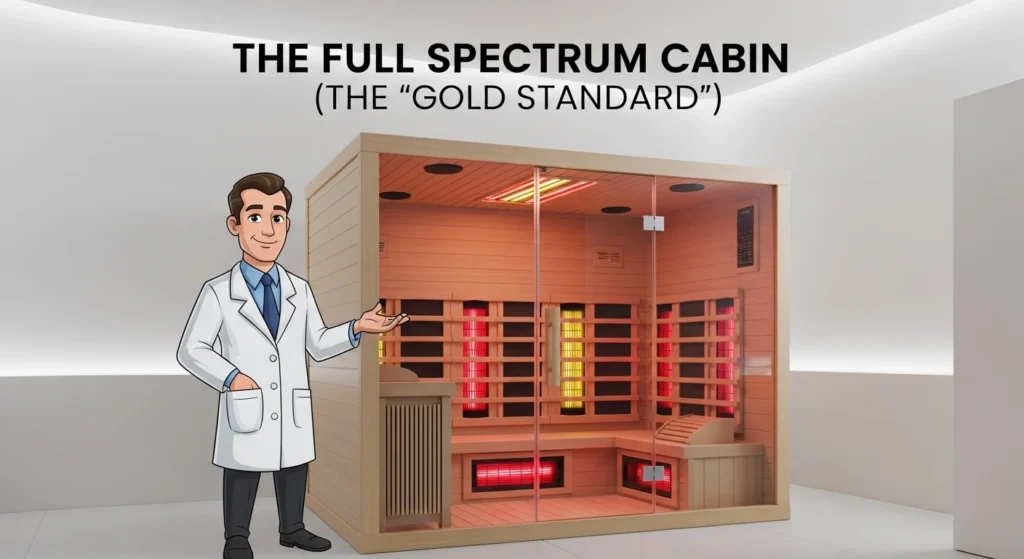
- How It Works: Instead of simply heating your body so that you sweat, this technology employs various layers of different wavelengths. Near infrared for rejuvenation of the skin surface, mid infrared for deeper muscles for circulation and far infrared for the deepest for detoxification.
- Why It’s A Top Contender: When asking what type of sauna is best for health, full spectrum takes the cake because it allows for targeted therapy. Some high end models allow you to switch off specific heaters to focus on skin health (NIR) or deep detox (FIR).
- Ideal For: The wellness enthusiast looking for a complete tool that targets the issues of anti-aging, pain relief, and detox in one unit.
2. The Ultra Low EMF Far Infrared Sauna
Safety is the top selling point here. What is ultra low EMF Far infrared sauna technology? It refers to the units that are engineered to emit extremely low levels of Electromagnetic Fields (usually below 3 milliGauss).
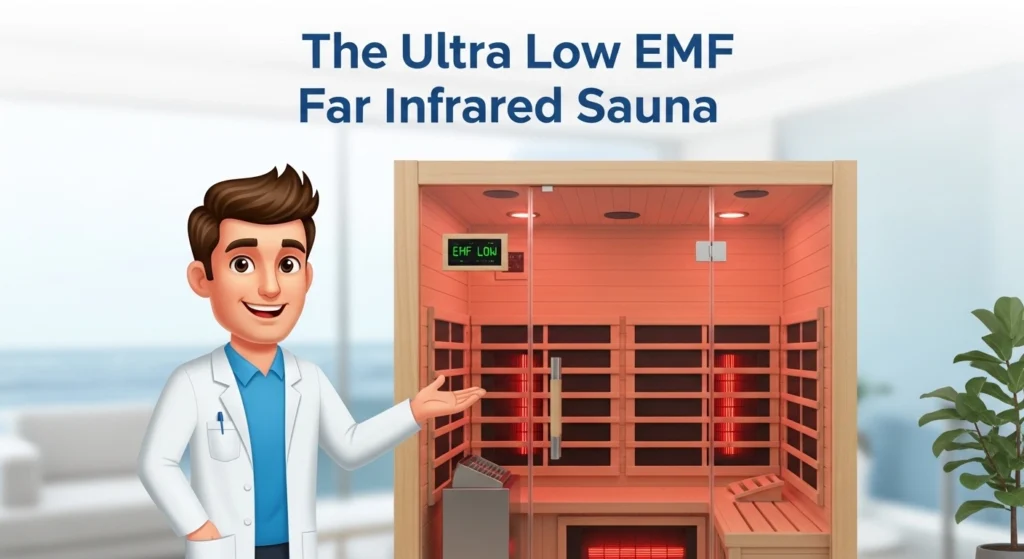
- The Tech: Manufacturers do this by using steel conduit wiring to shield the electromagnetic field or by using proprietary heater designs that neutralize EMF before it leaves the panel.
- Why It Matters: While standard saunas are generally safe, those who suffer from electro-hypersensitivity or those who want to minimize cumulative exposure prefer this option. If you are wondering what to look for when purchasing an infrared sauna for a family, safety certifications and actual EMF readings (verified by a Gauss meter) are very important.
- Ideal For: Health-conscious users who intend to do daily, long-duration sessions (30-60 minutes).
3. The Carbon Heater Sauna
In the debate of carbon vs ceramic infrared sauna technology carbon is the modern favourite.
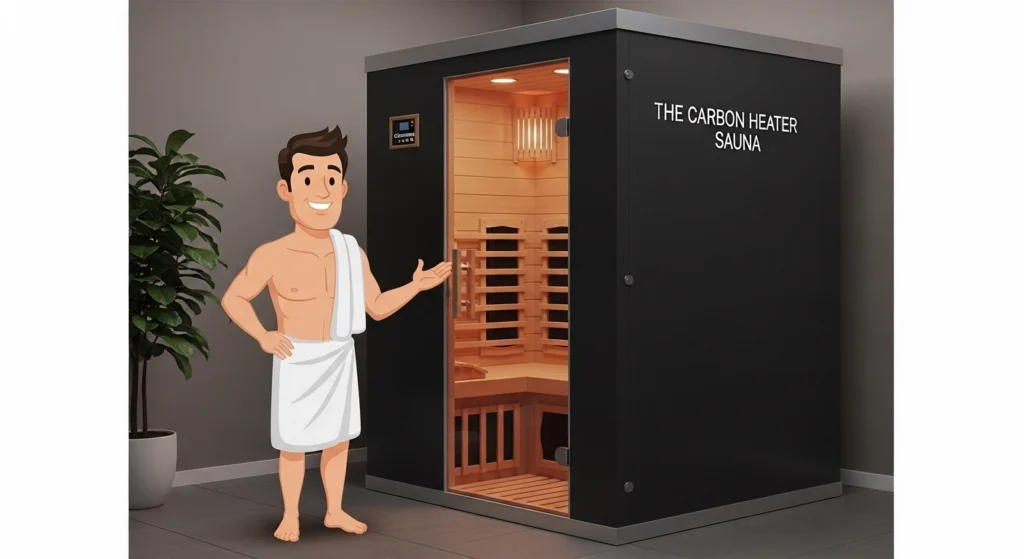
- The Science: Carbon heaters take the shape of flexible panels covering a large surface area. And because the heat is distributed over a large surface (usually the whole back wall of the bench or bench) the surface temperature doesn’t need to get dangerously hot to heat your body. This produces a soft and enveloping heat which is like the feeling of the sun on a spring day.
- Key Benefit: The even distribution of eliminates “cold spots” in the sauna. You will not find yourself turning around all the time to warm your back.
- Ideal For: People who want to have a comfortable relaxing experience without the intense radiating heat hitting them from one spot.
4. The Ceramic Heater Sauna
This is the traditional infrared technology. Ceramic heaters are typically in the form of rods or in tubes.
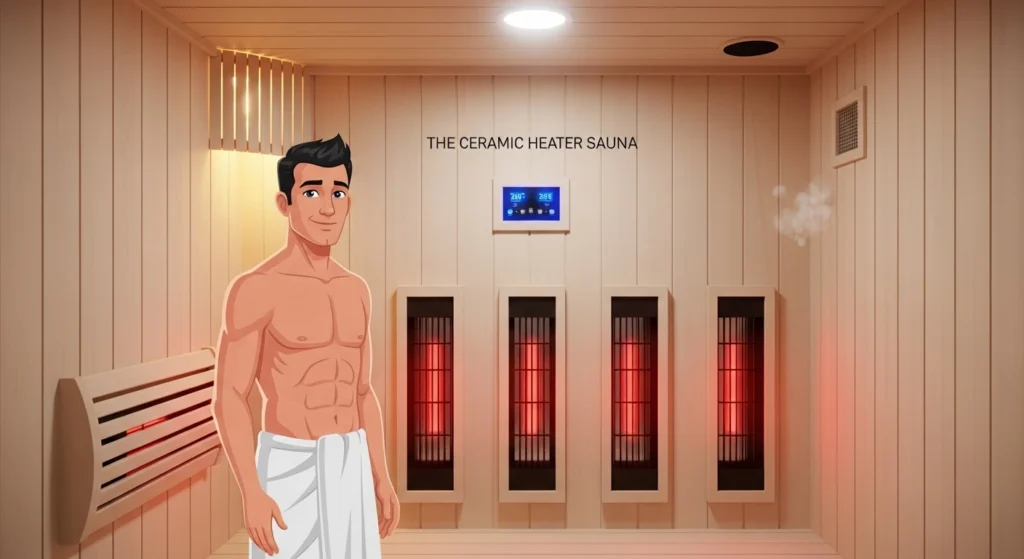
- The Experience: Ceramic has a high emissivity (efficiency at emitting infra-red), since the heat is radiating from a small surface area (the tube) it generates a very intense, concentrated heat directly in front of the rod.
- The Trade-off: While great for quick and intense heating, you have to be careful to not touch the rods, since they become very hot. The heat can be more “harsh” than the soft touch of carbon.
- Ideal For: Those who like a hotter, more intense sensation like a traditional sauna with the benefits of infrared.
- Pros: High heat intensity.
- Cons: Can cause the formation of hot spots directly in front of the rod; surface temperature is very high.
- Best For: People who prefer a more intense and concentrated heat sensation.
5. The Carbon-Ceramic Hybrid
This is often the answer of what type of heater is best for an infrared sauna for those who can’t decide.
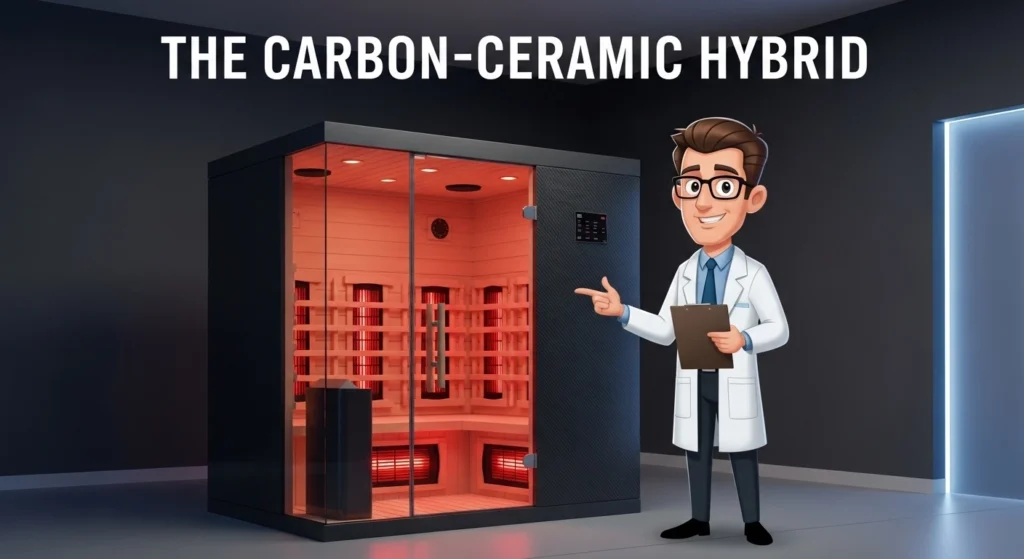
- Best of Both Worlds: Manufacturers sandwich the carbon sheets between the ceramic plates. This makes for a heater with the high emissivity and intensity of ceramic and the even distribution and low surface temperature of carbon.
- Why Choose This: Addresses the “soft heat” issue of carbon (some people feel carbon runs too cool), and the “hot spot” issue of ceramic. It is fast becoming the industry standard in high-end units.
- Ideal For: Users seeking the absolute best combination of efficiency, safety, and heat intensity.
6. The 2-Person Corner Unit
Space is a premium in modern houses. When seeking the best infrared sauna 2 person option, the corner unit is an item that is a masterpiece of design.

- Design Advantage: These units are in the shape of a wedge and can be tucked into the corner of a bathroom, bedroom or gym. Despite being smaller than what a rectangular 2-person unit, they can often feel larger on the inside because of the depth the corner shape affords.
- Social Aspect: Unlike a 1-person “coffin” style, a 2-person unit will let you share a session making it a social activity or to bond with a partner.
- Ideal For: Couples or homeowners with limited floor space, but with a desire for a dedicated cabin.
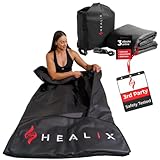
7. The Infrared Sauna Blanket
If you rent your place or have zero floor space the best infrared sauna blanket is a game-changer.
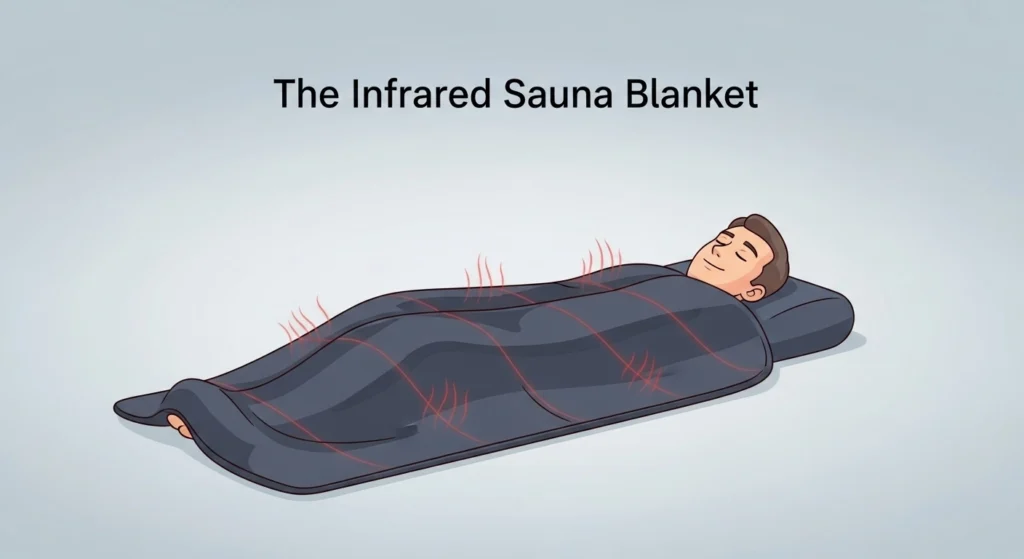
- How It Works: It resembles a sleeping bag except that it has infrared heating elements inside it. You lie inside of it, and it directly heats your body. Because the heat is so near your skin you sweat a lot even at lower temperature settings.
- Pros & Cons: Is a fraction of the price of a cabin ($200-$500 instead of $2,000+), and is able to fold away under a bed. However, your head is not in the unit, which is argued by some to limit the full-body detox experience as compared to a cabin where your head is heated.
- Ideal For: Renters, travelers or those on a budget that wish to get the detox benefits without the construction.
- pros: Sleeps under a bed, fraction of the cost of a cabin.
Cons: Can be claustrophobic, no space to move around and stretch.
8. The Near Infrared Sauna Red Light Therapy
This is a specialized setup that is commonly used for skin conditions as well as anti-aging.
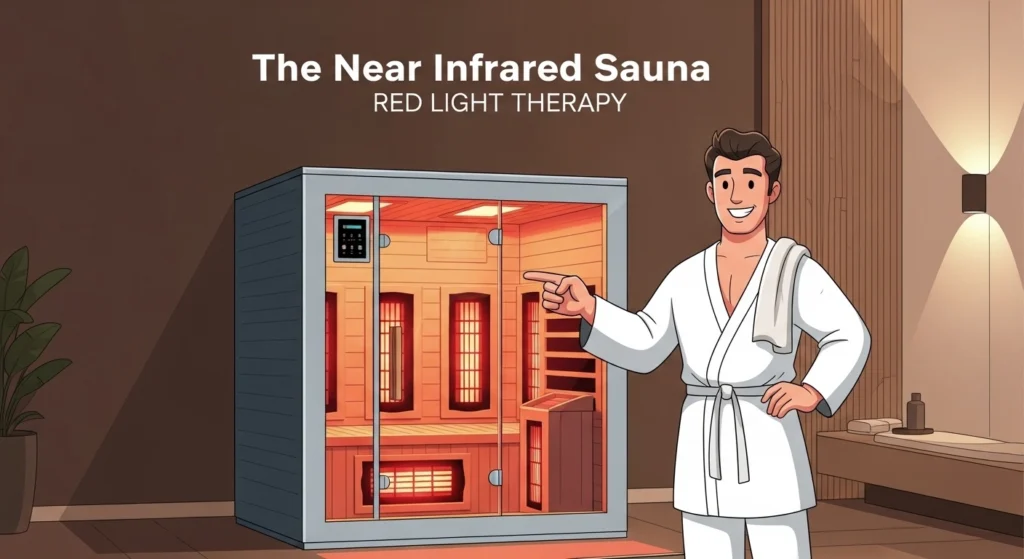
- The Combo: While all infrared saunas generate heat, when you add dedicated Red Light Therapy (RLT) bulbs the game changes. RLT uses specific wavelengths (around 660nm) that don’t create much heat, but that are scientifically proven to be great for collagen production and mitochondrial function.
- Why It’s Unique: When it comes to what kind of sauna is best for inflammation, this combo is powerful. The near-infrared heat is used to prepare the tissue while the red light is used to drive cellular repair.
- Ideal For: Those who are more concerned with skin wellness, scar reduction, mood improvement, and tubular healing, but also want to get rid of “sweating.”
9. Low EMF Portable Tent Sauna
A step up from the blanket, but less permanent than a cabin.
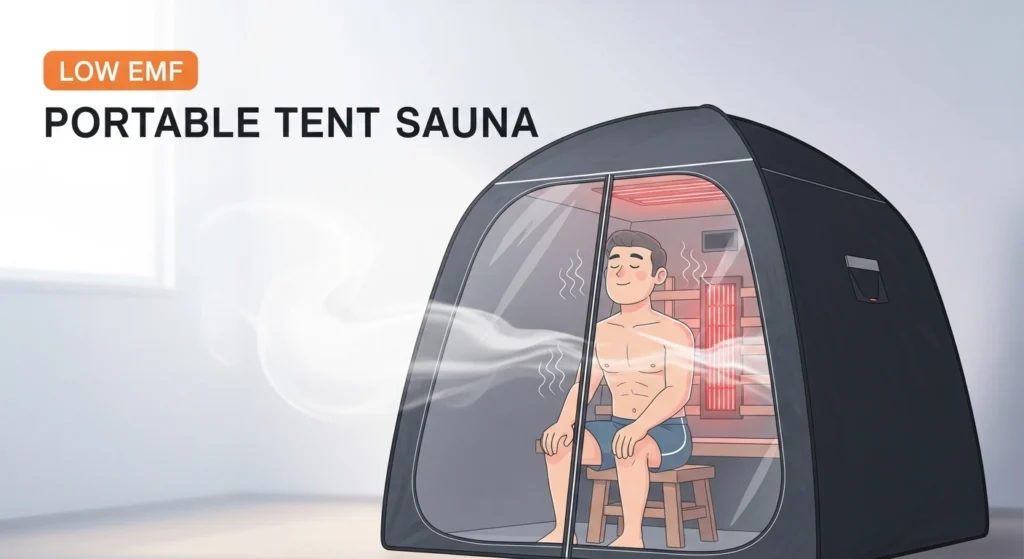
- Structure: Pop-up tent structure (like a camping tent) with a chair in it. The heaters are generally embedded in the walls of the tent.
- Safety Check: When the question of what is low emf infrared sauna in this category, be careful. Cheap portable tents sometimes pass on the EMF shielding. For portable units look for brands that specifically advertise “Low EMF.”
- Ideal For: People who move house a lot, or need to shove the sauna in a closet after every use.
10. The Outdoor All-Weather Cabin
Don’t have space inside? Take it outside.

- Construction: These units resemble small sheds. They need heavy duty insulation and weatherproofing (usually in the form of Canadian Cedar or Hemlock). They need to have appropriate roofing and waterproof seals to protect the electronics.
- Consideration: You will need a separate outdoor electrical line. Also, a sauna heated outdoors in the winter takes much longer and consumes considerably more power than an indoor unit.
- Ideal For: Homeowners who have backyards or patios and don’t want to bring the heat and humidity into the house.
11. The Medical-Grade Clearlight Sauna
Frequently mentioned in a search for what kind of infrared sauna is best in the world, medical grade saunas set the standard for safety.

- The Standard: Brands such as Clearlight uses “True Wave” heaters (a carbon-ceramic hybrid), and heavily shields all wiring. They are often the only saunas recommended by the Wellness Mama or other high profile health advocates due to the proof of their safety claims.
- Why Pay More: You are paying for the verification of the testing. Where a generic brand may make a claim of “Low EMF”, a more medical-grade brand will supply the meters and tests to prove it.
- Ideal For: Those with chronic illness, severe toxicity or electro-hypersensitivity who require the purest environment possible.
12. The DIY Infrared Sauna Kit
For the handy homeowner who wants to get maximum value.

- The Build: You purchase the heaters, controllers and wiring, and build the enclosure yourself. This way you can control all variables – the type of wood, how thick the insulation will be and the placement of the heaters.
- The Risk: If not wired correctly, you run the risk of fire hazards or high EMF exposure. It involves knowledge of electrical safety codes.
- Ideal For: Contractors or DIY enthusiasts who are sure in their abilities, and prefer a custom sized sauna at a fraction of the retail cost.
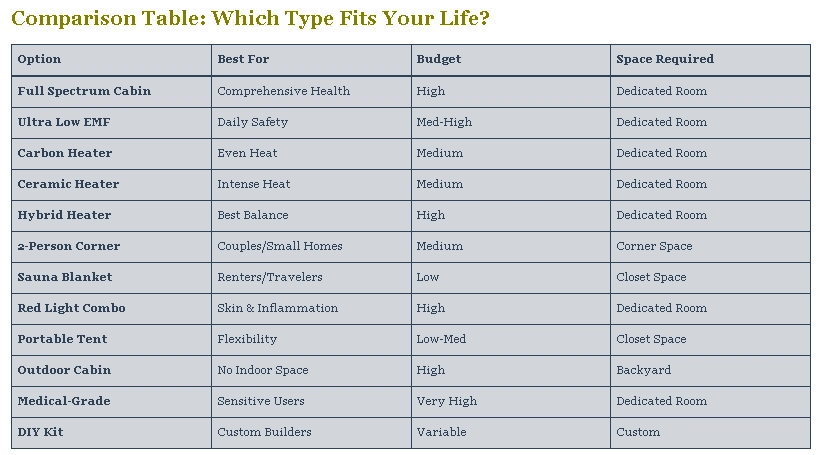
Comparison Table: Which Type Fits Your Life?
| Option | Best For | Budget | Space Required |
|---|---|---|---|
| Full Spectrum Cabin | Comprehensive Health | High | Dedicated Room |
| Ultra Low EMF | Daily Safety | Med-High | Dedicated Room |
| Carbon Heater | Even Heat | Medium | Dedicated Room |
| Ceramic Heater | Intense Heat | Medium | Dedicated Room |
| Hybrid Heater | Best Balance | High | Dedicated Room |
| 2-Person Corner | Couples/Small Homes | Medium | Corner Space |
| Sauna Blanket | Renters/Travelers | Low | Closet Space |
| Red Light Combo | Skin & Inflammation | High | Dedicated Room |
| Portable Tent | Flexibility | Low-Med | Closet Space |
| Outdoor Cabin | No Indoor Space | High | Backyard |
| Medical-Grade | Sensitive Users | Very High | Dedicated Room |
| DIY Kit | Custom Builders | Variable | Custom |
By understanding these 12 options, you can move past the marketing hype and choose the solution that truly answers what type of infrared sauna is best for your personal sanctuary.
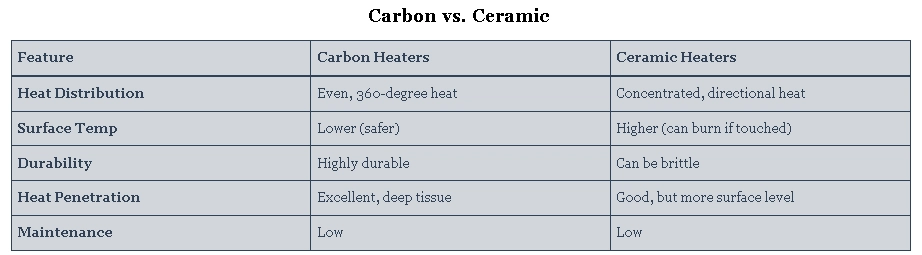
Carbon vs. Ceramic Infrared Sauna The Great Debate
One of the most common questions is the heater material. The carbon vs ceramic infrared sauna debate comes down to heat quality.
| Feature | Carbon Heaters | Ceramic Heaters |
|---|---|---|
| Heat Distribution | Even, 360-degree heat | Concentrated, directional heat |
| Surface Temp | Lower (safer) | Higher (can burn if touched) |
| Durability | Highly durable | Can be brittle |
| Heat Penetration | Excellent, deep tissue | Good, but more surface level |
| Maintenance | Low | Low |
Verdict: For most people who are looking for the best type of infrared sauna, carbon heaters (or carbon-ceramic combinations) are the better option because of their even heat distribution and their safety profile.
Is infra-red Sauna Better Than Traditional Sauna?
This is an age-old wellness debate. To know what kind of sauna is best for you, you have to compare the experiences.
Are infrared Saunas better than traditional?
- Traditional Saunas (Finnish): Heated rocks are used to heat the air to 170F – 200F. They cause sweat through the hot air they heat the body. They provide a harshier heat, which some prefer to be a “survival” challenge.
- Infrared Saunas: Directly heat the body at lower temps (120°F – 140°F). The composition of the sweat is different – often mentioned as 20% of toxins (e.g. heavy metals) compared to 3% in normal sweat.
Verdict: If you hate to feel like you’re in a sauna or you suffer from respiratory problems, infrared is the hands down winner. If you are looking for the intense sweat and social aspect of high heat, traditional may be for you. For health outcomes such as inflammation, the best sauna for inflammation is generally the infrared variety because of the higher depth of penetration to tissue.
What to Look for When Purchasing an Infrared Sauna
You have decided upon an infrared model. Now, what should i look for when purchasing an infrared sauna? Here is your checklist:
- EMF Rating: Make sure that it is Low EMF (less than 10mG) or Ultra Low EMF (less than 3mG).
- Wood Quality: Do not use cheap woods or those that are glued by some toxic glue. Basswood, Cedar and Hemlock are best. Non-allergenic basswood is very good for chemically sensitive people.
- Warranty: Look for lifetime warranty of the heaters and at least 5 years on the electronics.
- Heater Coverage: Make sure the heaters are placed in such a manner as to strike your back, sides, and legs/feet. A sauna that only has back heaters is not as effective as this.
- Certifications: Look for ETL, CE or UL certifications to ensure electrical safety.
Health Benefits: Why’s It Important?
What kind of sauna is Best for Health? The answer can be found in the results.
- Inflammation: Near and Mid-infrared are awesome to help reduce systemic inflammation.
- Detox Far infrared is the gold standard for heavy metal detoxification.
- Cardiovascular: Regular use has the same effect as moderate cardio exercise (passive cardio).
- Skin: Near infrared stimulates the production of collagen.
Knowing your main objective helps in narrowing the type of infrared sauna which is best. For general wellness, full spectrum is covering all of its bases.
You May Also Like To Read:
FAQs
What is the best infrared sauna for the home?
A Low EMF Carbon Heater cabin is generally the best compromise between safety, efficiency and comfort for home use. If space is not a problem, a quality sauna blanket is a good alternative.
Is infrared sauna superior to sauna?
It is up to you which one you prefer. Infrared is better for those who cannot tolerate the high heat, desire deeper tissue penetration or are interested in detoxification. Traditional is better for more heat enthusiasts.
What is the best infrared sauna on the market?
Brands such as Sunlighten and Clearlight are typically in the competition for the best of the best with their full spectrum technology and proprietary heaters that guarantee low EMF levels.
What is the best heater for an infrared sauna?
Carbon heaters are generally considered to be better in terms of even heat distribution and lower surface temperature which reduces burns.
How frequently should I use my infrared sauna?
Most experts would recommend 3-4 times a week for 30-40 min sessions to see significant health benefits.
Final Thoughts
Navigating the world of wellness technology can be overwhelming, but finding the answer to the age-old question of what the best infrared sauna is eventually comes down to listening to your body and assessing your lifestyle.
Whether you get a state-of-the-art full spectrum infrared sauna for your home gym or the convenient best infrared sauna blanket for your apartment, consistency is most important.The best sauna is one that you are actually going to use on a regular basis and get inflamed, detoxed, and relaxed.
Don’t get too caught up in the technical argument of carbon vs ceramic infrared sauna designs or the prestige of having the “best in the world.” Focus on safety standards such as Low EMF, high-quality materials and your specific health goals.
By making these elements a priority, you are not only investing in a piece of equipment, but rather a daily ritual that will benefit your health for years to come. Here’s to your path towards good health and the perfect sweat