
Steam Sauna Electrical & Plumbing Requirements: What Your Bathroom Needs Before You Build
A home steam sauna sounds simple: a sealed room, a generator, and steam. In practice, the room is only half the project. The electrical supply, water supply, drain, and the room’s handling of moisture all have to work together before the first session.
This guide walks through what to check, what to ask a licensed professional, and where people most often run into trouble. It is planning guidance, not an installation manual — treat the spec sheet for your exact generator model as the final word on its requirements.
Disclaimer — please read this first: This article is general guidance only, not a substitute for local codes or a licensed professional. Check with your local permit or code office before work starts, and use licensed electricians and plumbers for installation work. If anything here conflicts with your generator manual, follow the manual and your licensed professional.


Paid Links - As an Amazon Associate, I earn from qualifying purchases.
Start Here: Is Your Bathroom Ready for a Steam Room?
Not every bathroom can become a steam room without changes. Steam adds heat and a great deal of moisture to a small, enclosed space, and that moisture will find any weak spot. Before you buy a generator, check the room itself.


Paid Links - As an Amazon Associate, I earn from qualifying purchases.
- The room can be fully sealed, with a door that closes tightly against steam.
- The ceiling, walls, and floor can be made fully waterproof, not just water-resistant.
- Water, drain, and electrical supply can all reach the generator’s planned location.
- The generator can sit somewhere accessible for servicing, not sealed behind a finished wall.
- You have a plan for drying the room out after each session.
If any of those points is a no, the conversion will simply involve more construction work — and a bigger budget — than a straightforward install. Sorting this out early is far cheaper than discovering it halfway through a build.
Electrical: What a Steam Generator Actually Needs
A steam generator’s needs vary a great deal by model and size. Size is usually matched to room volume, so a larger room generally calls for a more powerful generator — and that generally places greater demands on your electrical system. For help matching size to room, see our guide to sizing a steam generator.
That variation is why no article can give you one electrical specification to buy around. Your generator’s manual and spec sheet will state its requirements for that model. A licensed electrician will then confirm whether your panel has capacity for it, what circuit arrangement suits your home, and whether upgrades are needed. Bring the spec sheet to that conversation — it avoids guesswork.
Plan the physical layout early, too. The generator is usually installed near, but not inside, the steam room — often in a nearby closet, vanity cavity, or utility space — with a control panel reachable without entering the steam. The electrician and plumber should agree on that location together, since the generator needs both supplies in the same place.
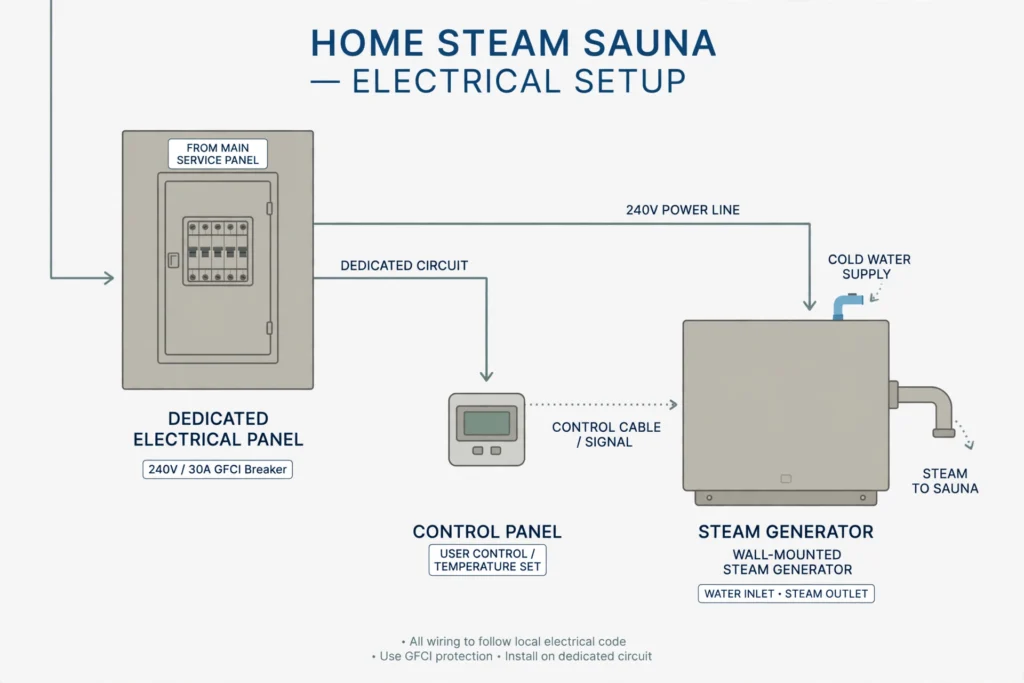
Questions Worth Asking Your Electrician
A short conversation up front prevents most electrical surprises. Consider asking these questions, and keep the answers with your manual:
- Does my panel have capacity for this generator model, or will it need an upgrade?
- Where should the generator and its controls be located for safe access and servicing?
- What protection and isolation does this installation need in a wet-room setting?
- Will any part of this work need a permit or inspection in our area?
Plumbing: Water In, Steam Out, Water Away
Plumbing for a steam sauna has three jobs: bring cold water to the generator, carry steam into the room, and get condensed water out safely. A failure in any of them shows up as leaks, poor steam, or damp damage.


Paid Links - As an Amazon Associate, I earn from qualifying purchases.
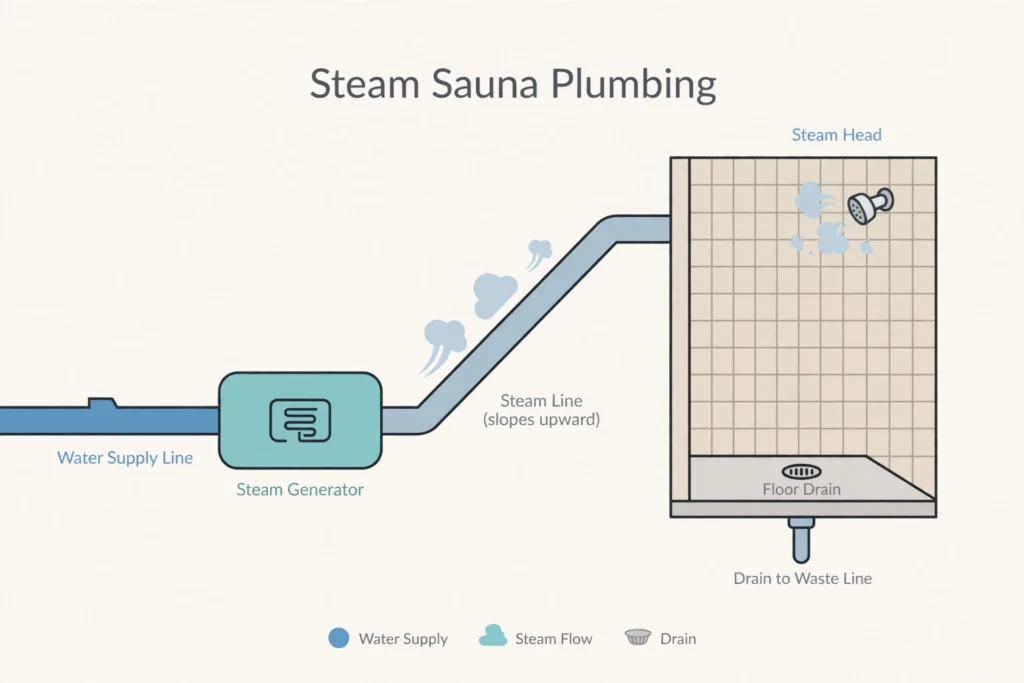
- Water supply. The generator needs a reliable cold-water feed. Your plumber will check water pressure and quality, confirm the feed route, and fit any shut-off or filtration the manufacturer recommends. Hard water is worth mentioning: mineral build-up is a common cause of generator problems.
- Steam line. Steam travels from the generator to a steam head inside the room through a dedicated steam line. Sharp bends, long runs, and low spots where condensate can collect can all affect performance, so settle the route on the plan, not on the day the walls are closed up.
- Steam head placement. The steam head sits low in the room, away from seating and away from where anyone would stand directly in the steam path. Confirm its position with your installer before tiling begins.
- Drainage. A steam room produces condensate, and the floor needs a way to carry it away — usually a sloped floor leading to a drain. If your bathroom has no suitable drain in the right place, adding one is a significant job to price before you commit.
- Access for servicing. Generators need descaling, inspection, and occasional repair. Make sure the generator, its water connections, and its drain points stay reachable after the room is finished.
For the whole build, including room construction, see our guide to building a steam sauna at home. If you are still weighing the project, our steam shower cost guide can help you think through the budget before getting quotes.
The Room Itself: Waterproofing, Slope, and Drying Out
Electrical and plumbing get the attention, but the room’s construction decides whether the installation lasts. A steam room needs a continuous waterproof layer on ceiling, walls, and floor, with sealed joints and corners. Ordinary bathroom waterproofing, designed for splashes, is not the same job as containing steam session after session.
The ceiling deserves a special mention. A flat ceiling lets condensate drip back down on the bather, so many steam rooms use a sloped or gently curved ceiling that sends condensation to the walls instead.
- Confirm the waterproofing system is rated for continuous steam exposure, not just showers.
- Check that the floor slopes toward the drain and that the drain is tested before tiling is finished.
- Plan ventilation and a drying routine: leave the door open after sessions and let the room dry fully.
Common Mistakes — and How to Avoid Them
| Mistake | Why it matters | What to do instead |
|---|---|---|
| Buying the generator before checking panel capacity | An undersized supply can stall the project | Get the spec sheet to an electrician first |
| Sealing the generator behind finished walls | Servicing becomes demolition | Keep an access panel or service space |
| Treating the room as maintenance-free | Trapped moisture leads to mould and damage | Dry the room after every session |
| Planning electrical and plumbing separately | Supplies end up in different places | Have both trades agree on the location together |
Permits, Quotes, and Hiring the Right People
Whether your project needs a permit depends on where you live and how much work is involved — adding a circuit, moving plumbing, or altering a room can each trigger different local requirements. Check with your local permit or code office early, rather than assuming a small project needs no paperwork.
When comparing quotes, compare like with like. Ask each contractor what is included: electrical work, plumbing work, waterproofing, tiling, the generator itself, and any permit or inspection fees. A quote that looks cheaper because it leaves out waterproofing or drainage is not cheaper at all.
The Maintenance Reality: A Steam Room Is Not Maintenance-Free
It is worth being honest about this, because it affects whether a steam room is right for you. A home steam room needs regular drying, regular cleaning, and periodic generator care such as descaling, on a schedule that depends on your water and how often you use it. Our guide to cleaning a steam sauna sets out a practical routine.
Left damp and uncleaned, any constantly wet room can develop mould, odours, and damage to grout and finishes. None of that is inevitable — it is simply the price of owning a room that is wet by design. If drying the room after a session sounds like a chore you will skip, factor that into your decision honestly.
Frequently Asked Questions
Do I need a dedicated circuit for a steam sauna generator?
That depends on your generator model. The manufacturer’s spec sheet states its electrical requirements, and a licensed electrician will confirm what your home needs — including whether a dedicated circuit or a panel upgrade is involved. Do not assume your existing bathroom circuit is sufficient.
Can I install a steam sauna myself?
The room finishing may be within a confident DIYer’s skills, but electrical and plumbing work in a wet room should be done by licensed professionals. Mistakes here carry safety risks and can void warranties or insurance. Use licensed electricians and plumbers, and check local permit requirements first.
Does a steam room need a floor drain?
A steam room produces condensate that has to go somewhere, so a sloped floor leading to a drain is the usual solution. If your bathroom has no suitable drain, adding one is a major part of the project and should be priced before you commit.
How do I know what size generator my room needs?
Generator size is matched to room volume and construction; start with your model’s sizing guidance, and confirm the final choice against its spec sheet.
Will a steam room cause mould in my bathroom?
It can if moisture is trapped, which is why waterproofing, a drying routine, and regular cleaning matter so much. A well-built, well-dried steam room should not cause mould — but a steam room that is never dried out is asking for trouble.