
If you’ve ever stood between two locker room doors — one leading to a warm, wood-paneled room, the other fogged up with thick steam — you already know these two rooms don’t feel the same. That’s the heart of the dry sauna vs wet sauna debate.
Both make you sweat, both relax you, but they get there through completely different mechanics, and that difference changes how long you should stay, how your body responds, and honestly, which one you’ll actually enjoy going back to.
Here’s the short version: a dry sauna is hot, dry air — usually somewhere between 150°F and 200°F, with humidity sitting at 5% to 20%. A wet sauna, more accurately called a steam room, runs cooler at 100°F to 120°F but keeps the air almost completely saturated, close to 100% humidity.


Paid Links - As an Amazon Associate, I earn from qualifying purchases.
Neither one wins outright. It really comes down to your heat tolerance, what you’re trying to get out of the session, and whether you have any health conditions worth checking with a doctor about first.


Paid Links - As an Amazon Associate, I earn from qualifying purchases.


Paid Links - As an Amazon Associate, I earn from qualifying purchases.
Quick Comparison
| Feature | Dry Sauna | Wet Sauna (Steam Room) |
|---|---|---|
| Temperature | 150–200°F | 100–120°F |
| Humidity | 5–20% | 95–100% |
| Feel | Intense but breathable | Heavy, thick, immediate |
| Typical session | 15–20 minutes | 10–15 minutes |
| Installation | Simpler | More complex, needs waterproofing |
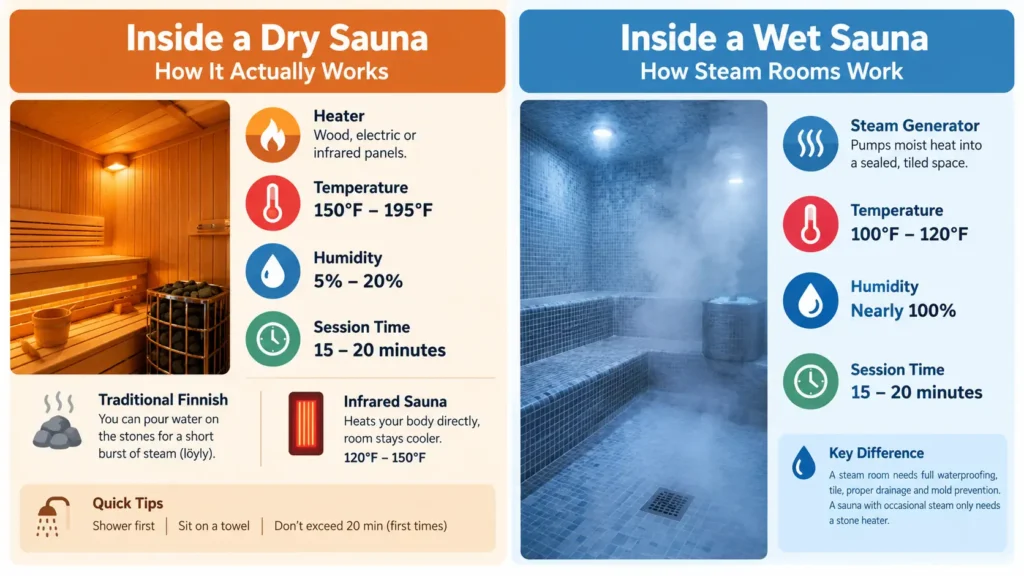
Inside a Dry Sauna: How It Actually Works
A dry sauna is what most people picture when they hear the word “sauna” — a small wood-lined room heated by a stove sitting under a pile of stones. The heater can run on wood, electricity, or infrared panels, and it pushes the air temperature up to somewhere between 150°F and 195°F while humidity stays low, usually in the 5% to 20% range.
That low moisture level is actually the whole trick. When the air is dry, sweat evaporates off your skin efficiently, your body’s natural cooling system keeps working, and that’s why people can tolerate such high heat for 15 to 20 minutes without feeling like they’re suffocating.


Paid Links - As an Amazon Associate, I earn from qualifying purchases.


Paid Links - As an Amazon Associate, I earn from qualifying purchases.
Traditional Finnish saunas let you pour a splash of water over the stones every so often for a short burst of steam, called löyly, but it fades within a few minutes and isn’t the same as sitting in a true steam room.
There’s also the infrared sauna, which technically falls under the dry sauna umbrella but works a little differently — instead of heating the air around you, infrared panels warm your body directly, so the room itself stays cooler, usually 120°F to 150°F, while you still sweat heavily.
Before jumping into a dry sauna, shower off any lotion or sweat, sit on a towel, and don’t push past 20 minutes your first few times. It’s an unforgiving heat if you’re not used to it, but it’s also one of the easiest home wellness additions to install and maintain.
Inside a Wet Sauna: How Steam Rooms Work
A wet sauna, or steam room, works on the opposite principle. Instead of a wood-fired heater and stones, a plumbed steam generator pumps moist heat directly into a sealed, tiled space.



Paid Links - As an Amazon Associate, I earn from qualifying purchases.
The temperature stays much lower than a dry sauna, typically 100°F to 120°F, but the humidity climbs to nearly 100%. Because the air is already saturated, your sweat has nowhere to go — it just sits on your skin, which is exactly why a steam room can feel more intense than the thermometer suggests.
People often use “wet sauna” loosely to describe two different things. Sometimes it means a traditional sauna where water gets tossed on the stones now and then. Other times it means a dedicated steam room built specifically for high humidity.
They’re related, but the build requirements aren’t close — a real steam room needs full waterproofing, tile, proper drainage, and mold prevention baked into the design from day one, while a sauna with occasional steam capability just needs a decent stone heater.
How the Heat Actually Feels on Your Body
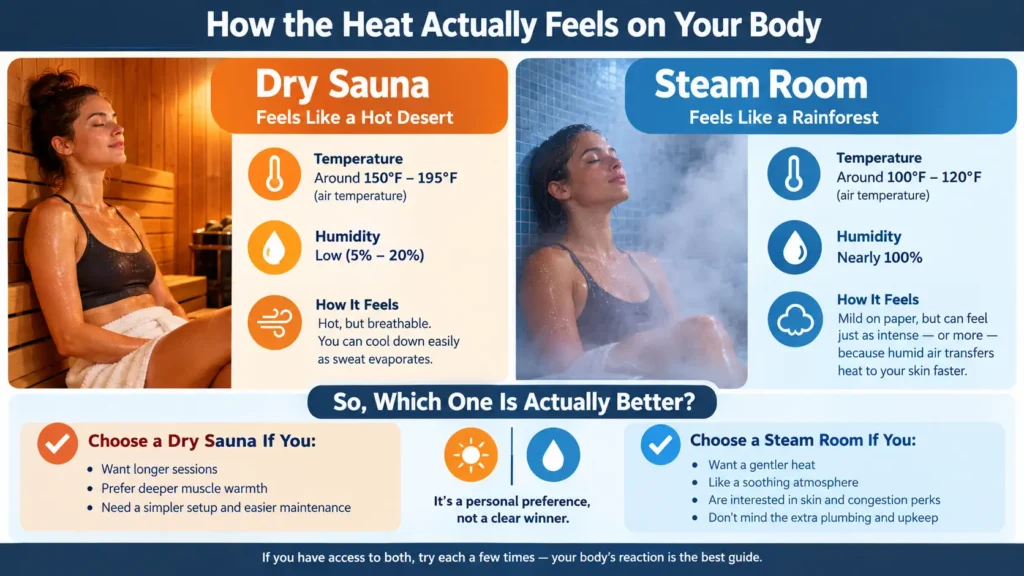
This is where the temperature numbers can trick you. A dry sauna at 180°F sounds brutal on paper, but because the air is dry, you can breathe comfortably and your body cools itself the whole time you’re in there.
A steam room at 110°F sounds mild by comparison, yet it can feel just as demanding, sometimes more so, because humid air transfers heat to your skin far more efficiently than dry air does. Sweat can’t evaporate in a saturated room, so your body heats up faster even at a much lower ambient temperature.
Think of it like two climates. A dry sauna feels like standing in a hot desert — intense, but clear and breathable. A steam room feels like stepping into a rainforest, thick and heavy, sometimes hard to even see across the room.
Neither feeling is wrong. Some people find the enclosed mist of a steam room genuinely calming; others find it a little claustrophobic and prefer the crisp, dry heat instead. This is really a personal preference thing more than a “which is objectively more powerful” thing.
So, Which One Is Actually Better?
Honestly, there’s no universal winner here — it depends on what you’re chasing. If you want longer sessions, deeper muscle warmth, and a setup that’s simpler to install and keep clean, a dry sauna is the more practical choice.
If you’re after gentler heat, a soothing atmosphere, and the specific skin and congestion perks that come with moist air, a steam room is worth the extra plumbing and upkeep.
A decent way to think about it: dry saunas reward people who like sustained, high heat and don’t mind a little dryness in the air. Steam rooms reward people who want a shorter, heavier session and appreciate the humidity.
If you have access to both at your gym or spa, try each a few times before deciding — your body’s reaction is a much better guide than any comparison chart, including this one.
The Health Benefits of Wet and Dry Sauna, Backed by Research
Both types offer real, meaningful benefits when you use them consistently, and a lot of the benefit overlaps — better circulation, temporary drops in blood pressure from the heat-induced vasodilation, and the plain stress relief of sitting quietly without your phone for 15 minutes.
The strongest evidence we have on sauna use and long-term health comes from a Finnish study that followed 2,315 middle-aged men for nearly 21 years as part of the Kuopio Ischemic Heart Disease Risk Factor Study.
Published in JAMA Internal Medicine in 2015, the research found that men who used a sauna two to three times a week had a 23% lower risk of a fatal coronary heart disease event compared with men who used one only once a week, and the men who went four to seven times a week saw an even bigger drop in risk.
It’s worth being upfront that this study looked specifically at traditional dry sauna bathing among Finnish men, so it shouldn’t be stretched to promise identical results from steam rooms or for every population, but it’s genuinely the best long-term data we have connecting frequent heat exposure to better cardiovascular outcomes.
Beyond that shared ground, each type has its own edge. Dry saunas tend to allow longer sessions since sweat evaporates efficiently, which means more sustained time at an elevated core temperature, something a lot of people use for deep muscle relaxation after a workout.
Steam rooms lean into respiratory comfort and skin hydration instead, since the moist air can loosen congestion and won’t dry out your skin the way prolonged dry heat sometimes does.

What Each One Does for Your Skin
If skin is your main concern, the steam room usually wins. Humid heat opens your pores without stripping moisture the way a long dry-sauna session can, which is part of why steam rooms show up so often in spa skincare routines.
You still sweat out debris sitting in your pores, but your skin isn’t left feeling tight and parched afterward the way it sometimes does after a dry sauna. That said, everyone’s skin reacts a bit differently — if you have sensitive or acne-prone skin, check whether a steam room is genuinely a good fit for your skin type before making it a regular habit, and always rinse off afterward rather than letting sweat and moisture sit on your face.
Dry saunas aren’t bad for skin either — they just require a little more aftercare. A good moisturizer post-session goes a long way toward avoiding that dried-out feeling some people get from repeated dry heat exposure.
Does Either One Actually Help You Lose Weight?
This one needs a myth-buster upfront: neither a dry sauna nor a steam room meaningfully burns fat. Any weight you lose in a session is water weight from sweating, and it comes right back once you rehydrate, which you should do anyway.
People sometimes step on the scale after a sauna session and get excited about a couple of pounds “lost,” not realizing it’s just fluid. If you’re curious about the actual numbers involved in how many calories a steam sauna session burns, the honest takeaway is that it’s a small amount tied mostly to your elevated heart rate, nowhere close to what you’d burn through actual exercise. Saunas can be a nice complement to a fitness routine, but they were never designed to replace one.
Which One Actually Makes You Sweat More? Dry Sauna vs Wet Sauna
People assume the hotter room makes you sweat more, but it’s really about humidity, not the thermometer. In a dry sauna, you sweat heavily, but it evaporates almost as fast as it appears, so you might not always feel as drenched as you actually are.
In a steam room, sweat has nowhere to go since the air is already saturated, so it pools on your skin and makes the whole session feel wetter and more intense, even at a much lower temperature.
If you’re judging “how hard was that session” purely by how soaked your towel looks afterward, the steam room will usually win that contest, even though your body may be working just as hard in the dry sauna.

Where Infrared Saunas Fit Into the Picture
Since infrared often gets lumped into this conversation, it’s worth a quick mention. An infrared sauna isn’t wet or dry in the traditional sense — it heats your body directly through infrared panels rather than heating the surrounding air, which means the room itself stays cooler, usually 120°F to 150°F, while your body still works up a real sweat.
People who find traditional dry sauna heat too intense sometimes prefer infrared because the ambient temperature is gentler, even though the internal effect on your body is fairly similar. It’s a good middle ground if you want the benefits of heat therapy without the full blast of a 190°F Finnish sauna.
How to Combine Sauna, Steam Room, and Cold Plunge
If your gym or spa has more than one of these, it’s worth thinking about the order instead of just wandering between them. A common approach is to start with the drier, hotter option first while your body has the most energy, move to the steam room for a gentler follow-up, and finish with a cold plunge or cool shower to bring your body temperature back down and tighten things up.
Jumping straight into extreme cold after a long heat session can be jarring, so easing into it works better for most people than shocking the system right away. If you want a more detailed walkthrough of how to sequence a sauna, steam room, and cold plunge session, it’s worth reading before your next spa day, especially if you’re new to combining heat and cold exposure.

Who Should Be Careful With Dry or Wet Sauna Use
Most healthy adults can use either type safely, but a few groups should check with a doctor before making it a habit. That includes anyone with uncontrolled high or low blood pressure, an unstable heart condition or recent cardiac event, pregnant women, anyone running a fever or fighting an active infection, and people who get dizzy or faint easily in heat.
Research on cardiovascular patients has found that people who are stable and relatively symptom-free in daily life can often use saunas without added risk, but that’s a conversation to have with your own doctor, not something to assume on your own.
One rule worth remembering: never combine sauna or steam room use with alcohol. Older Finnish and Swedish studies looking at sauna-related deaths found that alcohol played a role in a large share of the cases — heat stress on top of alcohol’s effect on blood pressure and judgment is a genuinely risky combination.
And a simple gut-check that cardiologists actually recommend: if you can walk into a sauna under your own power, you should be able to walk out the same way. If that’s not the case, get out immediately.
Cost and Maintenance: What to Expect
Dry saunas are generally the easier and cheaper home addition. You’re mostly looking at a heater, stones, and a wood-lined room, with maintenance limited to occasional cleaning and replacing stones every so often.
Steam rooms cost more upfront and take more planning, since they need a plumbed steam generator, full waterproofing, tile work, and drainage — skip any of that and you’re setting yourself up for mold problems down the line. If budget and simplicity matter most, a dry sauna is the more realistic first step.
If you specifically want the steam experience, factor in a bigger installation budget and a bit more regular upkeep to keep things clean and mold-free.
FAQs
What is the main difference between a dry sauna and a wet sauna?
Humidity. Dry saunas run hot (150–200°F) with low humidity (5–20%). Wet saunas, or steam rooms, run cooler (100–120°F) but at nearly 100% humidity.
Is a wet sauna the same as a steam room?
Mostly, yes, though people use the term loosely. A true steam room is a dedicated, plumbed space built for constant high humidity, while a “wet sauna” can also just mean a traditional sauna with occasional water on the stones.
Which is hotter, a dry sauna or a wet sauna?
A dry sauna reaches a higher air temperature, but a wet sauna can feel just as intense, or more so, because humid air transfers heat to your skin more efficiently.
Do you sweat more in a dry sauna or a wet sauna?
You sweat heavily in both. In a dry sauna it evaporates quickly; in a steam room it stays on your skin, which is why the session can feel wetter even at a lower temperature.
Which is better for weight loss, dry or wet sauna?
Neither. Any weight lost is water weight that returns once you rehydrate. Saunas support a fitness routine, but they don’t replace one.
Is a dry or wet sauna better for skin?
Wet saunas are generally gentler on skin since the humidity hydrates while still opening pores, while dry heat can leave skin feeling parched without proper aftercare.
Can a sauna help with a cold or congestion?
A steam room is the more commonly used option for temporary congestion relief, since moist heat can help loosen mucus. Anyone with asthma or a chronic respiratory condition should check with a doctor first.
How long should you stay in a dry sauna vs. a wet sauna?
A dry sauna session usually runs 15 to 20 minutes. A steam room session tends to be shorter, around 10 to 15 minutes, since the humid heat is more demanding on the body.
Is it safe to use a sauna if I have high blood pressure?
Stable, well-managed cardiovascular patients can often use saunas without added risk, but that should be confirmed with a doctor, especially if blood pressure is uncontrolled.
Can you build a wet sauna at home?
Yes, but it’s a bigger project than a dry sauna, since a true steam room needs a plumbed generator, full waterproofing, tile, and drainage, which usually means hiring a contractor.
Are infrared saunas dry or wet?
Infrared saunas are considered a dry sauna type. They heat your body directly rather than heating the room, and typically run cooler with low humidity.
Is it bad to drink alcohol before using a sauna?
Yes. Combining alcohol with heat stress raises the risk of dizziness, dehydration, and dangerous blood pressure drops, and it’s been linked to a notable share of sauna-related incidents in past research.
Which sauna type is easier to maintain?
Dry saunas are simpler and cheaper to maintain, mostly needing occasional cleaning and stone replacement. Steam rooms need more upkeep to prevent mold and keep the generator running properly.
Final Thoughts
At the end of the day, dry and wet saunas aren’t competing for the same job. One gives you sustained, dry heat that’s easy to install and easy to live with long-term. The other gives you a heavier, more enclosed experience that’s gentler on your skin and lungs but asks more of your budget and upkeep.
Both are backed by real evidence when it comes to relaxation and cardiovascular benefits, and both come with the same basic rule: know your own body, skip the alcohol, and check with a doctor first if you have any underlying heart or blood pressure concerns. Try both if you have the chance — your own reaction to the heat will tell you more than any comparison ever could.