
Does infrared sauna help with a hangover? No — and using one while you’re actively hungover or still have alcohol in your system can make things worse. You can’t sweat alcohol out of your body; your liver processes it at a fixed rate no amount of heat can speed up. Combining sauna heat with dehydration and alcohol’s effects on your heart and blood pressure is a genuine safety risk, not just an inconvenience.
If you’re reading this mid-hangover wondering whether to hop in the sauna, here’s the short version: wait. Below is exactly why, what actually helps a hangover, and when if ever a sauna session makes sense during recovery.
Key Takeaways
- Your liver clears alcohol at a fixed rate of about 0.015% blood alcohol concentration (BAC) per hour — sweating doesn’t speed this up.
- Sauna sessions already raise your heart rate by roughly 30–50%, similar to moderate exercise; alcohol’s effect on your heart adds unnecessary strain on top of that.
- One published study found alcohol combined with sauna use dropped systolic blood pressure from 136 mmHg to 113 mmHg, versus stable blood pressure with sauna alone.
- Alcohol is a factor in a significant share of sauna-related accidents and deaths in Finland, where sauna use is extremely common — a real-world signal, not just a lab finding.
- The only proven hangover remedies are hydration, electrolytes, food, rest, and time. A sauna isn’t one of them, and shouldn’t be used as a shortcut.
Does a Sauna “Sweat Out” a Hangover?
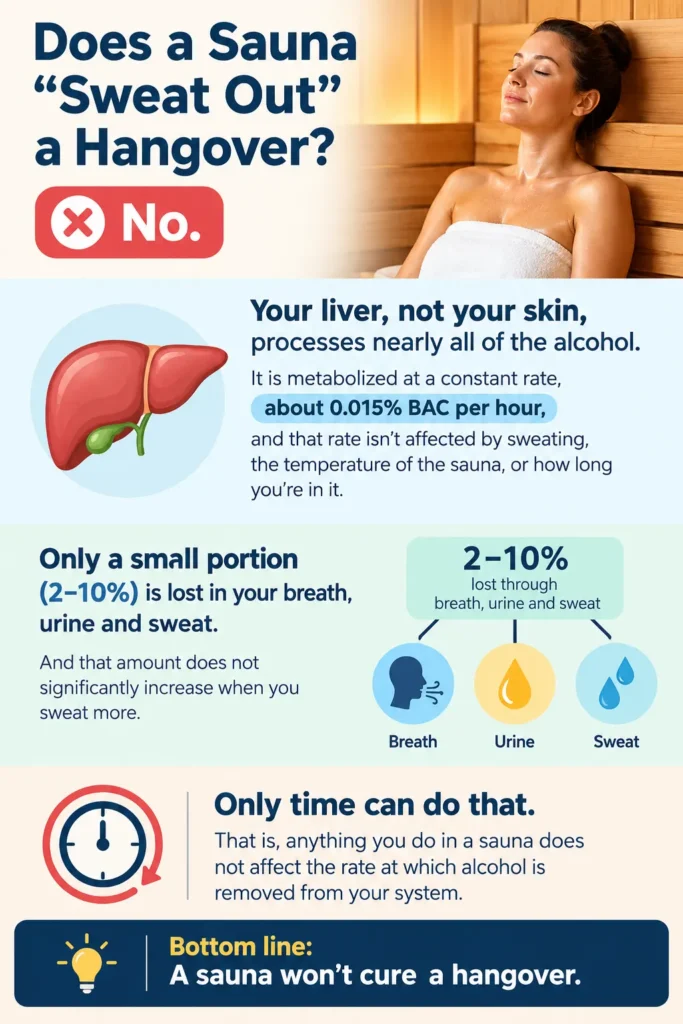
No. It’s one of the most entrenched myths in wellness culture, so let’s be blunt about why it’s incorrect. Your liver, not your skin, processes nearly all of the alcohol. It is metabolized at a constant rate, about 0.015% BAC per hour, and that rate isn’t affected by sweating, the temperature of the sauna, or how long you’re in it.
Only a small portion (2-10%) is lost in your breath, urine and sweat, and that amount does not significantly increase when you sweat more. That is, anything you do in a sauna does not affect the rate at which alcohol is removed from your system. Only time can do that.


Paid Links - As an Amazon Associate, I earn from qualifying purchases.
Why Sauna Heat Can Actually Make a Hangover Worse
This is the most important aspect if you are thinking about going to the sauna when you are hungover.
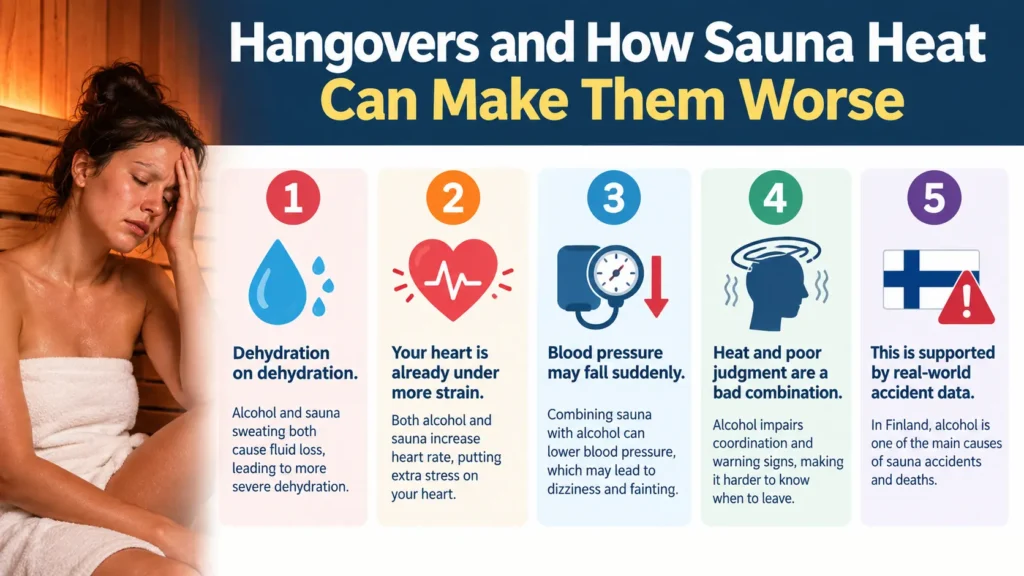
- Dehydration on dehydration. Alcohol is a diuretic, meaning that it causes you to lose more fluid than you consume, which is a big part of the reason you feel a headache and fatigued after a hangover. On top of that, there is fluid loss from sauna sweating. Together, this can lead to more severe dehydration than either factor alone.
- Your heart is already under more strain. During a typical infrared sauna session, your heart rate increases by about 30 to 50 percent above your rest rate, which is equivalent to moderate exercise. Your heart is already being affected by alcohol during a hangover, which may lead to an irregular or faster heart rate. It is generally thought that it is not a good idea to put additional strain on the heart from a sauna when it is already being strained by its own condition.
- Blood pressure may fall suddenly. According to a study published in the Journal of Internal Medicine, while sauna bathing alone did not affect the stability of systolic blood pressure, combining it with alcohol reduced the average blood pressure from 136 mmHg to 113 mmHg. That sudden drop in blood pressure can lead to dizziness and fainting, which is a serious issue in a close, enclosed area.
- Heat and poor judgment are a bad combination. When you still have alcohol in your system, your coordination, balance, and ability to recognize warning signs such as overheating or dizziness are all diminished. This is important because knowing when to leave a hot environment is the exact thing alcohol makes difficult.
- This is supported by real-world accident data. In Finland, where many people use sauna daily, alcohol has been found to be one of the main causes of sauna accidents and deaths every year. That is not a lab study, it is a pattern that is so serious that the health guidance in Finland explicitly states not to mix the two.
Does It Matter If It’s an Infrared Sauna Instead of a Traditional One?
Not in any way that alters the safety calculus. Infrared saunas operate at a lower ambient air temperature than traditional saunas, but they still heat your body directly and still increase your heart rate and core temperature. The cardiovascular strain, dehydration risk, and blood-pressure effects mentioned above are applicable to both hot air and infrared light.



Paid Links - As an Amazon Associate, I earn from qualifying purchases.
In fact, the lower temperatures at which infrared saunas are more comfortable may be misleading, and it may be easier to underestimate the level of stress that your body is under.
When Is It Actually Safe to Use a Sauna After Drinking?
| Situation | Sauna Use |
|---|---|
| Still feeling the effects of alcohol (any impairment) | Avoid entirely |
| Actively hungover: headache, nausea, dehydration, dizziness | Avoid until symptoms resolve |
| Alcohol fully metabolized, hangover symptoms gone, fully rehydrated | Generally fine for most healthy adults |
| History of heart arrhythmia, low blood pressure, or heavy drinking the night before | Talk to a doctor before resuming sauna use |
As a rough guide, remember that your liver clears roughly one standard drink per hour. If you had several drinks, plan on your body needing several hours — sometimes well into the next day — before alcohol is fully out of your system, separate from how your hangover symptoms feel.
What Actually Helps a Hangover
Since a sauna isn’t the answer, here’s what the evidence actually supports:
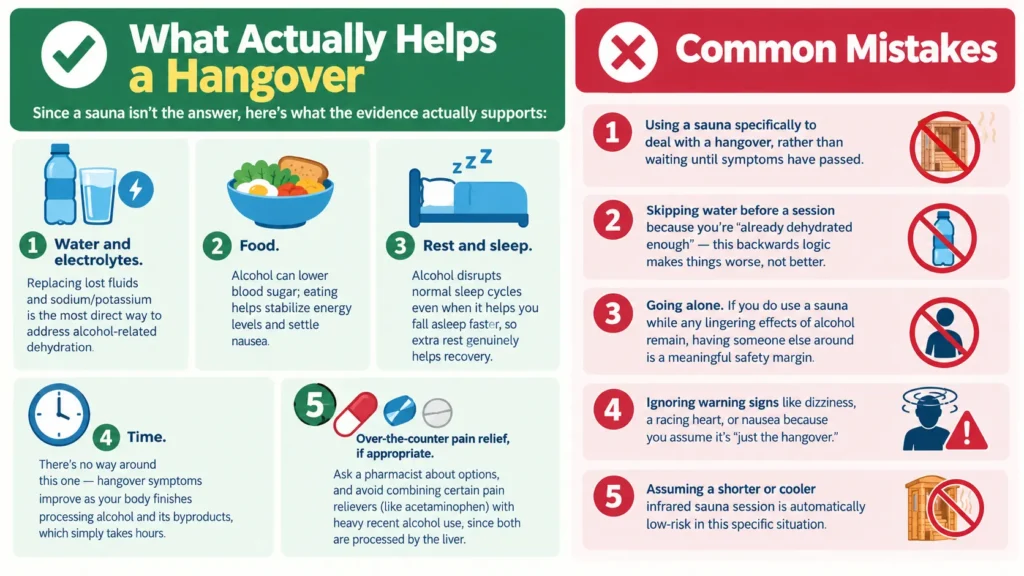
- Water and electrolytes. Replacing lost fluids and sodium/potassium is the most direct way to address alcohol-related dehydration.
- Food. Alcohol can lower blood sugar; eating helps stabilize energy levels and settle nausea.
- Rest and sleep. Alcohol disrupts normal sleep cycles even when it helps you fall asleep faster, so extra rest genuinely helps recovery.
- Time. There’s no way around this one — hangover symptoms improve as your body finishes processing alcohol and its byproducts, which simply takes hours.
- Over-the-counter pain relief, if appropriate. Ask a pharmacist about options, and avoid combining certain pain relievers (like acetaminophen) with heavy recent alcohol use, since both are processed by the liver.
Common Mistakes
- Using a sauna specifically to deal with a hangover, rather than waiting until symptoms have passed.
- Skipping water before a session because you’re “already dehydrated enough” — this backwards logic makes things worse, not better.
- Going alone. If you do use a sauna while any lingering effects of alcohol remain, having someone else around is a meaningful safety margin.
- Ignoring warning signs like dizziness, a racing heart, or nausea because you assume it’s “just the hangover.”
- Assuming a shorter or cooler infrared sauna session is automatically low-risk in this specific situation.
Myth vs. Fact
| Myth | Fact |
|---|---|
| “Sweating in a sauna helps flush alcohol out faster.” | Your liver processes alcohol at a fixed rate; sweating doesn’t speed this up. |
| “Infrared sauna is gentler, so it’s safer with a hangover.” | Lower ambient heat doesn’t reduce the cardiovascular strain or dehydration risk of combining heat and alcohol. |
| “A sauna will help me feel better faster.” | It’s more likely to worsen dehydration, dizziness, and nausea during an active hangover. |
| “It’s fine as long as I feel mostly sober.” | Feeling sober isn’t the same as having zero alcohol in your system — impairment and residual effects can outlast the obvious symptoms. |
| “People do this all the time, so it must be fine.” | Real-world accident data, particularly from Finland, shows alcohol is a recurring factor in sauna-related injuries and deaths. |
Frequently Asked Questions
Does infrared sauna help with a hangover?


Paid Links - As an Amazon Associate, I earn from qualifying purchases.
No. It does not increase the rate at which alcohol is metabolized and can exacerbate symptoms and cause cardiovascular stress if consumed while intoxicated or dehydrated.
Is it possible to sweat out alcohol in a sauna?
No, the rate at which alcohol is metabolized is constant at approximately 0.015% BAC per hour. A small percentage is lost in sweat, breath, and urine, and increasing sweat loss does not significantly increase that amount.
Can you use a sauna if you have a hangover?
It can be. Alcohol-induced dehydration, low blood pressure, and the already higher heart rate can cause actual dangers such as fainting and strain on the heart.
What is the best time to use a sauna after drinking?
There’s no magic number, but a good rule of thumb is to wait until alcohol has been completely metabolized (about one hour per standard drink) and until you’re fully rehydrated and hangover symptoms have subsided.
Will an infrared sauna be safer than a traditional sauna for a hangover?
Not meaningfully. During a hangover, both heat your body and increase your heart rate and risk of dehydration in the same way, regardless of the ambient temperature differences.
What really helps cure a hangover?
There is no quick fix for anything — hydrating, electrolytes, food, rest, and time are the only methods that have been shown to have evidence.
Can sauna use cause a heart problem if combined with alcohol?
The combination has been associated with a decrease in blood pressure and increased strain on the cardiovascular system, which is more dangerous for people who already have a heart condition, arrhythmia, or low blood pressure.
Final Thoughts
The honest answer to “does infrared sauna help with a hangover” is no — and in an active hangover state, it can genuinely make you feel worse or put unnecessary strain on your heart. The “sweat it out” idea sounds intuitive, but your liver doesn’t work any faster just because you’re warm, and the real risks of combining heat with alcohol’s effects on your blood pressure and hydration are well documented.
The better move is patience: hydrate, eat something, rest, and let time do what only time can do. Once you’re genuinely rehydrated and alcohol is fully out of your system, there’s nothing wrong with returning to your normal sauna routine — just don’t treat it as a hangover shortcut.