Which is better steam or infrared sauna? The answer will depend on your health goals, tolerance to heat and personal preferences.
Steam saunas use moist heat to induce relaxation as well as respiratory comfort while infrared saunas use radiant heat that penetrates deeper into the body at lower temperatures. Both provide real, scientific based benefits-but they’re not interchangeable.
In this guide, we’ll break down the difference between the two, what the health benefits are, how much weight you can lose in a sauna, how it affects your hair and skin, and even what experts and Reddit users are saying about it – so you can confidently choose the sauna that’s best for you.
Key Takeaways
- Steam saunas are moist heat and are best for hydration of the skin, sinus relief and relaxation.
- Infrared saunas are dry radiant heat saunas which may promote muscle recovery, circulation and metabolic health.
- For weight loss, infrared saunas are slightly more evidence – but neither is a substitute for diet or exercise.
- For the health of hair and scalp, the steam saunas are generally better.
- A steam and infrared sauna combo, when used safely, can have complementary benefits.
- Scientific discussions (including infrared vs steam sauna Huberman-style conversations) highlight heat exposure consistency – not extremes.
Which is Better Steam or Infrared Sauna?
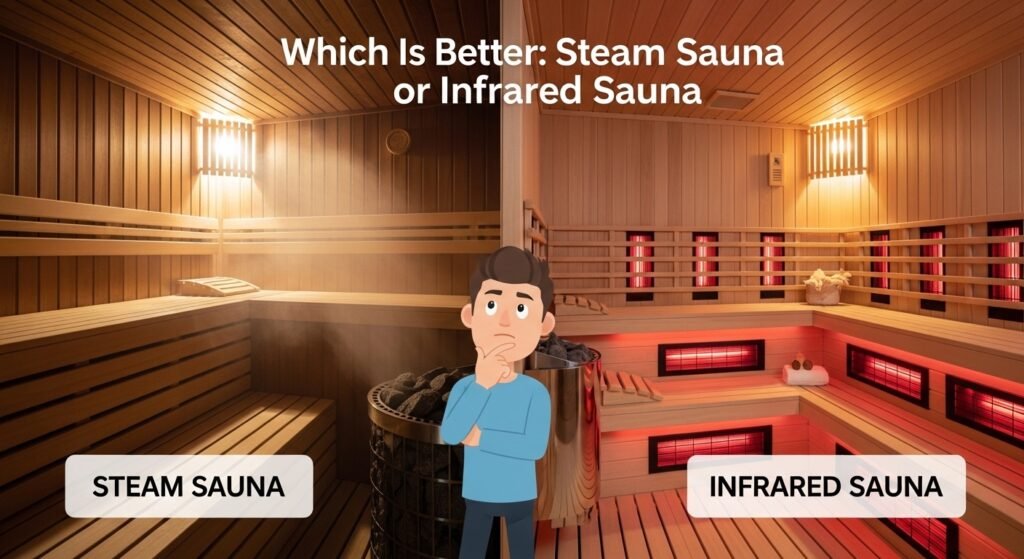
The debate on which is better steam or infrared sauna has reached a fever pitch in the wellness community. From Reddit threads to the Huberman Lab podcast everyone has an opinion. To know which one is right for you we have to look at the science behind how they heat your body.
The Steam Sauna (Traditional Experience)
Steam Saunas or “wet saunas” steam saunas use a steam generator to boil water to produce 100% humidity. The temperature is typically between 100–120°F (38–49°C), however the moisture makes it feel much hotter. It’s the classic experience of a spa – thick, heavy air that makes you feel like you are in a tropical rain forest.
Steam saunas are commonly used for:
- Opening pores
- Relieving nasal congestion
- Enhancing skin hydration
- Deep relaxation
The Infrared Sauna (Modern Technology)
In contrast, an infrared sauna doesn’t warm up the air around you. Instead, it uses infrared light waves to directly heat your body. This “radiant heat” lets you sweat extremely hard at lower and more comfortable temperatures (usually 120–150°F (49–65°C)).
Infrared saunas are often used for:
- Muscle recovery
- Circulation support
- Relaxation with lower heat stress
- Joint stiffness relief
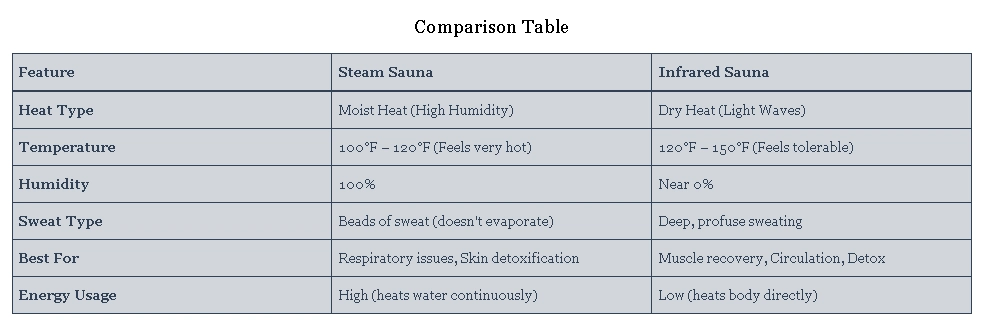
Comparison Table
| Feature | Steam Sauna | Infrared Sauna |
|---|---|---|
| Heat Type | Moist Heat (High Humidity) | Dry Heat (Light Waves) |
| Temperature | 100°F – 120°F (Feels very hot) | 120°F – 150°F (Feels tolerable) |
| Humidity | 100% | Near 0% |
| Sweat Type | Beads of sweat (doesn’t evaporate) | Deep, profuse sweating |
| Best For | Respiratory issues, Skin detoxification | Muscle recovery, Circulation, Detox |
| Energy Usage | High (heats water continuously) | Low (heats body directly) |
which is better steam or infrared sauna for hair

Steam Saunas
These are generally better than your hair. The moisture helps to hydrate the hair shaft and can help deep conditioning treatments to be much more effective. If you have curly or dry hair, then the steam is a godsend.
- Pros: Hydrates the scalp. If you apply a hair mask or oil beforehand, the steam helps it penetrate deeply. It can help loosen dandruff flakes.
- Cons: The “frizz factor.” If you have curly or color-treated hair, excessive moisture can swell the hair shaft and cause frizz or dullness.
Infrared Saunas
Since this is a dry heat, it can actually dry out your hair if you are not careful. If you’re infrared, you are best off wearing a hair wrap or using a protective oil before your session.
- Pros: Improves blood flow to the scalp, which can theoretically stimulate hair follicles (similar to the logic behind red light therapy for hair growth). It doesn’t ruin your blow-dry.
- Cons: It is dry heat. Like a desert, it can sap moisture from your hair strands if you are in there for a long time without protection.
Tip: If hair health is a major concern, apply a light oil (like jojoba or argan) to your ends before entering either sauna to act as a barrier.
Infrared vs Steam Sauna for Weight Loss
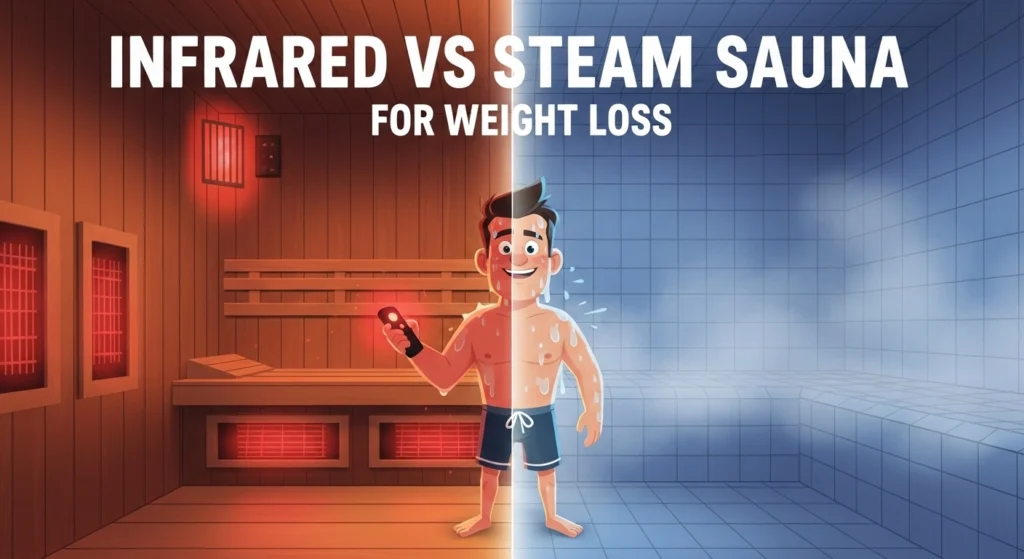
Let’s talk about the scale. Is one better at losing pounds?
When you are considering the options of infrared vs steam sauna for weight loss, it’s important to distinguish between water weight and fat loss. Both will cause you to lose water weight instantly through the sweat. However, infrared saunas are often cited as being superior for long term weight management.
Because the infrared rays penetrate deep into the body, they cause a higher metabolic response. Your heart rate rises much like a brisk walk and your body works harder to cool down your body, burning more calories per session. According to some studies, a 30-minute infrared session will help you burn anywhere between 200 and 600 calories, while steam rooms are usually lower in calorie burning due to their ability to not get the body to the same core temperature as fast.
Infrared vs Steam Sauna Health Benefits
When comparing infrared vs steam sauna health benefits, both are a power house for your heart. Heat exposure makes your blood vessels dilate (vasodilation), which improves the blood flow and reduces blood pressure over time.
1. Detoxification and Skin Health
- Steam Saunas: The high humidity opens up your pores and helps to clear out trapped dirt and oils. It is basically a face full treatment.
- Infrared Saunas: Because infrared heat is more penetrating it is thought that it can help the body to release heavy metals (like lead and mercury) and fat soluble toxins better than surface-level sweating.
2. Muscle and Joint Relief
If you’re comparing infrared sauna vs traditional sauna which is better for recovery, infrared tends to take the cake. The light waves penetrate to the joints and muscle fibers, which diminishes inflammation. This makes it a favorite for people who suffer from chronic pain or arthritis.
3. Respiratory Relief
This is where the steam sauna comes in. If you have seasonal allergies, asthma, or congestion the moist heat is a natural expectorant and soothes your throat & lungs in a way that is not possible with dry infrared heat.
Which is Better for You: Steam or Infrared Sauna?
Deciding which is better for you steam or infrared sauna comes down to personal preference and physical tolerance
Choose a Steam Sauna if:
- You like the feeling of being in a tropical rainforest.
- You have respiratory problems such as sinusitis, bronchitis, or asthma (the moist air assists in clearing up mucus).
- You want a deep hydration of the skin and cleansing of the pores.
- You don’t mind getting very hot, very fast.
Choose an Infrared Sauna if:
- You hate the suffocating sensation of taking in humid air.
- You are sensitive to high heat and still want to sweat.
- You are focused on recovery of any muscle or pain in your joints or chronic pain (such as arthritis).
- You want to read or listen to music while you sweat (the lower temperature of the air makes this easier).
Infrared Sauna Steam Combination
Did you know you don’t have to choose? There is an infrared and steam sauna combo. These are hybrid units that have infrared heaters that are installed in the walls of a room that can also serve as a steam room.
These units will let you start with the dry infrared heat to warm up your core, and then turn on the steam generator as well for the last 10 minutes to open pores and hydrate the skin. It is the best of both worlds but these units are generally more costly and need to be professionally installed with a lot of electric and plumbing work.
You May Also Like To Read:
FAQs
Can I go in a steam or infrared sauna everyday?
Yes, for the most part, for healthy adults, daily use is safe. However, you should do this slow (15-20 minutes) and listen to your body. It is very important that you stay hydrated if you are saunaing on a daily basis.
Which one is better for beginners?
Infrared saunas are generally better for beginners as the air temperature is lower (120degF – 140degF) and doesn’t feel as stifling as a steam room. That way you have the luxury of being able to breathe easier while your body acclimates to the heat.
Which one is more costly to operate?
The infrared saunas are generally less expensive to use. They heat up quickly (10-15 minutes) and consume less energy than a steam generator, which is required to continuously boil water to keep the humidity and temperature of the rooms.
Do saunas actually burn calories?
They do raise your heart rate and metabolic rate a little and will burn off some calories but should not be substituted for a healthy diet and exercising. The weight loss due to perspiration is nearly all water weight.
Is steam or infrared better for sinus infections?
Steam. The moist heat thins the mucus and helps to clear a congested sinus and lungs. A dry heat will sometimes irritate dry nasal passages of an infrared sauna.
Which is better for you steam or infrared sauna if you have a high blood pressure?
Both can be beneficial but infrared saunas are often more easily tolerated as the air temperature is lower inside and therefore the lungs are not under as immediate “suffocating” stress. Always consult with your doctor first.
Final Thoughts
After analyzing the benefits of steam sauna vs infrared sauna, looking at the infrared vs steam sauna for weight loss potential, and considering expert opinion like the infrared vs steam sauna huberman perspective, the line is drawn in the sand.
- If you want deep tissue penetrating, muscle recovery and a tolerable environment to relax in for long periods of time: Infrared is better.
- If you want intense heat, respiratory relief and a good skin cleanse to the point where you actually feel flushed and hydrated, then: Steam is better.
Many wellness enthusiasts actually use both in their routine – using infrared to aid their post-workout recovery, and steam for relaxation and skin care on the weekends.