When investing in a home wellness sanctuary, the heating elements and tech specs often steal the spotlight, but the material enclosing you is equally vital.
So, what’s the best wood for an infrared sauna? The short answer is that Basswood and Cedar are the top contenders, with Basswood being the superior choice for those with chemical sensitivities due to its hypoallergenic properties.
while Western Red Cedar remains the gold standard for durability and natural antimicrobial benefits.
Choosing the right lumber isn’t just about aesthetics; it dictates the longevity of your sauna, the purity of the air you breathe, and your overall relaxation experience.
In this comprehensive guide, we will break down Which Infrared Sauna Wood is Best? the specific pros and cons of each wood type, compare industry giants like Sunlighten and Clearlight, and help you decipher which material suits your health needs and budget.
Disclaimer: This content is for informational purposes only and not a substitute for professional medical advice. Always consult with a healthcare provider before starting any new wellness routine, especially if you have pre-existing health conditions.
Key Takeaways
- Hypoallergenic vs. Aromatic: Basswood and Poplar are best for chemical sensitivities; Cedar offers a distinct aroma and natural anti-fungal properties.
- Durability Matters: Cedar and Eucalyptus resist warping and cracking better than softer woods, making them ideal for high-heat environments.
- Avoid Toxic Materials: Never use plywood, particle board, or woods treated with chemical sealants, as these can off-gas harmful toxins when heated.
- Brand Specifics: Brands like Sunlighten often use Eucalyptus or Basswood, while Clearlight champions Cedar, influencing the “wood vs infrared sauna” user experience.
Understanding the Importance of Sauna Lumber
Before getting into specific species, it is very important to understand the importance of wood selection. Unlike the traditional sauna which works by heating the air, mainly using a stove and rocks, an infrared sauna uses electromagnetic radiation to heat your body directly.
However, the cabin still reaches temperatures from 120°Fahrenheit to 150°Fahrenheit.
When you ask, what is the best wood for infrared saunas, you are essentially asking what material will stand up to repeated cycles of heating and cooling without warping, cracking or releasing volatile organic compounds (VOCs).
The Dangers of Poor Quality Wood
Many budget-friendly sauna manufacturers cut costs by using thin panels or worse – laminated woods & plywood. The glue used in these composites can degrade in the heat giving off formaldehyde and other toxins. This invalidates the purpose of detoxification.
A good wood infrared sauna should also always use solid wood tongue and groove construction for structure and air purity.
Top Contenders: A Detailed Breakdown
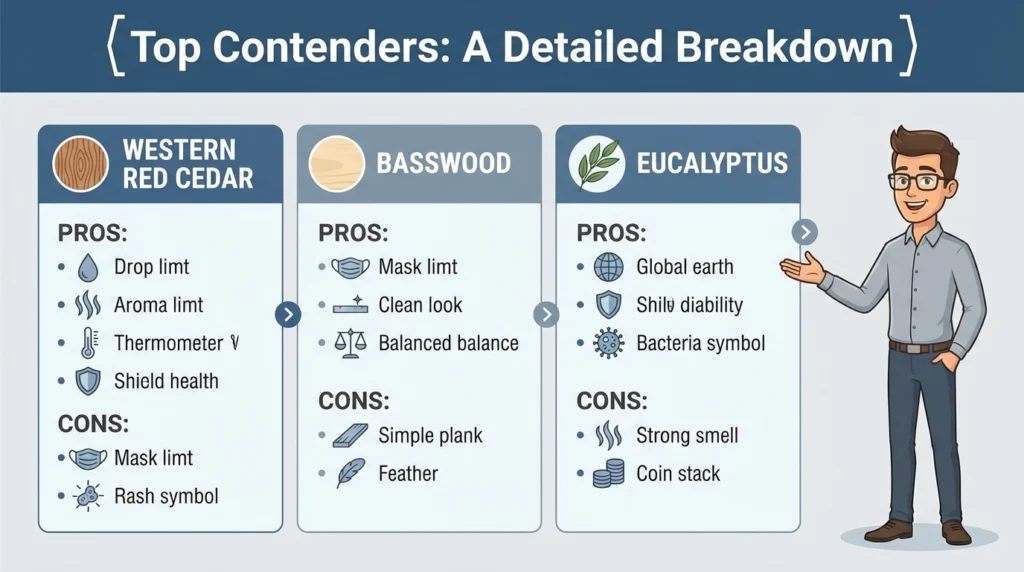
1. Western Red Cedar: The Traditional Choice
If you look at some forums with the question “which infrared sauna wood is best reddit,” Western Red Cedar will probably be the most common answer. It has been the mainstay of building saunas for decades, and for good reason.
Pros:
- Natural Oils: Cedar contains natural oils (thujaplicins) which act as a preservative and this helps cedar to be highly resistant to rot, decay, and insect infestation.
- Aroma: The distinctive, woody aroma is a major attraction to many users. It helps to make the relaxation experience.
- Thermal Properties: It is a great insulator and when the sauna is hot it still keeps cool to touch.
- Durability: It is resistant to warping and checking (cracking) compared to many softer woods.
Cons:
- Sensitivities: Some people find the intense smell overwhelming or irritating to the sinus.
- Allergies: Though a rare occurrence, some individuals have a specific allergy to cedar.
Verdict: If you are a fan of the traditional smell of a sauna and you want a unit that will last for 20+ years, Cedar is a premium choice.
2. Basswood: The Hypoallergenic King
When talking about basswood vs eucalyptus for sauna construction, Basswood will often win for those who are most interested in health. It is a hardwood variety that is found in North America and is famous for containing zero odor.
Pros:
- Hypoallergenic: Basswood lacks any resin, odor, or oils making it the safest wood for people who have severe allergies, are asthmatic, or have Multiple Chemical Sensitivity (MCS).
- Appearance: It has a light and creamy color which has a smooth and uniform grain that appears modern and clean.
- Stability: It is a dense wood with good holding strength to heat without excessive expansion or contraction.
Cons:
- Lack of Character: Some users feel that the light color is too basic.
- Softness: It is a softer hardwood capable of denting more easily than Cedar.
Verdict: If you have Asthma or Chemical Sensitivities, Basswood is the Answer to “what wood is best for sauna” construction for your specific needs.
3. Eucalyptus: The Sustainable Modern Option
You will see Sunlighten eucalyptus sauna models often when you are shopping. Eucalyptus has become a popular choice as a sustainable and eco-friendly material.
Pros:
- Sustainability: Eucalyptus grows fast so it is a renewable resource.
- Durability: It is very strong and stable, often being stronger than Cedar.
- Antibacterial: Like Cedar, it has natural anti-bacterial properties.
Cons:
- Scent: While lighter than Cedar, and it does have a medicinal scent which might not be for everyone.
- Cost: Eucalyptus of good quality is sometimes more expensive than domestic Basswood.
Brand Showdown: Sunlighten vs. Clearlight
It often is a matter of choice of wood depending on the manufacturer. Two leaders from the industry getting the market standard.

Sunlighten Sauna
Sunlighten is famous for their proprietary SoloCarbon heaters. when it comes to materials, Sunlighten offers a choice between Sunlighten eucalyptus sauna cabins and hypoallergenic Basswood.
- Why choose them? If you are looking for state of the art heater technology with sustainable wood options. Their eucalyptus is sustainably forestry and free of any chemical additives.
Clearlight Sauna
Clearlight usually has a choice of Western Red Cedar or North American Basswood. One of the features that a Clearlight sauna is often praised for is their “True Wave” heaters and lifetime warranty.
- Why choose them? They are very much focussed on low-EMF and ELF technology. If you want the classic Cedar experience, but you want high tech safety features, Clearlight is a great contender.
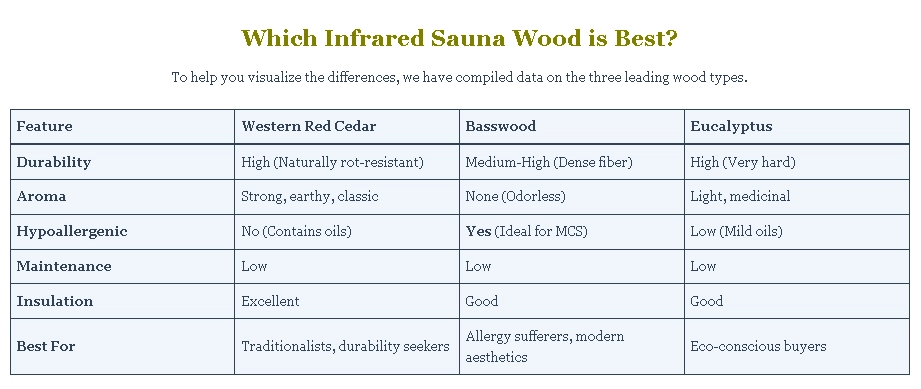
Which Infrared Sauna Wood is Best?
To help you visualize the differences, we have compiled data on the three leading wood types.
| Feature | Western Red Cedar | Basswood | Eucalyptus |
|---|---|---|---|
| Durability | High (Naturally rot-resistant) | Medium-High (Dense fiber) | High (Very hard) |
| Aroma | Strong, earthy, classic | None (Odorless) | Light, medicinal |
| Hypoallergenic | No (Contains oils) | Yes (Ideal for MCS) | Low (Mild oils) |
| Maintenance | Low | Low | Low |
| Insulation | Excellent | Good | Good |
| Best For | Traditionalists, durability seekers | Allergy sufferers, modern aesthetics | Eco-conscious buyers |
Wood vs Infrared Sauna: Does the Material Affect Performance?
One of the most common points of confusion is the “wood vs infrared sauna” comparison.
This phrase typically occurs in a comparison of a traditional wood burning sauna to an electric infrared model. However, in the context of this article we are looking at the effect of the wood material on the infrared performance.
The wood does not block the infrared waves but does affect heat retention. Cedar is a better insulation, which means that the sauna warms up quicker and holds the heat more efficiently, using less energy.
On the other hand, if you construct a unit using thin or poor wood, then the heater must work harder.
If you are asking, “can you build your own infrared sauna,” the answer is yes. However, you must source the quality of lumber.
If you are asking “can i make my own infrared sauna” out of leftover plywood from a construction site the answer is a hard no. The off-gassing of the glues and resins in composite woods can be dangerous to your health.
Future-Proofing: Trends for 2026
Looking forward to “which infrared sauna wood is best 2026” sustainability is going to be the defining factor. Consumers are becoming increasingly demanding when it comes to transparency regarding where it comes from.
- FSC Certified Woods: Expect to see more Forest Stewardship Council (FSC) certified Cedar and Eucalyptus.
- Thermally Modified Woods: Woods that have been treated with heat (instead of chemicals) to make them more durable are coming on the market. This provides the durability of Cedar that does not contain the oils, ideal for the chemically sensitive.
- Minimalist Finishes: The trend is switching from dark stains and going towards the natural, light look of raw Basswood or Ash.
How to Choose the Best Infrared Sauna for Your Home
When deciding how to choose the best infrared sauna, wood is just one piece of the puzzle. Here is a checklist to ensure you are making a sound investment:

- Inspect the Thickness: Walls should should be minimum 5mm to 7mm thick. Thin walls warp.
- Check the Glue: Make sure that the manufacturer uses non-toxic, water-based glues. Ask for Material Safety Data Sheet (MSDS) if in doubt.
- EMF Levels: No matter what wood is used, make sure that the sauna has low EMF (Electromagnetic Field) ratings.
- Warranty: A company that believes in the quality of its wood will provide a lifetime warranty on the cabin.
What is the Best Way to use an Infrared Sauna?
Once you’ve chosen your wood and established your sanctuary it’s important to know what is the best way to use an infrared sauna to ensure you get the most out of it.

- Hydrate: Drink water before you step through the door.
- Temperature: Set it between 120°F – 130°F. Unlike traditional saunas, higher isn’t necessarily better with infrared-you want the waves to penetrate not just the air to burn.
- Duration: Start with 15 minutes and increase to 30-40 minutes.
- Wipe Down: If you have a Cedar or Eucalyptus sauna, wipe down the benches with a damp cloth after use to preserve the wood and prevent odors.
You May Also Like To Read:
- Does Infrared Sauna Help With Digestion, Bloating & How
- Infrared Sauna Before or After Eating: What’s the Best Time?
FAQs
Is Cedar or Basswood better for an infrared sauna?
It just depends on your health profile. Cedar is superior in terms of durability and longevity, as well as aroma. Basswood is better for individuals with respiratory problems or chemical sensitivities for being odorless and hypoallergenic.
What does make a good infrared sauna wood?
A good wood has to be solid (not laminate), not warp under heat, not treated with chemicals, and pleasant to sit on. It should also be non-conductive, so as not to get too hot to the touch.
Can I use any wood for a sauna?
No. You should avoid resinous softwoods such as Pine or Spruce which emit a sticky sap when heated. You have to absolutely avoid plywood, particle board or pressure treated wood because of toxic off gassing.
Why Cedar is so popular in sauna?
Cedar is popular because it is naturally mold, mildew, and decay resistant which is very important in the moist environment of a sauna (even dry infrared saunas involve sweat). It also smells amazing and feels amazing to the touch.
How long does infrared sauna wood last?
With careful maintenance, good quality Cedar or Basswood sauna wood will last 15 to 25 years or longer. The most important is to provide proper ventilation of the room to let it dry out between sessions.
Final Thoughts
So, which infrared sauna wood is best? There isn’t a single winner, but there is a winner for you.
If you are a traditionalist who craves the authentic sauna experience and wants a cabin that resists mold effortlessly, Western Red Cedar is your match.
However, if you are purchasing a sauna for detoxification and suffer from allergies or sensitivities, Basswood is undeniably the superior option.
By focusing on solid wood construction, non-toxic glues, and reputable brands like Sunlighten or Clearlight, you ensure that your investment yields health benefits for years to come. Don’t compromise on the material—your lungs and your relaxation will thank you.