Trying to decide between an infrared sauna vs. traditional sauna? The short answer is: if you prefer intense heat and the classic “spa” experience, a traditional sauna is better.
However, if you seek a lower-temperature environment that penetrates deep into your tissues for targeted muscle recovery, an infrared sauna is the superior choice. Ultimately, the “winner” depends entirely on your personal health goals, heat tolerance, and budget.
Infrared Sauna vs. Traditional: in this depth guide we Compare health benefits, weight loss, cost, research, pros & cons to find which sauna is better for you.
Medical Disclaimer: This article is for informational purposes only and does not constitute medical advice. Always consult with a qualified healthcare professional before starting any new heat therapy regimen, especially if you have pregnant or pre-existing health conditions.
Key Takeaways
- Heat Source: Traditional saunas use heat to heat the air (convection) whereas infrared saunas use light waves to heat your body directly (radiant).
- Temperature: Traditional saunas are much hotter (150°F – 195°F) than infrared saunas (120°F – 140°F).
- Health Goals: If you are looking for intense sweating and cardiovascular stimulation that is similar to moderate exercise, traditional is king. For deep tissue relaxation and for lower heat tolerance choose infrared.
- Cost & Installation: Infrared saunas tend to be cheaper to operate and are simpler to install, and may not even need any special wiring or ventilation.
What is the Difference Between Infrared Sauna and Traditional Sauna?
To understand the infrared sauna vs. traditional debate, we first need to take a look at the mechanics. At their base, both work to bring about sweating and relaxation, but the way they do both is fundamentally different.

The Traditional Experience
A traditional sauna is often called dry sauna or Finnish sauna, and it uses a stove (wood-burning or electric) to heat rocks. This heats the air in the cabin to high temperatures, usually between 150°F and 195°F.
You are basically sitting in an oven; the hot air is all around you and raises your body temperature. Often water can be poured over the rocks to make steam (löyly), thereby raising the humidity and apparent heat.
The Infrared Experience
In contrast, a infrared sauna uses infrared lamps (electromagnetic radiation) to warm up your body directly. Instead of heating up the air around you, the infrared light penetrates your skin and heats you from the inside out.
Because the air isn’t doing the heavy lifting, the ambient temperature is much lower (typically between 120°F and 140°F).
This distinction is the most important factor in the difference between infrared sauna vs. traditional sauna. It changes everything from the feeling of the session to the specific health benefits that you may get.
Infrared vs. Traditional Sauna Health Benefits
Both types of saunas have a plethora of health benefits, which are largely centered around the theory of heat therapy. However, there are slight differences in the specific physiological responses.

Cardiovascular Health
Research shows that both types have the ability to imitate the effects of moderate exercise on the heart. A study published in the Journal of Human Hypertension demonstrates that regular sauna bathing (traditional) is related to a lower risk of cardiovascular disease.
When we look at infrared vs traditional sauna research, traditional saunas tend to produce a more rapid spike in heart rate as a result of the intense heat stress. This high heat causes the heart to pump faster in order to cool down the body, resulting in a “passive cardio” workout.
Detoxification
This is a hot topic. Benefits of Infrared Sauna vs. Traditional Models Aside, proponents of the infrared sauna tend to claim that the infrared heat is what triggers a “deeper detox.”
While the science on “detoxing” through sweat is mixed (the liver and kidneys do most of the work), infrared saunas do produce a vigorous sweat at lower temperatures.
Some analysis has indicated that sweat from infrared saunas may contain a higher ratio of bi-products such as heavy metals than traditional sweat, which is mostly water and salt but it is still an area of debate within the scientific literature.
Pain Relief and Circulation
If you are looking at infrared vs traditional sauna for muscle recovery, infrared often comes out on top. The deep penetrating heat of infrared waves can increase blood flow to specific areas of muscle tension than hot air can.
This makes it a favorite of athletes to soothe sore muscles and joint pain, such as arthritis.
Expert Insights: Infrared vs. Traditional Sauna Huberman & Rhonda Patrick
No discourse about the science of sauna is complete without some mention of the leading health experts. When taking a look at infrared vs traditional sauna huberman style, or Dr Rhonda Patrick protocols specific patterns are seen.
The Huberman Perspective
Andrew Huberman, a neuroscientist at Stanford, often writes about the benefits of taking a long time to have a hot one. In infrared vs traditional sauna huberman context, he often is in favor of traditional saunas for one thing – heat shock proteins.
Huberman points out that the heated temperatures of traditional saunas are more efficient in triggering Heat Shock Proteins (HSPs). These proteins help in repairing the damaged cells and protecting against the oxidative stress.
While infrared saunas do cause an increase in core body temperature, typically the high heat stress needed to get HSP to be released is better achieved in a traditional setting.
The Rhonda Patrick Standard
Dr. Rhonda Patrick is a great proponent of Finnish-style sauna use. In her analysis of rhonda patrick infrared sauna vs. traditional, she discusses epidemiological studies from Finland that prove that frequent use of traditional saunas is associated with a significantly lower risk of dementia, cardiovascular disease and all-cause mortality.
However, both experts concede that the “best” sauna is the one that you’ll use on a regular basis. If the extreme heat of a traditional sauna is too much to deal with, then an infrared sauna is a good alternative that can still deliver significant health benefits.
Infrared vs. Traditional Sauna: Pros and Cons
Let’s break down the infrared vs traditional sauna pros and cons to help you weigh your options practically.
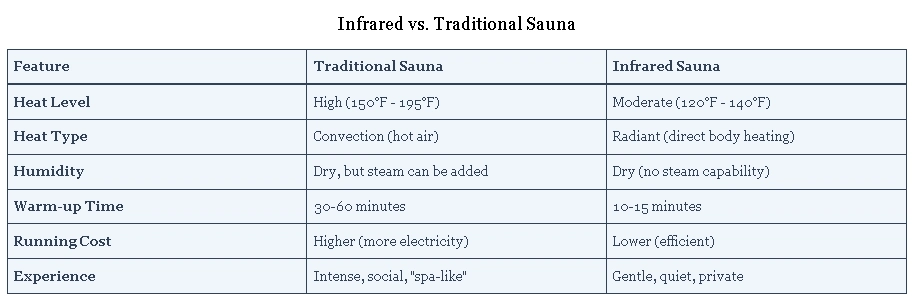
Infrared vs. Traditional Sauna
| Feature | Traditional Sauna | Infrared Sauna |
|---|---|---|
| Heat Level | High (150°F – 195°F) | Moderate (120°F – 140°F) |
| Heat Type | Convection (hot air) | Radiant (direct body heating) |
| Humidity | Dry, but steam can be added | Dry (no steam capability) |
| Warm-up Time | 30-60 minutes | 10-15 minutes |
| Running Cost | Higher (more electricity) | Lower (efficient) |
| Experience | Intense, social, “spa-like” | Gentle, quiet, private |
Pros of Traditional Saunas
- The “True” Experience: For true purists there is just nothing quite like the blast of heat, and the ability to add steam.
- High Heat Tolerance: If you are one who loves to get an extreme workout, this will be a higher intensity session.
- Social Aspect: They tend to accommodate more people in a more comfortable manner.
Cons of Traditional Saunas
- High Energy Usage: In order to heat a room to 190°F, a lot of energy is required.
- Installation: Often requires special electrical wiring and special ventilation.
- Heat Tolerance: The high temperature can be suffocating to beginners or those who have health sensitivities.
Pros of Infrared Saunas
- Lower Operating Cost: Generally lower cost to operate.
- Direct Heating: Excellent for people who don’t like the sensation of breathing hot air.
- Easy Installation: Many plug directly into standard outlets.
Cons of Infrared Saunas
- No Steam: You will not be able to pour water on the rocks to cause a steam burst.
- Less Intense: “Sauna purists” may find the lower temperature is unfulfilling.
Infrared vs Traditional Sauna for Weight Loss
Neither are magic weight loss pills. However, infrared vs traditional sauna weight loss comparisons show that infrared saunas may have a slight edge in burning calories.
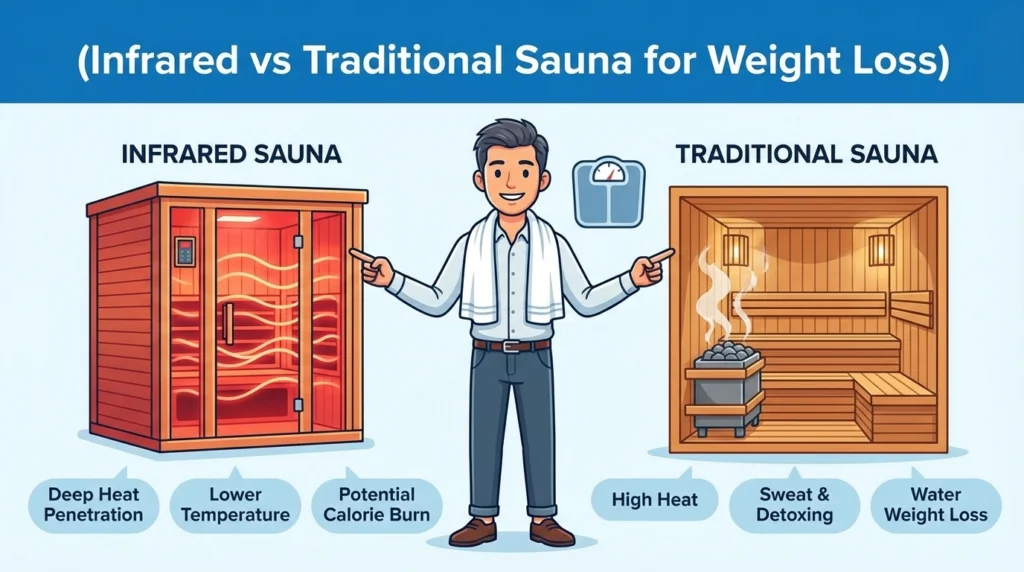
Because infrared heat penetrates to a deeper level, your body must work harder to cool itself down which may increase your metabolism rate better than a steam room (which utilizes humid heat).
But much of the immediate weight loss experienced after any stay in the sauna is water weight. In order to keep the weight off, you need to re-hydrate right away. The real benefit comes from the relaxation and muscle recovery to allow you to be active and exercise harder later.
The Reddit Verdict: Infrared Sauna vs. Traditional Sauna Reddit Threads
So if you scour forums such as Reddit to find out what real users think the infrared sauna vs. traditional sauna reddit consensus is quite telling.
- The “Feels” Factor: Traditional users on Reddit often report that infrared doesn’t “feel” like a sauna. They miss the intense sweat and the ritual of ladling water over rocks.
- The Health Factor: A number of the Reddit users with chronic pain or Lyme disease report improved management of their symptoms with infrared.
- The Convenience Factor: Homeowners prefer infrared for ease of installation. One well received comment was, “I bought an infrared because I didn’t want to rewire my garage.” “It works, but I still go to the gym for a traditional Finnish Bake on the weekends.”
Which is Better For You?
In the battle of infrared sauna vs. traditional sauna which is better, the answer is subjective.
Choose a Traditional Sauna if:
- You love intense heat and high temperatures.
- You want the classic social sauna experience.
- You are following specific protocols (like Dr. Rhonda Patrick’s) that emphasize high heat for Heat Shock Proteins.
Choose an Infrared Sauna if:
- You find traditional saunas too hot or suffocating.
- You want a cost-effective option for your home that plugs into a standard outlet.
- Your primary goal is muscle recovery, pain management, or skin health.
Ultimately, the best sauna is the one that fits your lifestyle and encourages you to use it consistently. Whether you choose the ancient heat of a Finnish dry sauna or the modern technology of a full-spectrum infrared pod, you are making a healthy investment in your longevity.
You May Also Like To Read:
- What to Do Before and After an Infrared Sauna
- What to Avoid Before and After an Infrared Sauna Session
FAQs
Is infrared sauna superior to regular sauna?
Neither is objectively “better.” An infrared sauna is more suitable for those who prefer lower temperatures and deep tissue heating whereas a regular (traditional) sauna is more suitable for those who prefer high heat and cardiovascular intensity.
Is infrared sauna as good as the regular sauna?
Yes, but in different ways. Infrared saunas are great for targeted recovery for muscles and work at lower and more tolerable temperatures. Regular saunas are best for those who prefer the traditional high-heat effect and the tough cardio “workout” effect.
What is better infrared or dry sauna?
A “dry sauna” is simply a traditional sauna that does not have steam. This is up to you depending on your heat tolerance. If you want deep tissue penetration at 130°F, go infrared. If you want the ability to be able to tolerate high heat and potentially add steam, go dry/traditional.
Will you lose weight in an infrared sauna?
Yes, you can burn calories as your body works to cool itself down. But, most immediate weight loss is water weight. Infrared saunas have the potential to help you lose weight by boosting your metabolic rate and alleviating stress but they are not a replacement for diet and exercise.
How often should I use a sauna?
Most experts suggest going to a sauna 3 to 4 times a week for 20 minutes to benefit health. Always keep hydrated before and after.
Final Thoughts
Navigating the world of heat therapy can be overwhelming, but the choice between infrared sauna vs. traditional doesn’t have to be a cause of stress. It really comes down to a simple trade off between intensity and penetration.
If you are a purist and you crave that blast of hot air and the ability to push yourself through some extreme temperatures to get cardiovascular conditioning, then the traditional route is your best bet.
On the other hand, if you may be seeking a gentle, therapeutic experience that works well within your home and budget that targets deep muscle aches then infrared is the clear winner.
The most important thing to take away here is consistency. The health benefits of sauna bathing, ranging from better heart health to improved sleep, accrue over time.
The “better” sauna is simply one that suits your lifestyle, budget and comfort level so well, that you actually look forward to stepping inside it every single time. Choose the heat that heals you, and make a regular part of your wellness routine.