Thinking of turning your house into your own wellness retreat? You aren’t alone. As we enter 2026, the demand for home wellness technology is greater than ever before, and the infrared sauna is at the pinnacle of the list.
But before you can sweat out the stress of the day you are probably wondering about the logistics: Infrared Sauna Installation and the ongoing hit to your wallet.
Here is the quick answer: For most standard home models, the infrared sauna installation and operating cost USA residents can expect average somewhere from $50 to $200 for setup (if DIY), to somewhere around $15 to $45 per month in electricity, depending on usage. It is surprisingly affordable, and easier to set up than you might imagine.
In this guide, we are going to Infrared Sauna Installation guide for 2026. Learn setup requirements, wiring, space needs, and full infrared sauna installation and operating cost in the USA.
Key Takeaways
- Affordable Operation: Having an infrared sauna is way more affordable than other steam saunas, ranging from $0.20 to $0.50 per session.
- DIY-Friendly: Most infrared saunas are made to be easily put together with no special tools, but electrical considerations are critical.
- Electrical Variance: While many smaller units are designed to be run off of standard 110v/15amp receptacles, larger or commercial grade units may need a dedicated 220v setup.
- Location Matters: Having the right flooring (avoid deep pile carpet right under the heater) and ventilation is the key to longevity and safety.
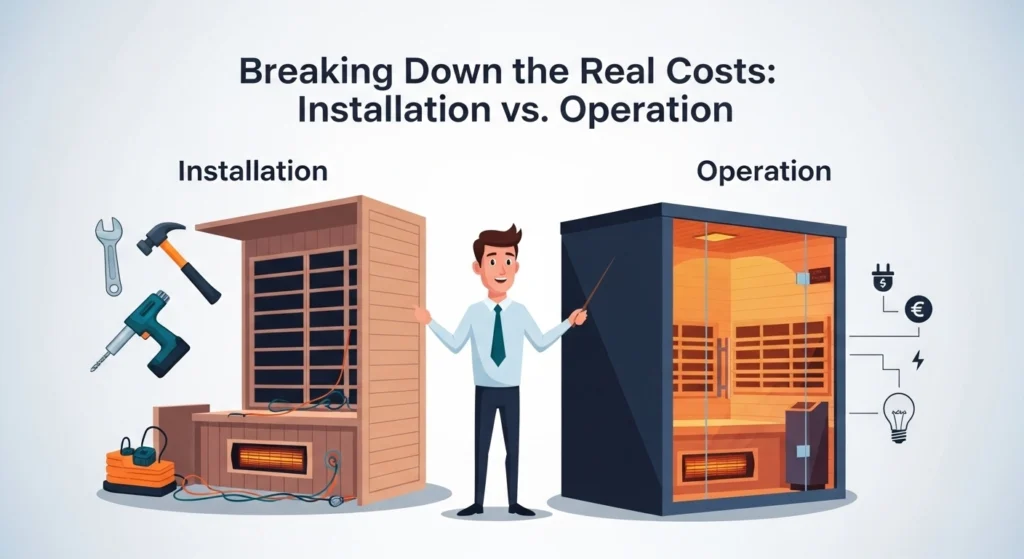
Breaking Down the Real Costs: Installation vs. Operation
When working your budget for a sauna, you have two different buckets for your finances: the cost of setting it up and the cost of the utilities. Understanding the difference is very important in order to avoid surprises.
How Much Electricity Is Used By an Infrared Sauna?
One of the biggest myths is that these units are energy hogs. In fact, infrared saunas are fairly efficient. Unlike traditional saunas that heat up the air around you, infrared heaters heat up your body directly. Along with that, this means that they require less energy to achieve the desired therapeutic effect.
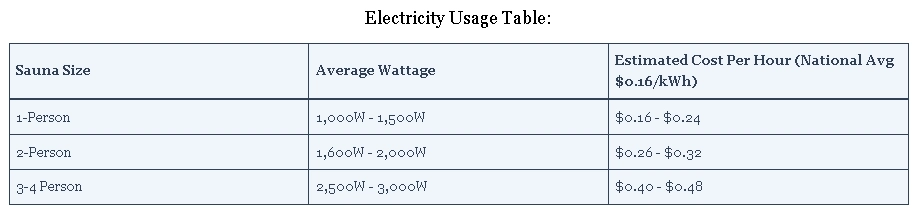
Most infrared saunas that are found in a household use between 1,000 to 3,000 watts of power. To put that in perspective, that is roughly equivalent to a standard space heater or a hair dryer running constantly.
Electricity Usage Table:
| Sauna Size | Average Wattage | Estimated Cost Per Hour (National Avg $0.16/kWh) |
|---|---|---|
| 1-Person | 1,000W – 1,500W | $0.16 – $0.24 |
| 2-Person | 1,600W – 2,000W | $0.26 – $0.32 |
| 3-4 Person | 2,500W – 3,000W | $0.40 – $0.48 |
Note: Costs are estimates based on 2025-2026 projected energy rates.
Infrared Sauna Monthly Operating Cost
If you use your sauna four times a week for 45 minutes a session, the amount of impact you have on a monthly basis is minimal. The average cost of the infrared sauna monthly is $15-$30.
If you are calculating this manually, then you can use an infrared sauna installation and operating cost calculator logic: (Wattage x Hours Used x Days x Rate) / 1000.
Installation Costs: DIY vs. Pro
The sauna installation cost can vary wildly depending on your handyman skills.
- DIY: Most prefab units are free to install the self, apart from your time.
- Professional: If you do a search for “sauna installation near me“, you are likely to find contractors charging between $200 and $500 for assembly work, which does not include the work of an electrician.
- Electrical Work: This is the concealed cost. If you require a new dedicated circuit an electrician will charge $150 to $500 depending on the capacity of your panel.
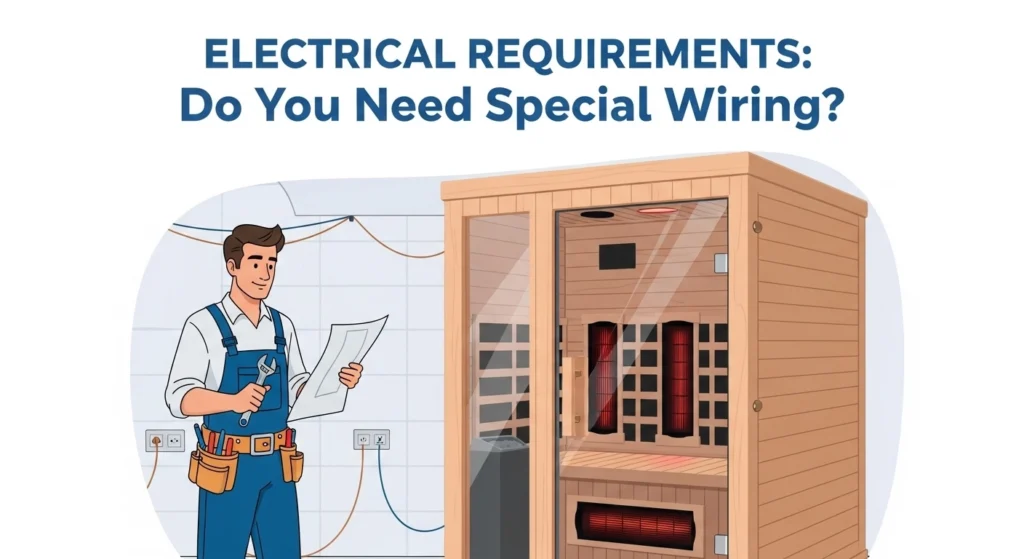
Electrical Requirements: Do You Need Special Wiring?
This is the part that scares people but it shouldn’t. Let’s take the mystery out of the volts and amps.
Infrared Sauna 110v vs 220v Setup
Most residential infrared saunas are designed to be plugged into the standard wall outlet. This is the issue of infrared sauna 110 vs 220v set up that is settled for the majority of homeowners:
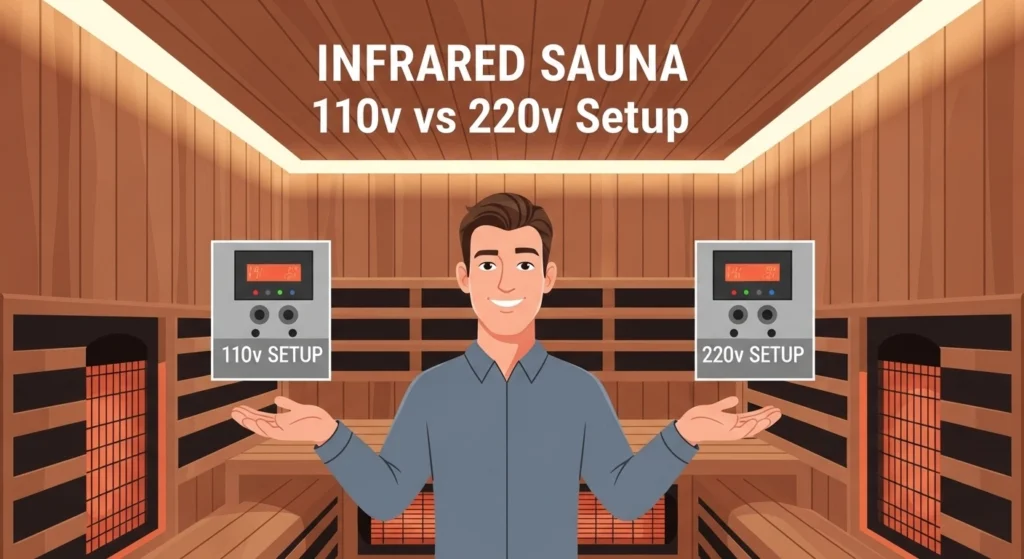
- 110v (Standard): Ideal for 1-2 person saunas. You can usually plug and play. However, you must ensure the outlet is dedicated—meaning it shouldn’t share a circuit with your garage door opener or refrigerator.
- 220v (Heavy Duty): Needed for larger or faster heating times. This requires a special line and a special type of plug (often an NEMA 6-20P or 6-30P).
The Infrared Sauna Circuit Breaker Requirements
Safety is paramount. The infrared sauna circuit breaker requirements cannot be argued.
- 15 Amp Breaker: Sufficient for most 1-2 person 110v units.
- 20 Amp Breaker: Needed for larger 110v units, to stop them from tripping.
- 20-30 Amp Breaker: Required for 220v units.
Important: Never use an extension cord with an infrared type sauna. It produces a fire hazard because of the high amperage draw.
The DIY Guide: Assembly and Setup
You’ve got the box. Now what? Diy infrared sauna installation is usually a weekend project. Most manufacturers engineer their cabins using either a tongue and groove or buckle assembly system that requires no screws for the walls.
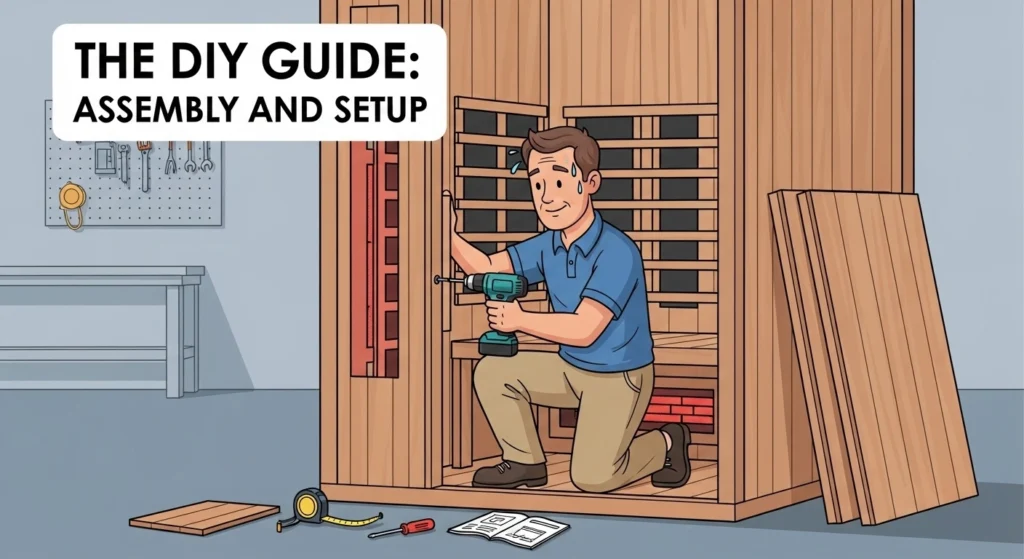
Infrared Sauna Assembly Instructions
While each brand is distinct, the overall process entails the following steps:
- Floor Assembly: You put the floor panel down.
- Wall Construction: Side walls slide or buckle into place.
- Bench Installation: Sliding the bench supports in.
- Roof: Place the roof panel on top of it.
- Electrical Connection: Wire the internal heaters to the control panel (typically easy plug in connectors within the roof).
If you are interested in a certain infrared sauna installation pdf, it will almost always be available on the manufacturer’s website. For instance brands such as Clearlight offers detailed Clearlight sauna assembly instructions that are color-coded for ease.
Brand-Specific Tips
- Good Health Sauna Installation: Users often report that the panels are assembled on-site, causing it to go faster. Always refer to the Good Health Sauna manual for specific directions as to the order in which the panels should be assembled to prevent warping.
- Good Health Sauna Control Panel: The controls for the digital controls are typically pre-wired. You simply mount the housing of the control panel and place the ribbon cables in place.
Location: Where to Put It
Before you assemble the right spot is needed. The infrared sauna space requirements at home are not limited to square footage.
Infrared Sauna Carpet: Yes or No?
This is one of the common questions, “Can I put infrared sauna on carpet?“
Technically, yes but it is not recommended.
- The Risk: Carpet traps moisture and does not allow any air circulation under the sauna floor.
- The Solution: You need a solid tile, vinyl or wooden platform on top of the carpet first. This is to ensure stability and prevent mold growth underneath the unit.
Infrared Sauna Basement Installation Tips
The most popular place is in basements. Here are infrared sauna basement installation tips:
- Moisture Check: Make sure that your basement is dry. Infrared saunas make use of dry heat although excessive humidity in the air may damage the wood over time.
- Drainage: You don’t need a drain for an infrared sauna (unlike steam saunas), but it’s a good idea to have a dehumidifier nearby.
How to Install an Infrared Sauna Outside
Can you put it outside? Yes, but you have to have a special outdoor model. Infrared sauna outdoor installation guide requirements:
- Weatherproofing: To properly weatherproof a roof it must be shingled or covered with metal flashing.
- Insulation: The walls require insulation with greater R-value insulation.
- Cover: Always use a cover that is custom waterproof when not in use.
- Cost of Sauna Outdoor: Hope you can pay 20-30% more for the outdoor-rated model than the indoor one.
Infrared Sauna Ventilation Requirements
While infrared saunas don’t generate steam, they generate heat. The infra-red sauna ventilation requirements are frequently not considered.
- You need a vent in the floor area (intake) and a vent in the ceiling area (exhaust) or simply leave a small gap on the floor under the door.
- Good ventilation is important to ensure that oxygen is fresh and that the wood does not dry out and crack too soon.
Complimenting Your Experience: Technology and Therapy
Modern saunas are not simply hot boxes.
Home Infrared Sauna with Red Light Therapy
Many 2026 models have now been equipped with a home infrared sauna that has red light therapy.
- What is it? These are red and near-infrared emitting light (660nm and 850nm wavelength) LED panels.
- Installation: These typically mount into the walls on the inside of the sauna and plug into the internal power strip of the sauna.
- Benefit: While the sauna takes a rather aggressive approach to heating your body up, the red light therapy focuses more on skin health and cell repair.
Infrared Sauna Room Insulation Tips
If you are constructing a custom room to build or wish to make the most efficient room possible, then consider infrared sauna room insulation tips.
- Reflective foil insulation durable underneath the interior wood paneling may reflect the infrared waves back toward you, making it as much as 15% more efficient.
- This is a great hack if you are searching for infrared sauna energy efficiency comparison data in order to reduce bills.
Maintenance and Long-Term Costs
Once it’s set up, the work is not over.
Infrared Sauna Maintenance Cost Per Year
The good news? It’s cheap.
Infrared sauna maintenance cost per year is normally less than $50.
- Cleaning: Use a damp cloth with mild cleaner that is non-toxic on a monthly basis.
- Wood Care: Do not varnish or stain the interior wood; it needs to “breathe.” If the wood becomes dark, light sanding works wonders.
Infrared Sauna Cost to Operate Per Session
Let’s look at the micro-cost. The infrared sauna cost per session of operation is usually less than a dollar.
- Usage: 40-minute session.
- Energy: Approx 1.5 kWh.
- Cost: Roughly $0.25.
Compare this to a gym membership or a visit to the spa and the savings are very apparent. Whether you are wondering “how much is a sauna box” (referring to prefab units) or a custom build the return on investment in regards to health is high.
You May Also Like To Read:
FAQs
Do I need an Electrician to install it?
If you are installing a standard 110v unit towards an existing outlet then probably not. However, if you require a dedicated circuit or you are upgrading to 220v, always hire a licensed electrician.
Can I build an infrared sauna myself?
Yes, most 1-2 person units are one-person assembly. However, it is helpful to have a second pair of hands with lifting the roof panel and holding the wall sections steady.
Is a sauna a value to my home?
Yes. Home buyers more and more consider saunas to be premium amenities, like a hot tub or a high-end kitchen appliance.
How often should I use my infrared sauna?
Most experts suggest 3-4 times a week, for 30-45 minutes each time to achieve health benefits such as better circulation and relaxation.
Final Thoughts
Embarking on the journey on Infrared Sauna Installation is more than just a home improvement project, it is a lifestyle upgrade. As we have seen, the barrier to entry is lower than most people assume.
Whether you are tackling a diy infrared sauna installation in your basement or setting up a specialized outdoor unit the process is manageable for the average homeowner. The financial picture is likewise reassuring.
When you look at the cost associated with the infrared sauna installation and operating cost USA homeowners are faced with, the monthly costs are surprisingly low – not even worth a couple of takeout coffees.
For less than $0.50 a session, you gain access to relaxation, detoxification and muscle recovery right in the comfort of your own home.
Don’t let the technical jargon of amps, volts and wiring put you off. With the proper preparation, a good understanding of your space, and perhaps a sneak peek into a good health sauna manual or manufacturers guide, it is possible to turn a corner of your home into a sanctuary.
Whether you go for a basic model, or one with a wide array of features, such as a home infrared sauna with red light therapy, the investment into your health is one that pays dividends for years to come.
So, measure your space, check your circuits, and get ready to enjoy the warmth. Your personal spa awaits.