To learn how to protect your hair in an infrared sauna, you need to minimize direct heat exposure and moisture loss. The most effective methods include wearing a thermal sauna hat or sauna hair cap, applying a natural sauna hair oil like jojoba or argan before entering, and thoroughly rinsing your hair with cool water immediately after your session to seal the hair cuticle.
Let’s be honest—sitting in an infrared sauna is one of the best things you can do for your body. The deep penetrating heat melts away muscle tension, boosts your mood, and leaves your skin glowing. But while your body is thriving, your hair might be secretly suffering.
If you’ve ever noticed your strands feeling unusually dry, brittle, or frizzy after a heat session, you’re not alone. That leads us to a very common question among wellness enthusiasts: is infrared sauna bad for your hair? The short answer is no, not if you take the right precautions. But if you walk in with bare, unprotected hair, the prolonged dry heat can take a toll.
In this comprehensive guide, we’re going to dive deep into exactly how to protect your hair in an infrared sauna, covering everything from the best sauna hair wraps to the science behind heat damage. Let’s make sure your next sauna session is just as good for your locks as it is for your muscles.
Disclaimer: This content is for informational purposes only and is not a substitute for professional medical advice. Always consult your healthcare provider before starting infrared sauna therapy, especially if you have pre-existing health conditions or are pregnant.
Key Takeaways
- Use a barrier: A wool or felt sauna hat is the absolute best defense against dry heat.
- Oil up: Applying a natural sauna hair oil before your session prevents moisture from escaping your strands.
- Rinse afterward: Always wash or rinse with cool water post-sauna to close the hair cuticle and lock in hydration.
- Time it right: Keep your sessions to a reasonable 15–20 minutes to avoid unnecessary heat exposure.
- Hydrate internally: Drinking plenty of water before and after your session keeps your scalp and hair follicles hydrated from the inside out.
Is Infrared Sauna Bad for Your Hair? Understanding the Science
In order to see the reason we need sauna hair protection, we will have to examine the effect infrared heat has on your strands.
In contrast to other traditional saunas where the air is heated by a stove to reach blistering hot temperatures, infrared saunas make use of light therapy to directly heat your body, both internally and externally. Air temperature is a lot lower (120°F to 140°F), yet the deep, penetrating heat will make you sweat a lot.
Very delicate is your hair. It’s primarily made up of a protein called keratin, held together by hydrogen bonds. These hydrogen bonds may disperse temporarily when subjected to long-term heat, that is, even to the mild heat of an infrared cabin. Moreover, the dry climate will be able to deprive the hair shaft of its natural moisture and the result will be a dry, straw-like texture.
But to pose the question of whether infrared sauna is bad with your hair is akin to posing the question of whether the sun is bad with your skin. Only suffer when you fail to safeguard yourself. When properly prepared, the benefits of infrared sauna on hair are even greater than the dangers.
Top 10 Benefits of Infrared Sauna for Hair
Before we get into the protection strategies, let’s talk about the upside. When you figure out how to protect hair in sauna environments, you unlock some incredible benefits for your scalp and strands.
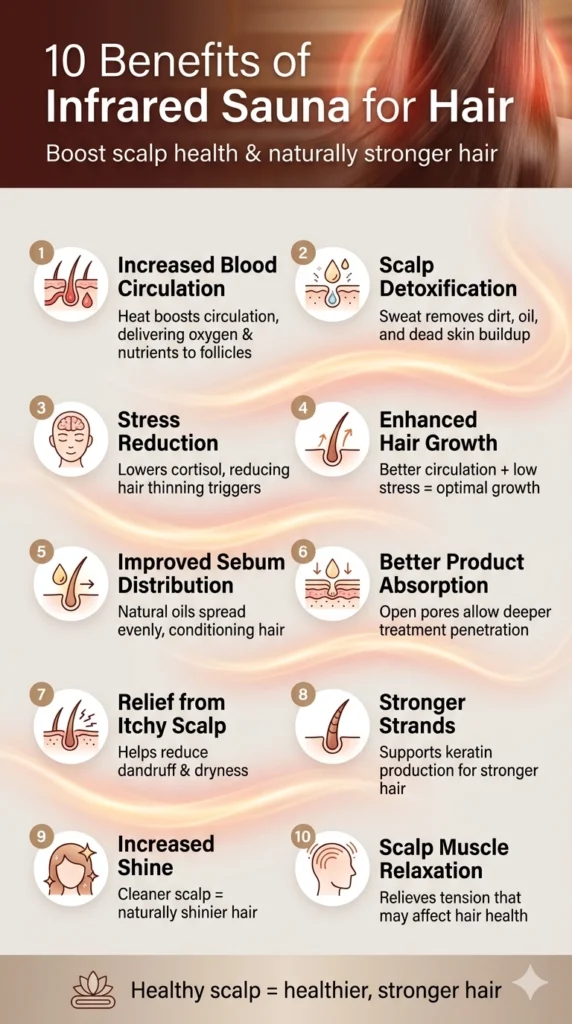
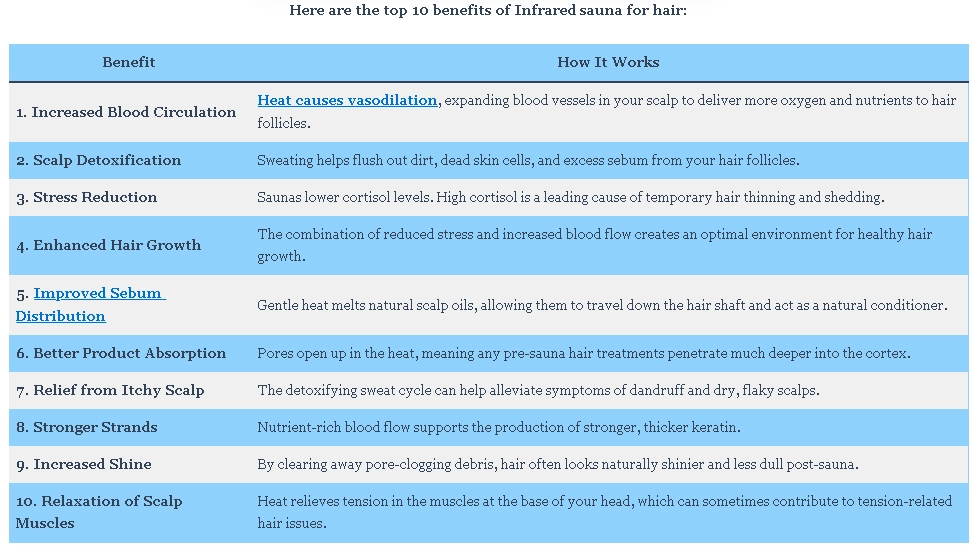
Here are the top 10 benefits of Infrared sauna for hair:
| Benefit | How It Works |
|---|---|
| 1. Increased Blood Circulation | Heat causes vasodilation, expanding blood vessels in your scalp to deliver more oxygen and nutrients to hair follicles. |
| 2. Scalp Detoxification | Sweating helps flush out dirt, dead skin cells, and excess sebum from your hair follicles. |
| 3. Stress Reduction | Saunas lower cortisol levels. High cortisol is a leading cause of temporary hair thinning and shedding. |
| 4. Enhanced Hair Growth | The combination of reduced stress and increased blood flow creates an optimal environment for healthy hair growth. |
| 5. Improved Sebum Distribution | Gentle heat melts natural scalp oils, allowing them to travel down the hair shaft and act as a natural conditioner. |
| 6. Better Product Absorption | Pores open up in the heat, meaning any pre-sauna hair treatments penetrate much deeper into the cortex. |
| 7. Relief from Itchy Scalp | The detoxifying sweat cycle can help alleviate symptoms of dandruff and dry, flaky scalps. |
| 8. Stronger Strands | Nutrient-rich blood flow supports the production of stronger, thicker keratin. |
| 9. Increased Shine | By clearing away pore-clogging debris, hair often looks naturally shinier and less dull post-sauna. |
| 10. Relaxation of Scalp Muscles | Heat relieves tension in the muscles at the base of your head, which can sometimes contribute to tension-related hair issues. |
Is Infrared Sauna Bad for Hair Loss? Let’s Clear the Air
Among the largest myths swirling around wellness boards is the fact that sweating in a sauna will lead to the loss of hair. Therefore, does it make sauna bad to lose your hair?
No, permanent loss of hair is not a result of an infrared sauna. Indeed, due to their ability to reduce stress hormones to such an extent, saunas can even help prevent stress-induced hair loss (telogen effluvium).
There is a catch however. When your hair is greatly dehydrated and brittle due to frequent, unprotected use of the sauna, the hair can break off at the roots or down the shaft. This rupture may resemble that of hair thinning. But fear not, it is mechanical fissure, and not loss of hair on the follicle. The hair will grow back healthy and strong, as soon as you start using proper protection of your hair when in the sauna.
How to Protect Your Hair in an Infrared Sauna: 7 Expert Tips
When you go online and ask the question how do I protect my hair in an infrared sauna, you have probably been misled by numerous contradicting pieces of information. The 7 best, evidence-based practices to maintain your hair in good health are listed here.
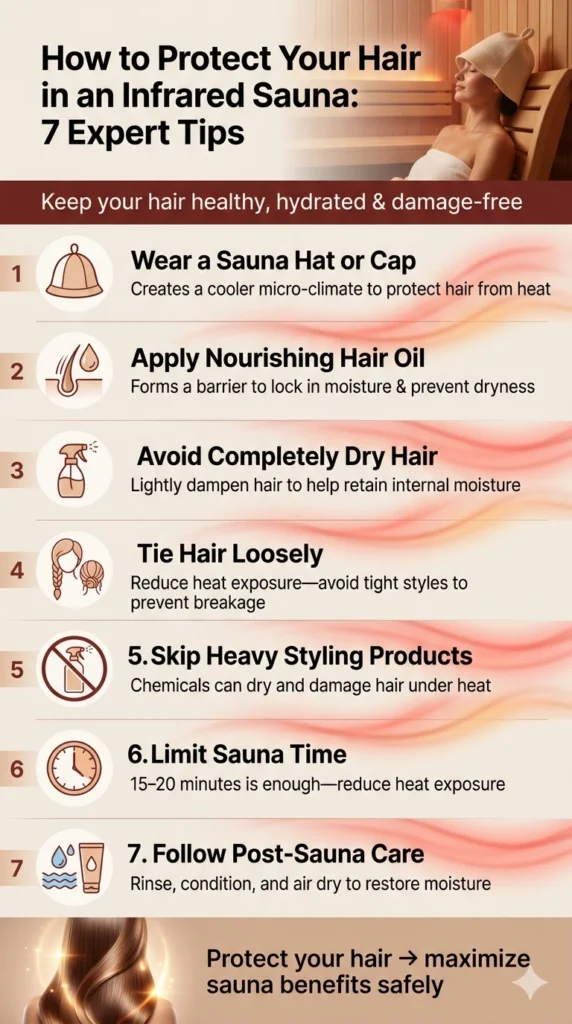
1. Wear a Sauna Hat or Sauna Hair Cap
It is the ultimate standard of sauna hair protection, especially among the traditional Finnish sauna culture. A sauna hat is most commonly of wool or felt. Hair is a kind of insulator–it traps heat. A sauna hat forms a micro-climate on your head, and the temperature of the air in the cabin is significantly lower than in other places.
When you do not like a classic wool hat, then you can use contemporary sauna hair cap that is made of silicone or moisture-wicking fabric. Instead, a basic sauna wrap, crafted of a breathable cotton towel, can miraculously work wonders.
2. Apply a Nourishing Sauna Hair Oil
Do not go into an infrared sauna with dry and completely bare hair. The use of a thick sauna hair oil prior to your session forms a protective coating around the hair cuticle, which holds the moisture in.
Find oils that resemble the natural lipids in the hair:
- Jojoba Oil: It is very similar to human sebum and as such, it is very lightweight and effective.
- Argan Oil: Vitamin E-rich, antioxidant-rich oil to protect against heat.
- Coconut Oil: A traditional option, but it may be too heavy on fine hair.
Pro Tip: Massage the oil into your mid-lengths and ends. Do not put heavy oils on your roots when you have an oily scalp because the oil will melt when exposed to the heat and make your hair appear greasy.
3. Don’t Go In with Bone-Dry Hair
Although infrared saunas are technically a dry heat as opposed to a steam room, you still do not want your hair left totally dry. When you are asking yourself how to keep your hair dry in a sauna, begin by spraying your hair with a bottle of plain water which is then dampened lightly after which you proceed to put in your oil. This provides the hair with a kind of inner water to cling onto throughout the session.
4. Keep Your Hair Out of the Way
When you have your hair hanging down your back, it is getting as much exposure to the heat as it can. Braid or plait or loosely pile your hair on the back of your head. Pulling it back in a tight, slicked out ponytail is not recommended because the tension can be broken, with the heat. Make it casual and relaxed.
5. Skip the Heavy Styling Products
This is a very important step. Avoid coming to a sauna with hairspray, dry shampoo, heavy gels and volumizing mousses in your hair. These products are usually made with alcohols and artificial polymers. These chemicals may dry out your hair shaft, leaving your hair dull and this may even irritate your scalp when subjected to infrared heat. Wash your hair before your session always, in case of heavy styling products in your hair.
6. Time Your Sessions Wisely
Whenever people pose a question to me, asking how do I protect my hair in the sauna, I will always respond that time management is a form of protection. You don’t need to sit in an infrared sauna for 45 minutes to get the benefits. Most individuals are comfortable within the 15-20-minute range. Shorten your sessions and subject your fragile strands to less heat.
7. Implement a Post-Sauna Hair Care Routine
The question of what you do after sauna is sometimes as important as what you do during a sauna. When you come out, you can feel your hair cuticles a bit swollen with heat.
- Rinse: Rinse your hair with lukewarm or cool water to wash away the sweat and close the cuticle.
- Condition: Rub a moisturizing conditioner to replenish any lost moisture.
- Air Dry: Do not spray your hair with a hot blow dryer! Allow to dry naturally to avoid adding heat damage.
How to Protect Hair in Steam Room vs. Infrared Sauna
It’s important to note that how to protect hair in steam room environments is slightly different than protecting it in an infrared sauna.
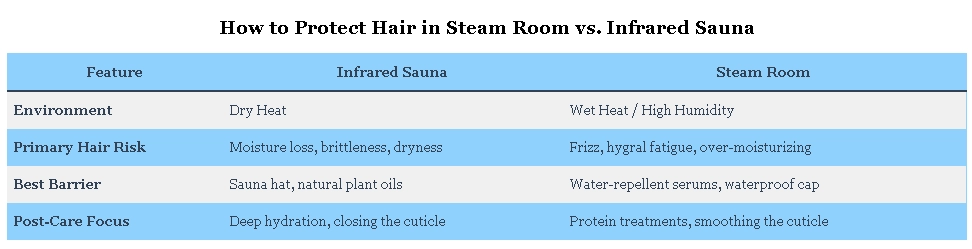
- Steam Rooms: The air is 100% humidity. The main risk here is frizz and hygral fatigue (the swelling and contracting of the hair shaft from absorbing too much water). To protect hair in a steam room, you want water-repellent barriers like heavy silicone-based serums or a waterproof swim cap.
- Infrared Saunas: The air is very dry. The main risk here is desiccation (drying out). Therefore, your sauna hair protection should focus on oil-based barriers (like jojoba or argan) and physical heat deflectors (like a sauna hat).
| Feature | Infrared Sauna | Steam Room |
|---|---|---|
| Environment | Dry Heat | Wet Heat / High Humidity |
| Primary Hair Risk | Moisture loss, brittleness, dryness | Frizz, hygral fatigue, over-moisturizing |
| Best Barrier | Sauna hat, natural plant oils | Water-repellent serums, waterproof cap |
| Post-Care Focus | Deep hydration, closing the cuticle | Protein treatments, smoothing the cuticle |
How Do I Protect My Hair in the Infrared Sauna if I Have Curly Hair?
Special care must be given to curly hair in the sauna. The natural scalp oils are unable to travel down the hair shaft as easily due to the coiled structure of curly strands. This predisposes curly hair to be drier and heat-damage prone.
When you have curly hair, it is all about the protection of hair in the time spent in a sauna. Rub a good size of a thick hair butter (such as shea butter) or a heavy oil (such as castor oil and argan oil combined) into the roots to the ends. Braid your hair and use a satin lined sauna hair wrap, and most certainly wear a sauna hat. Then use a leave-in conditioner, as opposed to a rinse-out conditioner, to fix in that additional moisture.
You May Also Like To Read:
FAQs
Is it possible to use a regular towel and not a sauna hat?
Although it is better than nothing, wrapping a towel around your head is not the best. Ordinary bath towels are composed of very absorbent cotton which may in fact pull the moisture out of your hair in a dry infrared sauna. A sauna hat can be made specifically to withstand the heat or a sauna hair cap with moisture wicking is far more efficient.
Will the sauna hair oil leave my hair flat and greasy?
Not if you use it correctly. It just takes a dime-sized portion of oil (such as argan or jojoba) concentrated on the mid-lengths and ends. Once you are done with your sauna, be sure to wash all your hair with the cool water and apply a light shampoo in case you feel that it is being left behind. Your hair is not to be greasy but to shine.
What is the frequency of my infrared sauna without harming my hair?
With adequate sauna hair protection (hat and oil) you can easily use an infrared sauna 3 to 4 times per week without harming your hair. When you come in with uncovered and unprotected hair, you might begin to experience dryness and brittle hair even after a few consecutive sessions.
Does infrared sauna grow your hair?
Yes, indirectly. The penetrating heat will cause the blood to flow to the scalp which will make sure that your hair follicles get all the oxygen and nutrients it needs. In addition, the infrared therapy has stress relieving benefits that reduce cortisol, a hormone that suppresses hair growth. Infrared saunas are also great as long as you keep the hair shafts hydrated so that your hair can grow well.
Would I wash my hair just after going to the sauna?
You need not use shampoo regularly because washing your hair too often may make your hair dry out, depriving it of its natural oils. Nevertheless, you should definitely run some cool water through your hair so as to wash off the salt of your sweat, which will be very drying when left on your hair. Use shampoo with each sauna session, after the rinse with conditioner.
Final Thoughts
At the end of the day, figuring out how to protect your hair in an infrared sauna shouldn’t feel like a complicated chore—it should just be a natural extension of your wellness routine. It’s incredibly easy to get caught up in the myth that all heat equals inevitable damage, but as we’ve covered, that simply isn’t the case. By taking a few proactive minutes to prep your strands before you step inside, you completely flip the script.
Whether you opt for a traditional wool sauna hat, a breathable sauna hair wrap, or a liberal coating of your favorite hair oil, the goal is always the same: block the dry heat and lock in your hair’s natural moisture. When you pair these simple protective steps with the incredible infrared sauna benefits for hair—like boosted blood circulation, stress reduction, and a deeply cleansed scalp—you’re setting yourself up for some serious hair health gains.
You really don’t have to choose between a restorative, sweat-dripping sauna session and a good hair day. With these expert strategies in your back pocket, you can step out of the heat feeling completely rejuvenated, with locks that look just as hydrated, smooth, and healthy as the rest of your body feels. So grab your oil, tie up a loose bun, and get your sweat on with total confidence!