When comparing cryotherapy vs infrared sauna, the main difference is how each therapy affects the body. Cryotherapy uses extremely cold temperatures (as low as –200°F) for short periods, while infrared saunas use gentle infrared heat to warm the body from the inside out.
Cryotherapy is typically preferred for reducing inflammation, muscle recovery, and pain relief, whereas infrared saunas are often chosen for relaxation, detoxification through sweating, skin health, and circulation improvement.
The better option depends on your goals—weight loss, recovery, skin health, or overall wellness.
Cryotherapy vs infrared sauna explained: benefits, pros and cons, weight loss, skin health, and recovery. Learn which therapy is better for your wellness routine.
Disclaimer: Always consult with a medical professional before starting any new wellness treatment, especially if you are pregnant, have heart conditions, or have implants.
Key Takeaways
- Mechanism Matters: Cryotherapy engages the nervous system through sudden cold shock (vasoconstriction), while Infrared Saunas use radiant heat to increase core body temperature (vasodilation).
- Weight Loss is Indirect: Neither is a “magic pill” for weight loss. Saunas burn calories by raising heart rate similar to light cardio, while cryotherapy boosts metabolism via shivering and recovery, aiding workout performance.
- Skin Health: Saunas improve complexion through sweating and circulation; Cryotherapy reduces inflammation and pore size.
- Combination is Possible: Yes, you can do them on the same day (contrast therapy), but specific protocols should be followed for safety.
- Investment: Is buying an infrared sauna worth it? For regular users, home saunas offer long-term value compared to the recurring high costs of cryotherapy sessions at a spa.
Cryotherapy vs Infrared Sauna Understanding the Basics
Before you can determine which is better cryotherapy or infrared sauna, it helps to understand the workings of each therapy.
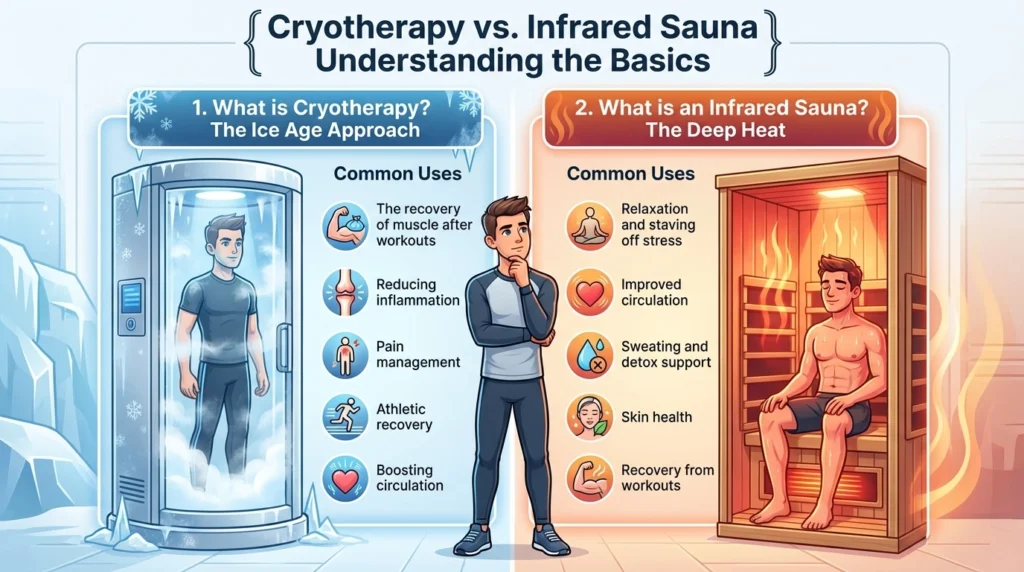
What is Cryotherapy? The Ice Age Approach
Whole Body Cryotherapy (WBC) involves standing in a cylindrical chamber for 2 to 4 minutes while liquid nitrogen or electric cooling lower the ambient temperature to between -200°F and -300°F (-128.89°C and -184.44°C).
Unlike an ice bath, the cold is dry. The goal isn’t to freeze your skin; it’s to trick your brain into thinking it’s in survival mode.
This induces vasoconstriction (shrinking of blood vessels), pulling blood away from extremities to protect vital organs. Once you step out, the blood rushes back (vasodilation), flushing the system with fresh oxygen and nutrients.
Common Uses
- The recovery of muscle after workouts
- Reducing inflammation
- Pain management
- Athletic recovery
- Boosting circulation
One popular method for cryotherapy used by athletes is because the cold can constrict blood vessels and reduce inflammation, helping muscles to recover faster.
What is an Infrared Sauna? The Deep Heat
An Infrared Sauna is quite different from the steamy wooden boxes you might see at your local gym. Instead of heating the air to unbearable temperatures, infrared lamps use electromagnetic radiation to heat your body directly.
The air temperature is lower (usually between 120°F and 150°F), but the heat penetrates deeper into the tissues—up to 1.5 inches. This induces a heavy sweat at lower temperatures, making it more tolerable for many people than traditional saunas.
Common Uses
- Relaxation and staving off stress
- Improved circulation
- Sweating and detox support
- Skin health
- Recovery from workouts
Unlike traditional saunas, infrared saunas are more gentle on the body because they heat up the entire body.
Cryotherapy vs Infrared Sauna Benefits: A Head-to-Head Comparison
To really get to the cryotherapy vs infrared sauna benefits, we need to examine how they compare to specific health markers.
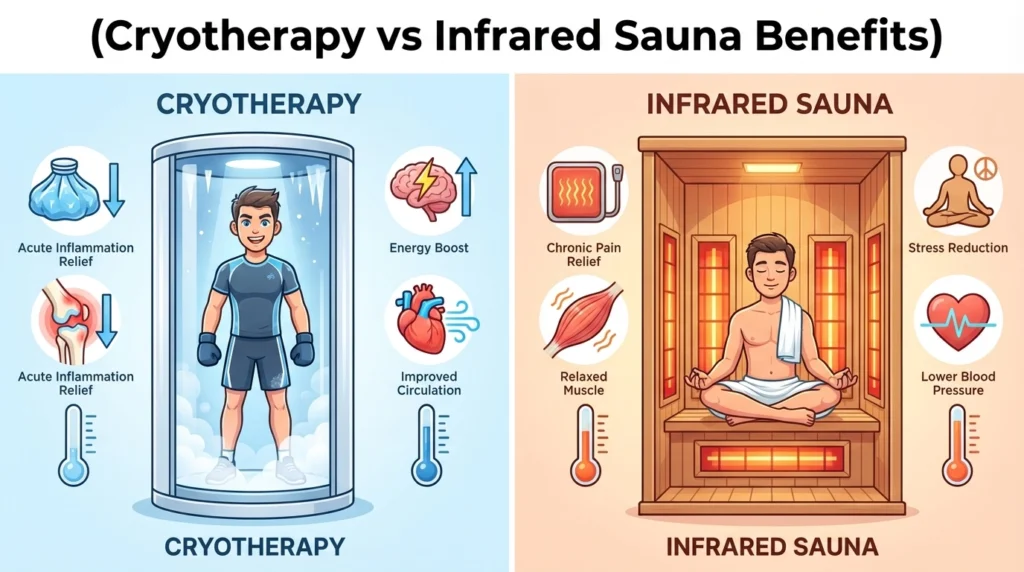
1. Inflammation and Pain Relief
This is the most common reason why people are seeking these therapies.
- Cryotherapy: Is the gold standard for Acute inflammation. Athletes use it in order to numb nerve irritation and to speed up recovery. The cold slows down the metabolic activity and swelling.
- Infrared Sauna: Better for Chronic pain and stiffness. The heat loosens the tight muscles and makes the collagen tissues more elastic.
2. Mood and Mental Health
- Cryotherapy: The shock is an overload of endorphins and norepinephrine. Users often report a “high” or an immediate booster of energy after a session.
- Infrared Sauna: Produces a meditative state. It reduces cortisol (stress hormone) and helps to relax.
3. Cardiovascular Health
- Cryotherapy: Can cause temporary increase in blood pressure during the procedure but usually improves circulation in the long term.
- Infrared Sauna: Simulates moderate exercise. Regular use is linked to better endothelial function and lower blood pressure in the long term.
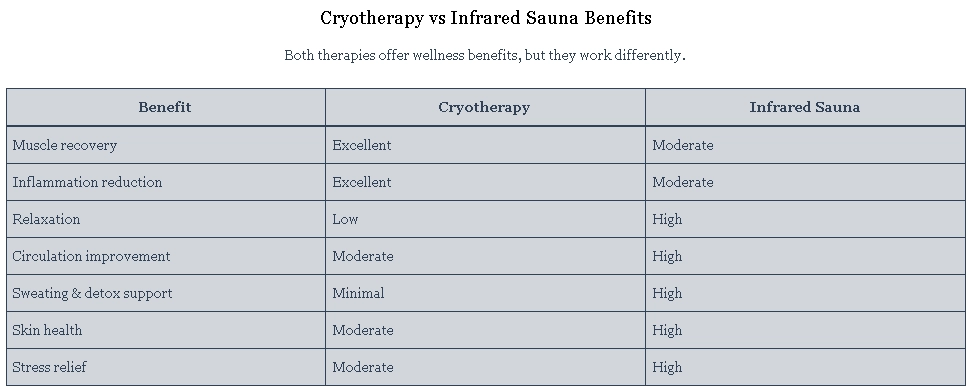
Cryotherapy vs Infrared Sauna Benefits
Both therapies offer wellness benefits, but they work differently.
| Benefit | Cryotherapy | Infrared Sauna |
|---|---|---|
| Muscle recovery | Excellent | Moderate |
| Inflammation reduction | Excellent | Moderate |
| Relaxation | Low | High |
| Circulation improvement | Moderate | High |
| Sweating & detox support | Minimal | High |
| Skin health | Moderate | High |
| Stress relief | Moderate | High |
Infrared Sauna vs Cryotherapy for Weight Loss
This is arguably the most searched-on aspect of the topic. People often ask the following questions: which is better, cryotherapy or infrared sauna for weight loss? Let’s look at the data.
The Sauna Perspective
When looking at infrared sauna vs cryotherapy weight loss saunas have a more direct calorie burn. As your core temperature increases your heart rate increases to pump blood out to the skin to cool you off. You can burn anywhere from 300 to 600 calories in a 30-minute session.
However, a lot of the weight loss is water weight to begin with. For long term fat loss the sauna is beneficial as it enhances insulin sensitivity and reduces stress (high cortisol contributes to fat retention).
The Cryotherapy Perspective
Cryotherapy doesn’t burn as much of a calorie burn during the session. However, the extremely cold stimulates “thermogenesis.” Your body struggles to warm back up and to do this, it burns brown fat (Brown Adipose Tissue).
Studies suggest that you may burn 200-500 calories after your session over the next 24 hours as your metabolism remains elevated.
- Verdict: If you’re looking to simulate the calorie burning of a workout, the infrared sauna vs cryotherapy for weight loss debate goes in favor of the sauna.
- However, as cryotherapy is very good for the metabolic rate long term, as well as the recovery needed for keeping a workout routine intact.
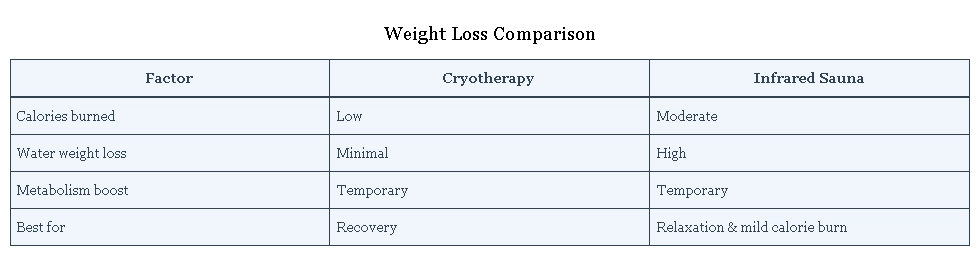
Weight Loss Comparison
| Factor | Cryotherapy | Infrared Sauna |
|---|---|---|
| Calories burned | Low | Moderate |
| Water weight loss | Minimal | High |
| Metabolism boost | Temporary | Temporary |
| Best for | Recovery | Relaxation & mild calorie burn |
Which is Better: Cryotherapy or Infrared Sauna for Skin?
If you are chasing a glow, you are likely wondering which is better, cryotherapy or infrared sauna for skin health.

Infrared Sauna for Skin:
The “sauna glow” is real. By causing heavy sweating you free up your pores and release toxins, bacteria and heavy metals. The increased blood flow depends to bring oxygen and nutrients to the skin’s surface. It can be helpful for conditions such as acne, eczema, and psoriasis.
- Best for: Acne, Detoxification, Anti-Aging Collagen Production
Cryotherapy for Skin:
Cryotherapy is a facial on steroids. The freezing temperatures lead to vascular constriction, followed by dilation, and this rushes blood to the face.
It tightens pores, puffiness is reduced and the fast thermal stress causes increased collagen production. It is especially effective for calming inflammatory conditions of the skin such as dermatitis.
- Best for: Tightening pores, reducing puffiness, healing inflammation.
The Reddit Verdict: What Real Users Say
If you go through cryotherapy vs infrared sauna reddit or which is better cryotherapy or infrared sauna reddit, you will find an interesting split in opinion based on user experience.
- The Consensus: Reddit users on biohacking subreddits generally agree that if you have an acute injury or severe inflammation Cryotherapy is the winner.
- The Preference: However, the cryotherapy vs infrared sauna Reddit discussions are often biased in favor of Saunas to use every day. Why? Because sauna is more relaxing. Many users have reported cryotherapy to be “stressful” on the body (which is the point), and the sauna to be a reward. Redditors will often cite the longevity studies in Finland of the effects of saunas and how regular use is correlative with lower all-cause mortality, a data point that is harder to find for cryotherapy as it is a newer popularity.
Can You Do Cryotherapy and Infrared Sauna on the Same Day?
This leads us to an age-old advanced biohacking question: Can you go infrared sauna after cryotherapy? Or should you do them at all?
This practice is commonly known as “Contrast Therapy.”
- The Answer: Yes, you can, but order is important.
Recommendation: Sauna First and then Cryotherapy.
Why? The sauna warms you up, opens up the blood vessels and relaxes muscles. If this is followed directly by cryotherapy, massive “pump” effect is created. You flush the system with heat and then constrict the whole thing to capture the benefits and decrease inflammation.
Can you do infrared sauna after cryotherapy?
You can, but it’s not generally recommended for recovery as much. If you do cryo first you numb the nerves and you reduce the inflammation. Jumping into a sauna immediately could lead to the return of inflammation or swelling before the body has had time to heal.
However, a few users prefer the “warm up” after freezing. If you decide to have sauna after cryo, please wait at least 15 – 20 minutes for your body temperature to normalize. This helps to make sure you don’t shock your system too hard.
Is Buying an Infrared Sauna Worth It?
The accessibility is a major factor. Cryotherapy almost always requires a visit to the clinic. Saunas do, however, seem to be popular home wellness devices.
So, is purchasing an infrared sauna worth it?
The Pros of Owning One:
- Convenience: You can use it on a daily basis without having to drive to a spa.
- Cost Effectiveness: The price of one cryo session is between $40 and $80. A good home infrared sauna cost between $1,000 – $3,000. If you use it 3 times a week for a year it pays for itself compared to clinic rates.
- Privacy: Many people are not comfortable sweating a lot in a public place.
The Cons:
- Space: They consume a lot of space.
- EMF Exposure: Cheap models can have increased electromagnetic fields (EMF). You must keep in mind to purchase a model with a low-EMF.
If you are serious about the benefits of heat, is a infrared sauna worth buying? For most of the wellness inclined, the answer is a resounding, yes. It has one of the highest ROIs (Returns on Investment) on home health equipment.
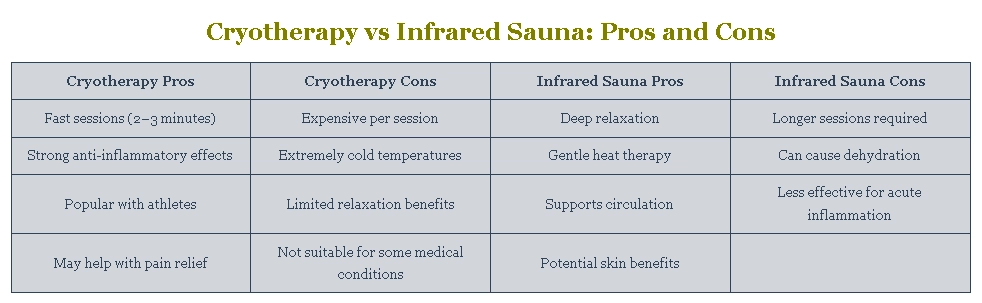
Cryotherapy vs Infrared Sauna: Pros and Cons
| Cryotherapy Pros | Cryotherapy Cons | Infrared Sauna Pros | Infrared Sauna Cons |
| Fast sessions (2–3 minutes) | Expensive per session | Deep relaxation | Longer sessions required |
| Strong anti-inflammatory effects | Extremely cold temperatures | Gentle heat therapy | Can cause dehydration |
| Popular with athletes | Limited relaxation benefits | Supports circulation | Less effective for acute inflammation |
| May help with pain relief | Not suitable for some medical conditions | Potential skin benefits |
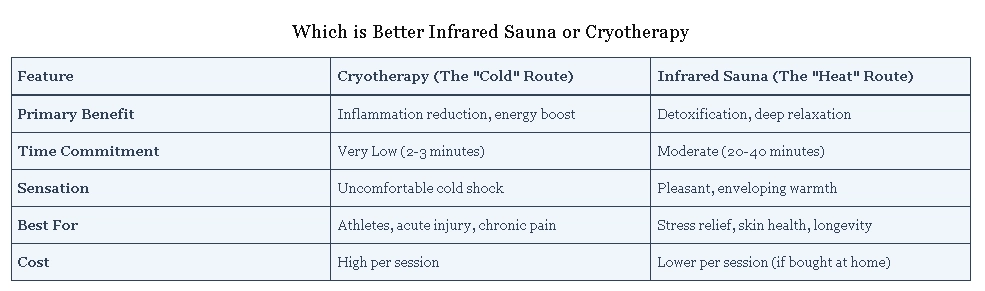
Which is Better Infrared Sauna or Cryotherapy? (The Final Verdict)
We’ve looked at the data, the Reddit threads, and the biological mechanisms. So, what’s better infrared sauna or cryotherapy?
There is no overall winner, only a winner for you.
| Feature | Cryotherapy (The “Cold” Route) | Infrared Sauna (The “Heat” Route) |
|---|---|---|
| Primary Benefit | Inflammation reduction, energy boost | Detoxification, deep relaxation |
| Time Commitment | Very Low (2-3 minutes) | Moderate (20-40 minutes) |
| Sensation | Uncomfortable cold shock | Pleasant, enveloping warmth |
| Best For | Athletes, acute injury, chronic pain | Stress relief, skin health, longevity |
| Cost | High per session | Lower per session (if bought at home) |
Choose Cryotherapy if:
- You are an athlete recovering from intense training.
- You suffer from chronic pain or autoimmune inflammation.
- You need a quick energy boost and have limited time.
Choose Infrared Sauna if:
- You want to relax and lower cortisol/stress.
- You want to improve skin health and detoxify.
- You are focusing on longevity and cardiovascular health.
You May Also Like To Read:
FAQs
Can you do cryotherapy and infrared sauna on the same day?
Yes, this is called contrast therapy. It is recommended, generally, to first do the sauna to heat the body and to open up the blood vessels and then to do cryotherapy to flush the system and reduce inflammation.
Is the purchase of an infrared sauna worth it for weight loss?
It can be a helpful tool, but it should not be used in lieu of diet and exercise. It helps to burn additional calories and reduces the levels of cortisol (a hormone responsible for retention of belly fat), which makes it a good investment for holistic weight loss plan.
Which is Better Infrared Sauna or Cryotherapy for Arthritis?
It depends on the type. Cryotherapy is often more suitable for acute flare ups for numbing pain and reducing swelling. Infrared Sauna is often better for chronic stiffness to loose the joints and improve mobility. Consult your doctor on your specific condition.
How often should I perform these therapies?
Cryotherapy can be performed daily if tolerated but 2-3 times weekly is standard for maintenance. Infrared Sauna use is ideal at 3-4 times a week for approximately 20-30 minutes each time.
Final Thoughts
Listening to Your Body’s Thermal Needs
Navigating the wellness world can feel overwhelming, but the choice between Cryotherapy vs Infrared Sauna doesn’t have to be binary.
As we’ve explored, both therapies offer legitimate, science-backed benefits that can transform your recovery routine—whether you’re looking to soothe aching muscles, rejuvenate your skin, or simply find a moment of Zen in a busy world.
The most important takeaway here is that recovery is personal. While the data suggests saunas are fantastic for long-term longevity and stress reduction, cryotherapy remains the gold standard for acute inflammation and that immediate energy kick.
There is no “one size fits all” answer to which is better, cryotherapy or infrared sauna, because your body’s needs change daily.
My advice? Stop stressing over the “perfect” choice. If you have access to both, experiment with contrast therapy—doing the sauna and cryo on the same day—to experience the benefits of both hot and cold extremes.
You might find that the combination gives you the best of both worlds. Ultimately, the best therapy is the one you actually enjoy enough to stick with consistently.
Whether you choose to sweat it out in a home sauna or brave the freeze in a cryo-chamber, you are taking a proactive step toward better health—and that is always a win.