
How Much Does It Cost to Run a Steam Sauna Per Session?
A steam sauna feels like a luxury, but the cost of a single session is usually much smaller than most people expect. The catch is that there is no single answer: your bill depends on the size of your steam generator, how long you steam, what you pay for electricity, and how much water the session uses.
The good news is that you can work out your own number in under a minute. Once you know your generator’s power rating and your electricity rate, the rest is simple arithmetic — and this guide walks you through it with worked examples you can adapt.
The Short Answer
For a typical home steam session, electricity is almost always the main cost, and water is a small addition. In the worked example below — a mid-size generator, a 30-minute session, and an example electricity rate — the total comes to well under a dollar per session before any fixed charges.


Paid Links - As an Amazon Associate, I earn from qualifying purchases.
Your own figure could be higher or lower. A bigger generator, a longer session, or a higher electricity rate will push it up, while a smaller, well-sealed steam space and shorter sessions will bring it down. That is why this article gives you the formula rather than a single price.


Paid Links - As an Amazon Associate, I earn from qualifying purchases.
The Formula: Four Numbers You Need
You only need four inputs to calculate the electricity cost of one session. Your generator’s rating plate or manual should state its power in kilowatts (kW), and your electricity bill or supplier’s website should state your rate per kilowatt-hour (kWh).
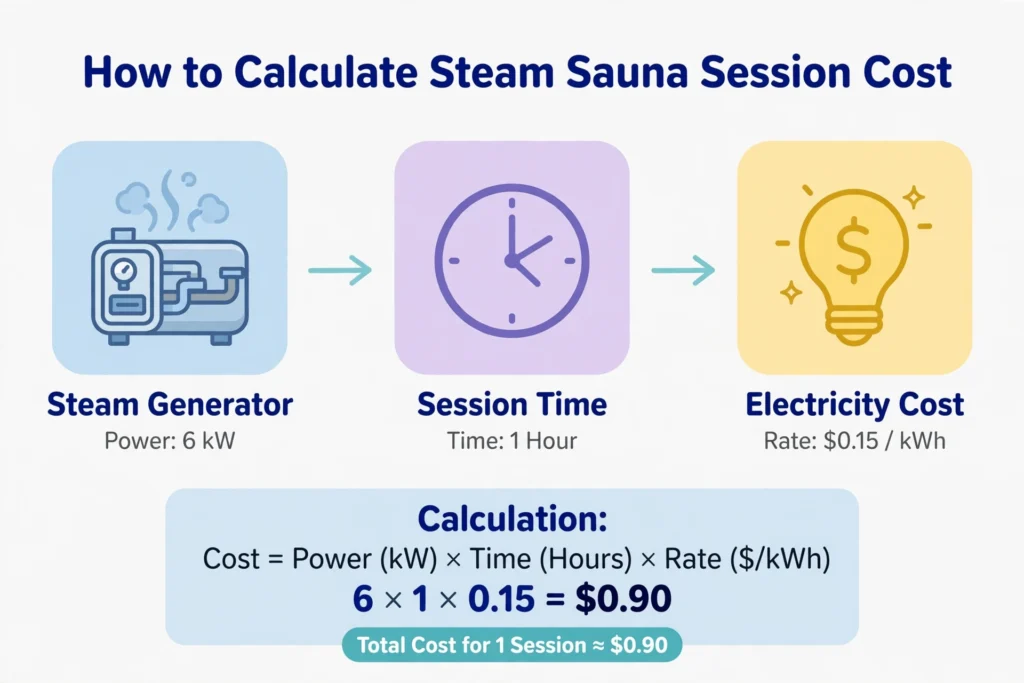
The electricity formula is: generator kW × session hours × electricity rate = electricity cost per session. Then add the water cost: water used × your water rate = water cost per session. Add the two together for your total running cost.
Worked Example: A 30-Minute Session
Let us run the numbers with clearly stated example inputs — not prices quoted as facts. Suppose you have a 9 kW generator, you steam for 30 minutes, and your example electricity rate is $0.15 per kWh.
Now try a different set of example inputs to see how sensitive the result is. A smaller 6 kW generator, a 20-minute session, and a higher example rate of $0.20 per kWh gives: 6 × 0.33 = about 2 kWh, and 2 × $0.20 = about $0.40 for electricity. Same kind of sauna, very different session cost — which is exactly why plugging in your own numbers matters.
If your generator cycles on and off to hold temperature rather than running at full power the whole time, your real electricity use may be lower than the full-power calculation. The formula above therefore gives a useful upper estimate for a session at full rated power, not a metered reading.
What Moves the Cost Up or Down?
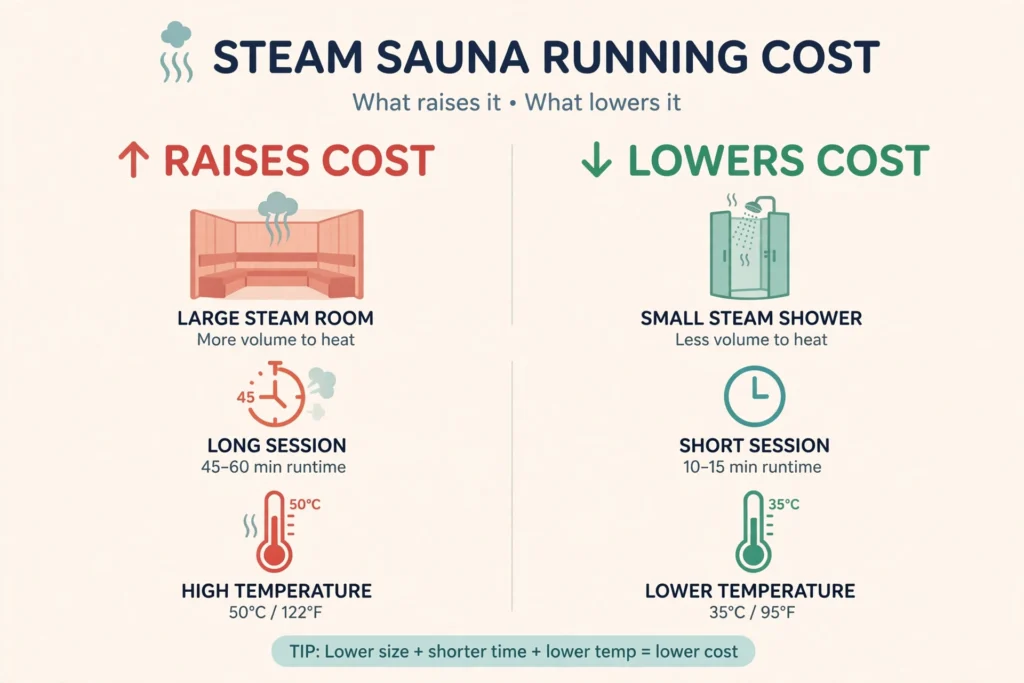
Generator size is the biggest lever. A generator matched to your steam space does the job efficiently, while a heavily oversized unit draws more power than the room needs. Choosing the right size matters, which is why it pays to check a steam generator kW sizing guide before you buy — the size you choose now sets your running cost for years.


Paid Links - As an Amazon Associate, I earn from qualifying purchases.
What About the Water Cost?
Water is usually the smaller part of the bill. A steam generator turns a modest amount of water into steam, and household water rates are typically low compared with electricity rates. Even so, it is worth including if you want an honest total — and water quality matters for more than cost, since hard water can scale a generator over time. If you are choosing what to fill it with, see what works best in a guide to the best water to use in a steam sauna.
To estimate your water cost, take the example approach from above: multiply an assumed volume per session by your local water rate from your bill. If your supplier bills in litres or cubic metres, convert your session volume to the same unit first so the arithmetic stays clean.
From One Session to a Monthly Estimate
Once you have your per-session figure, the monthly estimate is easy. Multiply it by the number of sessions you expect each week, then by roughly four weeks. Using the first worked example above — about $0.69 per session, three sessions a week — gives roughly $8.28 a month in that example.
That monthly figure covers running costs only. It does not include the purchase price, installation, or maintenance, which are separate one-off or occasional costs. For the upfront side of the budget, the companion guide to steam shower costs covers what a steam setup costs to buy and install.
Cost Disclaimer
Please note: all figures in this article are planning estimates based on stated example inputs, not quotes. Prices vary by region, brand, and installer, and your electricity and water rates may differ from the examples used here. Get local quotes and verify current listings and rates before buying or budgeting for a steam sauna.
Ways to Keep Running Costs Down
The cheapest session is one you actually enjoy, so do not cut corners on comfort — but a few habits help. Keep sessions to the length you genuinely use, seal and insulate the steam space properly, and steam off-peak if your tariff rewards it.
Electrical and plumbing requirements also affect both safety and efficiency, so check the steam sauna electrical and plumbing requirements before installation or any upgrade. A correctly wired, properly supplied generator runs as its maker intended — and that is the cheapest way to run it.
Sauna Safety Basics
Cost is only half the picture; safe use matters more. Drink water before and after your session, keep sessions short, and step out and cool down if you feel unwell, dizzy, or overheated. Do not drink alcohol before or during a steam session.
Check with a doctor first if you are pregnant, have a heart condition or low blood pressure, or take medication that affects heat tolerance. Children, older adults, and anyone with a health condition should be extra cautious with heat and steam.
Steam rooms also need honest moisture care. Good ventilation and a proper drying routine after each session protect the room from damp and mould — a steam sauna is never maintenance-free, and ignoring moisture will cost far more in repairs than any session ever saves.
Frequently Asked Questions
How much electricity does a steam sauna use per session?
It depends on generator size and session length. Using the formula in this article — generator kW × session hours × your electricity rate — a 9 kW generator running for 30 minutes at an example rate of $0.15 per kWh uses 4.5 kWh, costing about $0.68 for electricity in that example.
Is water or electricity the bigger running cost?
Electricity is almost always the bigger cost. Water use per session is modest and household water rates are typically low, so water usually adds only a few cents in the worked examples above.
Does a bigger steam generator cost more to run?
Yes, if it runs at full power — a higher kW rating uses more electricity per hour. That is why matching the generator to your room size matters: an oversized unit draws more power than the space needs.
How can I calculate my own steam sauna running cost?
Multiply your generator’s kW rating by your session length in hours, then by your electricity rate per kWh, and add your water cost (water used × your water rate). Substitute your own numbers from your generator manual and utility bills.