
You’ve got a scratchy throat, a stuffy nose, and an infrared sauna sitting in the corner. It’s tempting to think a long, hot session will cook the bug right out of you.
So, does an infrared sauna kill bacteria and viruses? Short answer: no, not inside your body. The heat feels intense, but your core temperature barely moves, and that’s nowhere near what it takes to destroy a germ.
Still, there’s more to the story. Regular sauna use has been linked to fewer colds, and a few simple habits keep your cabin clean. Here’s what the research really says, minus the hype.
Quick answer: No. An infrared sauna doesn’t kill viruses or bacteria inside your body. Your core temperature rises only slightly, far below the heat labs need to inactivate germs. Regular sauna use may lower your odds of catching colds and chest infections, but that likely comes from immune and circulation effects, not germ-killing heat.
Key Takeaways
- Heat can inactivate viruses in a lab, but only at temperatures your body can’t safely reach.
- Sweating doesn’t flush out viruses or bacteria.
- Regular sauna use is linked to fewer colds, though most of that research isn’t about infrared.
- Skip the sauna if you have a fever or a contagious illness.
- Your cabin can carry germs, so wipe it down and bring your own towel.
What an Infrared Sauna Actually Does
Let’s clear up the basics first, because that’s where most of the confusion starts. An infrared sauna uses heaters that give off infrared light. That light warms your body directly instead of heating the air around you.


Paid Links - As an Amazon Associate, I earn from qualifying purchases.
If you want the full breakdown of how infrared saunas work, it comes down to radiant heat soaking into your skin and the tissue just beneath it.
Because the air isn’t doing the heavy lifting, the cabin stays cooler than a traditional sauna. Most infrared cabins run around 120 to 150°F (49 to 65°C). A traditional sauna usually sits somewhere between 150 and 195°F. Plenty of people find the gentler air easier to sit in for 20 to 40 minutes.



Paid Links - As an Amazon Associate, I earn from qualifying purchases.
Here’s the part that matters for this topic. Those heaters are a heat source, nothing more. They aren’t a sterilizer. They don’t give off the germicidal UV-C light that disinfecting lamps use, so there’s no built-in germ-zapping going on.
Does an Infrared Sauna Kill Bacteria and Viruses?
Infrared Sauna For Viruses
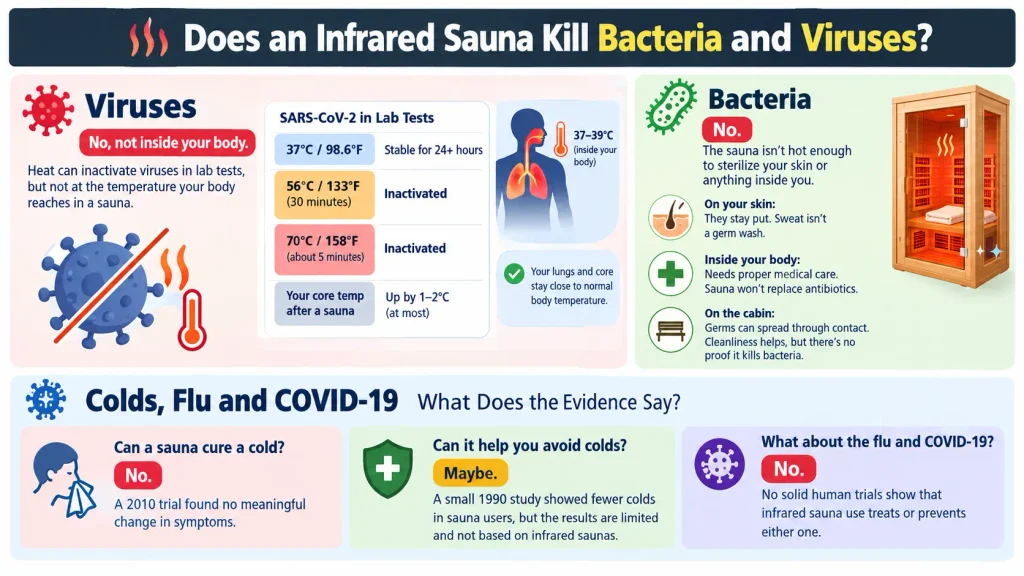
No, not inside your body. Viruses really are sensitive to heat, and that’s exactly why the idea sticks around. The catch is in the numbers.
In lab tests, researchers heat samples of virus sitting in liquid. A University of Hong Kong team reported in The Lancet Microbe in 2020 that SARS-CoV-2 holds up well in the cold but breaks down with heat.
At 70°C (158°F), it was inactivated in about five minutes. A separate FDA-funded preprint found the virus stayed stable at body temperature for at least 24 hours, while 30 minutes at 56°C (133°F) shut it down.



Paid Links - As an Amazon Associate, I earn from qualifying purchases.
| Condition | What happens to SARS-CoV-2 (lab) |
|---|---|
| 37°C / 98.6°F (normal body temp) | Stable for at least 24 hours |
| 56°C / 133°F for 30 minutes | Inactivated |
| 70°C / 158°F for about 5 minutes | Inactivated |
| Your core temperature after a sauna | Up by a degree or two at most |
Why the heat never reaches the virus
Think about where a cold or COVID virus actually lives. It’s in your nose, throat, lungs and cells. Those spots stay close to 37 to 39°C no matter how hot the cabin gets, because your body works hard to protect its core.
Your skin might feel like toast, but your lungs aren’t cooking. If your core did climb high enough to wipe out a virus, you’d be in medical trouble long before the germs were.
Dr. Marc Cohen made a similar point in a 2020 paper in Temperature. Enveloped viruses are sensitive to heat, he wrote, but nobody yet knows whether heat therapy can treat or prevent COVID-19. That’s an honest summary of where things stand.
Infrared Sauna For Bacteria
No. Bacteria handle heat in different ways, but the air in a home or studio sauna isn’t hot enough to sterilize your skin or anything inside you.
- On your skin: You’ll sweat buckets, yet the bacteria that normally live there stay put. Sweat isn’t a germ wash.
- Inside your body: A real bacterial infection, like strep throat or a urinary tract infection, needs proper medical care. Sitting in a sauna won’t replace antibiotics.
- On the cabin itself: Warm, sweaty, shared spaces can pick up germs through skin contact. I couldn’t find a controlled study that measured bacteria on infrared sauna benches or walls, so cleaning is common sense rather than proven science. Still, it costs you a minute and a towel.
Colds, Flu and COVID-19: What Does the Evidence Say?
Can a sauna cure a cold?
There’s no good evidence for it. A 2010 randomized trial in the Medical Journal of Australia had people with colds breathe hot, humid sauna air. Symptoms didn’t change in any meaningful way, for better or worse. A few people felt a warm face and a lighter headache, but that faded.
Can it help you avoid colds?
Maybe, if you stick with it. In a 1990 study in Annals of Medicine, Austrian researchers compared 25 people who used a sauna once or twice a week with 25 who didn’t.
Over six months, the sauna group caught fewer colds. In the last three months, their rate was roughly half the other group’s. When colds did show up, they lasted about as long and felt about as rough.
The catch: it was small, people weren’t randomly assigned, and they used traditional saunas with cooling breaks, not infrared.
What about the flu and COVID-19?
No solid human trials show that infrared sauna use treats or prevents either one. If a website says otherwise, it’s running ahead of the evidence.
What the Research Really Shows
| Study | Who | Finding | Limits |
|---|---|---|---|
| Ernst et al., Annals of Medicine, 1990 | 50 adults, 6 months | Fewer colds with regular sauna | Small, not randomized, traditional sauna |
| Kunutsor et al., Respiratory Medicine, 2017 | 2,210 Finnish men, about 25 years | 2 to 3 sessions weekly tied to 28% lower pneumonia risk; 4+ to 37% lower | Observational, men only |
| Kunutsor et al., European Journal of Epidemiology, 2017 | About 1,900 Finnish men | Frequent use tied to lower respiratory disease risk (reported 27% and 41%) | Observational |
| Medical Journal of Australia trial, 2010 | Adults with a cold | No effect on symptoms | Short-term |
Most of the strongest human data comes from Finland, and it’s observational. That means it spots patterns but can’t prove the sauna caused them. Frequent sauna-goers may also exercise more or live differently in ways nobody fully measured.
And here’s the gap hardly anyone mentions: I found no solid trial that tests infrared saunas against infection rates.
How Regular Sauna Use Might Help Your Defenses
People often ask whether a sauna can boost your immune system. The honest answer is, possibly a little, and not through germ-killing heat. Researchers have a few ideas:
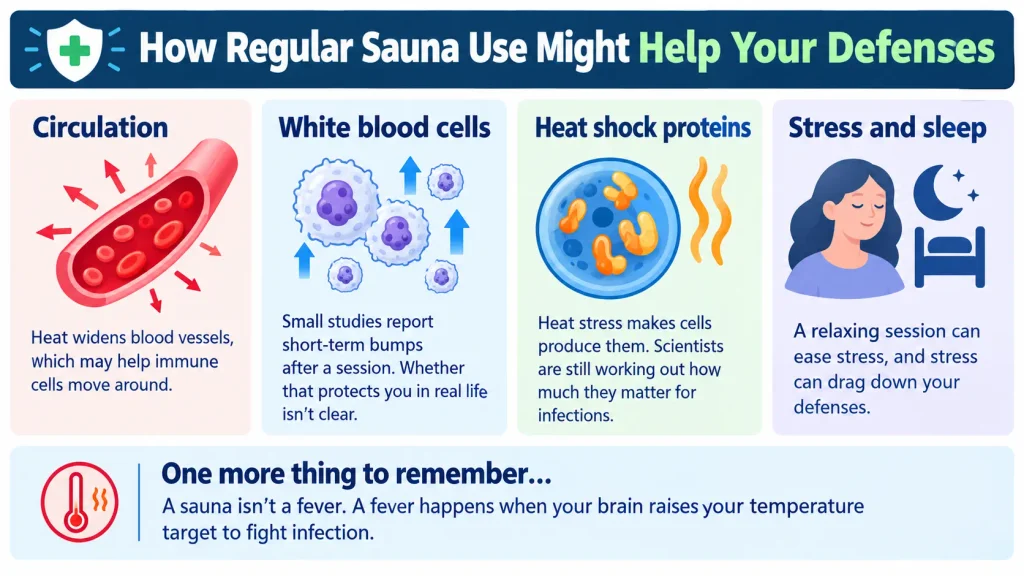
- Circulation: Heat widens blood vessels, which may help immune cells move around.
- White blood cells: Small studies report short-term bumps after a session. Whether that protects you in real life isn’t clear.
- Heat shock proteins: Heat stress makes cells produce them. Scientists are still working out how much they matter for infections.
- Stress and sleep: A relaxing session can ease stress, and stress can drag down your defenses.
One more thing worth clearing up. A sauna isn’t a fever. A fever happens when your brain raises your temperature target to fight an infection. A sauna heats you from the outside. They look alike on a thermometer, but your body treats them very differently.
Infrared vs. Traditional Sauna: Which Has More Evidence?
Most of the best studies come from Finland, where people use traditional saunas. That matters, because infrared and traditional saunas heat you in different ways. Infrared may deliver a similar heat load, but that’s an assumption, not something anyone has proven for infections.
| Feature | Infrared sauna | Traditional sauna |
|---|---|---|
| Typical air temperature | About 120 to 150°F | About 150 to 195°F |
| How it heats | Warms your body directly | Heats the air, and you |
| Research on colds and lung infections | Very limited | Several studies, mostly observational |
| Kills germs in your body? | No | No |
Myth vs. Fact
| Myth | Fact |
|---|---|
| “I can sweat out a virus.” | Viruses replicate inside cells. Sweat isn’t how your body clears them. |
| “Infrared heat kills bacteria and viruses.” | Not at safe sauna temperatures, and not inside your body. |
| “A sauna cures a cold.” | A controlled trial found no benefit once you’re sick. |
| “Sauna detox removes 5 to 6 times more toxins.” | I found no solid evidence for this. Sweat is mostly water and salt. |
| “More heat means faster recovery.” | Extra heat when you’re ill adds strain and dehydration risk. |
Should You Use an Infrared Sauna When You’re Sick?
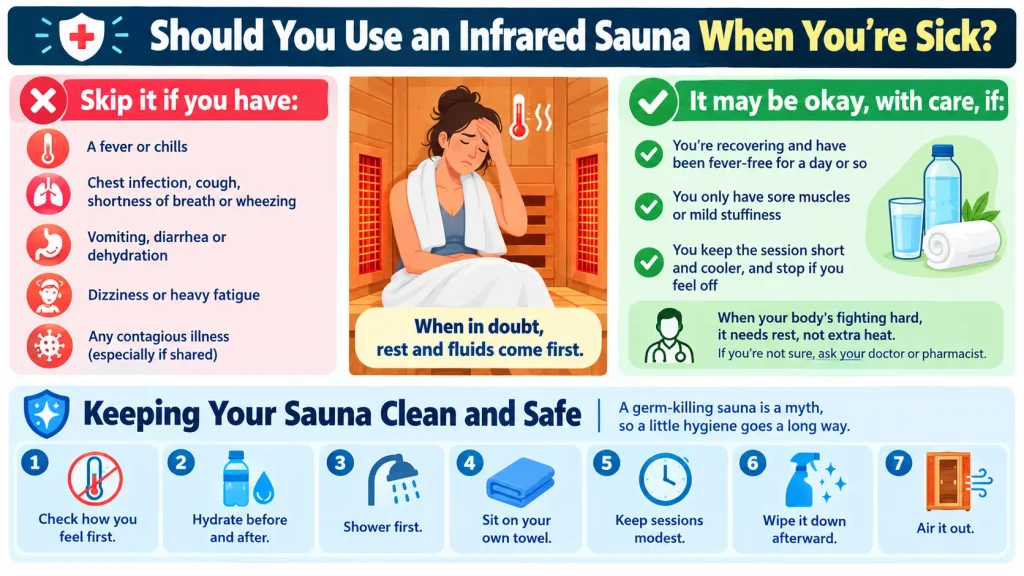
Plenty of people wonder whether it’s okay to use an infrared sauna when you’re sick. If you have a fever, chest symptoms or anything contagious, skip it. Rest and fluids come first.
Skip it if you have:
- A fever or chills
- A chest infection, a cough that leaves you short of breath, or wheezing
- Vomiting, diarrhea or dehydration
- Dizziness or heavy fatigue
- Any contagious illness, especially if the sauna is shared
It may be okay, with care, if:
- You’re recovering and have been fever-free for a day or so
- You only have sore muscles or mild stuffiness
- You keep the session short and cooler, and stop if you feel off
A registered nurse at an Australian wellness clinic put it well: when your body’s fighting hard, it needs rest, not extra heat. If you’re not sure, ask your doctor or pharmacist.
Keeping Your Sauna Clean and Safe
A germ-killing sauna is a myth, so a little hygiene goes a long way.
- Check how you feel first. Fever, infection, dehydration or dizziness means skip it.
- Hydrate before and after. Water with a pinch of electrolytes works fine.
- Shower first. It keeps the cabin cleaner.
- Sit on your own towel. Don’t let bare skin touch the bench.
- Keep sessions modest. Many people do 15 to 30 minutes. Start shorter if you’re new.
- Wipe it down afterward. Follow the maker’s manual when you clean your infrared sauna, since the wrong spray can damage wood and heaters.
- Air it out. Leave the door ajar so the cabin dries.
Common slip-ups include staying in too long “to kill the bug,” skipping water, using the sauna with a fever, and trusting it instead of a flu shot. If you have a heart condition, low blood pressure, are pregnant, or take certain medications, talk to a doctor before you start.
Frequently Asked Questions
Does an infrared sauna kill viruses?
No. Viruses are heat-sensitive in a lab, but sauna temperatures and your body’s core temperature stay far too low to destroy them inside you.
Can you sweat out a virus or the flu?
No. Sweating cools you down. It doesn’t clear viruses from your cells or lungs.
Should I use an infrared sauna with a cold?
If you have a fever or feel worn out, skip it. With very mild symptoms and nothing contagious, a short session may feel soothing, but it won’t speed up recovery.
Can regular sauna use help prevent colds?
Possibly. A small 1990 study and large Finnish studies link regular sauna use to fewer colds and lung infections. They can’t prove cause and effect, and they didn’t focus on infrared.
Do saunas spread germs?
Shared ones can, mostly through skin contact, sweat and shared surfaces. Shower first, bring your own towel, and stay home when you’re sick.
Can a sauna replace flu shots or handwashing?
No. Vaccines, handwashing and rest are proven. A sauna is a nice extra, not a stand-in.
Final Thoughts
Heat can destroy viruses in a lab, but your body can’t safely get hot enough for an infrared sauna to do it. So the honest answer to whether an infrared sauna kills bacteria and viruses is no.
That doesn’t make saunas pointless. Regular sessions may support circulation, relaxation, and maybe your odds of catching a cold. Just treat them as a wellness habit, not a treatment for germs. Skip them when you’re sick, keep the cabin clean, and lean on sleep, fluids, vaccines and your doctor when it counts.