
Ask five people what a traditional steam sauna is and you’ll probably get five different answers. One pictures a foggy tiled room at the gym. Another pictures a log cabin beside a frozen lake. Both are half right, and that’s exactly the problem. This Traditional Steam Sauna Guide sorts it out.
You’ll learn what the term really means, how heat and steam work together, what research says about the benefits (and where it falls short), and how to tell a well-built sauna from a pretty box that disappoints. Whether you’re about to buy one or just want to use one without feeling lost, you’re in the right place.
Quick answer: A traditional steam sauna is a wood-lined room heated by a stove and stones. The air is hot and fairly dry until you pour water on the stones, which creates a burst of steam whenever you want it.


Paid Links - As an Amazon Associate, I earn from qualifying purchases.
What Is a Traditional Steam Sauna?
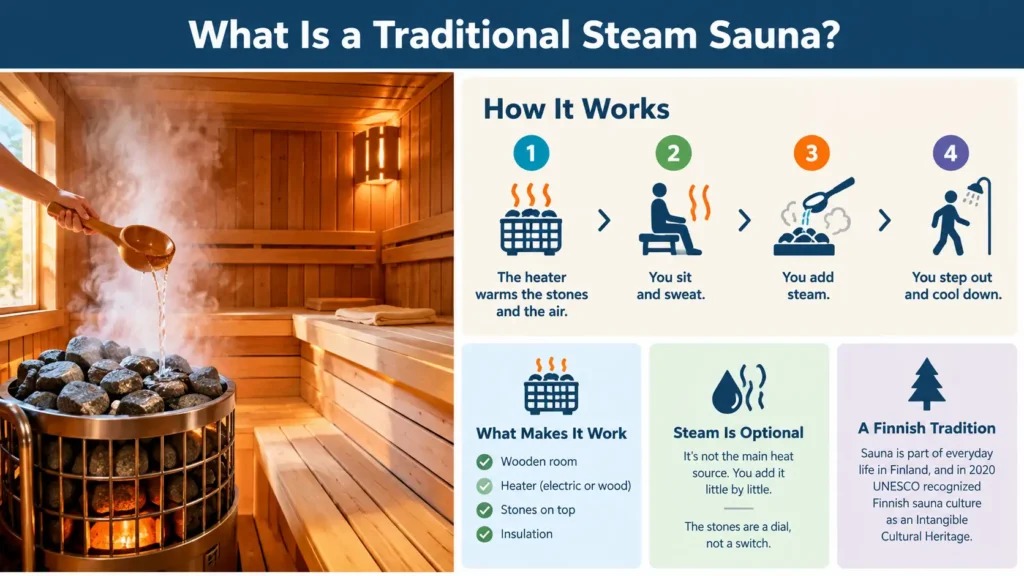
It is a wooden room with an electric or wood-burning heater, stones on top of the heater, and insulation. The air gets hot. As soon as you pour water on the stones, it becomes steam and the room becomes thicker and hotter for a few moments.


Paid Links - As an Amazon Associate, I earn from qualifying purchases.
The Finns refer to that blow as löyly (pronounced approximately “LOE-loo”). In Finland, sauna is a part of everyday life, and in 2020, UNESCO inscribed the Finnish sauna culture on the Intangible Cultural Heritage List.
Notice what that means: the steam isn’t the main heat source. It’s something you add, a little at a time. Think of the stones as a dial, not a switch.
Why the name causes confusion
The phrase blends two ideas. “Sauna” usually means hot air and wooden walls. “Steam” usually means a humid room. A traditional steam sauna sits in the middle because you control the humidity yourself. Some people call it a wet-dry sauna, a Finnish sauna or simply a traditional sauna. They’re all close cousins.
How a Traditional Steam Sauna Works
The process is simple, which is part of its charm.
- The heater warms the stones and the air. Hot air rises, so the top bench is the hottest spot.
- You sit and sweat. Your skin heats up, your heart rate climbs and your body starts cooling itself.
- You add steam. One small ladle on the stones and humidity jumps. The heat feels sharper on your skin even though the air temperature barely changes.
- You step out and cool down. Fresh air, a shower or a quiet rest. Then you go back in if you like.
The benches act like a thermostat. Sit low if you want it gentle and climb higher when you’re ready for more. Beginners almost always do better starting low.
Traditional Steam Sauna vs. Steam Room
This is the comparison people search for most, so let’s make it simple. A steam room runs much cooler and holds humidity close to 100 percent. A traditional sauna runs far hotter and starts out drier. You also sit in very different spaces: wood and benches in one, tile and fog in the other.


Paid Links - As an Amazon Associate, I earn from qualifying purchases.
| Feature | Traditional steam sauna | Steam room | Infrared sauna |
|---|---|---|---|
| Typical air temperature | About 160–200°F (70–95°C) | About 104–120°F (40–49°C) | About 120–150°F |
| Humidity | Low, rises when you add water | Near 100% | Low |
| Heat source | Heater and stones | Steam generator | Infrared panels |
| Interior | Wood | Tile, stone or acrylic | Wood |
| Typical session | 10–20 minutes | 10–15 minutes | 20–40 minutes |
These ranges are typical, not strict. Designs and personal preference vary.
Infrared saunas heat your body more directly at lower air temperatures, so many people find them gentler. A traditional sauna feels more intense and more ritual-like. Neither is “better.” It depends on what you enjoy.
A quick way to choose:
- Love strong heat and the ritual? Traditional steam sauna.
- Prefer warm, humid air that’s easy on the lungs? Steam room.
- Want something mild and low-key? Infrared.
Core Features Worth Knowing
If you’re shopping, these are the parts that matter most.
- The heater. Electric heaters are the standard for homes because they’re simple and controllable. Wood-burning stoves deliver a classic feel, but they need a proper flue, more attention and local rules compliance.
- The stones. Sauna stones, usually peridotite or olivine-diabase, are chosen because they store heat and survive repeated heating and cooling. Stack them loosely. Packed too tightly, they block airflow and the heater works harder than it should.
- The wood. Cedar smells wonderful and handles moisture well. Aspen and alder are smooth and low in resin, which makes them comfortable on bare skin. Hemlock and thermally modified woods are also common. For benches, avoid anything very resinous because resin can get hot and sticky.
- The benches. Two levels give you control over heat. Boards should be smooth, with no splinters and no exposed screw heads where skin touches.
- Ventilation. This is the most overlooked feature. Fresh air should come in low, near the heater, and stale air should leave higher up or on the opposite side. Without it, the air feels heavy and the wood ages faster.
- Controls. A thermostat and timer keep temperatures steady and prevent overheating. Many modern units let you preheat from your phone, which is handy on cold mornings.
- Door and glass. Tempered glass is standard. The door should swing outward and shouldn’t lock from the inside. That’s a basic safety rule, not a style choice.

Benefits: What the Evidence Says (and Doesn’t)
Let’s be honest first: the research is promising but not perfect.
Regular sauna use is associated with better heart health, possibly lower dementia risk and a strong sense of relaxation. The key word is associated. Most of the best-known studies are observational, which means they find links, not proof of cause and effect.
- Heart health. A study published in JAMA Internal Medicine in 2015 followed 2,315 middle-aged Finnish men for about 20 years. Men who used a sauna four to seven times a week had lower rates of sudden cardiac death, fatal heart disease and death from any cause than men who went once a week.
- Brain health. A related Finnish study in Age and Ageing (2017) linked frequent sauna use with lower dementia and Alzheimer’s risk.
- Relaxation and sleep. Heat, quiet and stepping away from screens help many people unwind. This is commonly reported, though harder to measure in a lab.
- Muscle comfort. Plenty of athletes enjoy a session after training. Whether it speeds up recovery isn’t settled, but it often feels good, and feeling good matters.
Keep these limits in mind:
- The large studies focused on Finnish men who had likely used saunas all their lives. Results may not apply equally to everyone.
- People who use saunas often may also share other healthy habits.
- A sauna isn’t a treatment for any disease.
- It isn’t a weight-loss tool either. Most of what you lose is water, and it comes back when you drink.
What Separates a Quality Sauna From a Poor One
Looks can fool you. A glossy cabin with a weak heater and no ventilation will disappoint you within a month. Check these things before you commit:
| Component | Good sign | Red flag |
|---|---|---|
| Wood | Kiln-dried, smooth, tight-fitting boards | Cracks, warping, large resin pockets |
| Insulation | Insulated walls and ceiling with a vapor barrier | Thin, single-layer walls |
| Heater | Safety-listed (such as UL or ETL in North America) and sized for the room | No certification, badly over- or undersized |
| Heater guard | Protective rail around the heater | Open, unguarded stones |
| Fasteners | Stainless or coated, kept away from skin contact | Exposed metal on benches |
| Door | Tempered glass, swings outward, no inside lock | Inward swing or lockable |
| Ventilation | Planned intake and exhaust | No clear airflow path |
| Controls | Thermostat plus a high-limit cutoff | Manual control only |
A rule of thumb for the size of heater is approximately 1 kW per cubic meter (35 cubic feet) of space. If the room has a lot of glass, tile or masonry, which absorb heat, add capacity. Always follow the heater maker’s chart over a general rule.
Buying Guide: Space, Power and Total Cost
Indoor or outdoor? Indoor models are convenient but need space, ventilation and an electrical plan. Outdoor cabins and barrels free up your floor space, but they have to cope with weather, and cold winters mean longer preheating. If you’re leaning that way, think about where the sauna will sit, how you’ll get power to it and how the ground drains.
What drives the total cost:
- The sauna itself (kit, prefab or custom)
- Heater type and size
- Electrical work (many 6–9 kW home heaters need a dedicated 240V circuit, so get a licensed electrician to confirm)
- Site prep and flooring
- Delivery and assembly
- Accessories like a bucket, ladle, thermometer, hygrometer and lighting
Not going to give exact prices as they vary a lot according to region, brand and build quality. A better way: get at least three quotes and compare the price of the kit plus the installation. The lowest price cabin can end up being the highest price when electrical and delivery charges are included.
Estimating running costs. Use this formula: heater kW × hours on × your electricity rate. A 6 kW heater running flat out for one hour uses 6 kWh. Real use is lower because the thermostat cycles on and off once the room is hot. Check your latest utility bill for your actual rate, then do the math.
How to Use a Traditional Steam Sauna, Step by Step
A good session is calm and unhurried. Here’s a simple routine that works for most healthy adults:
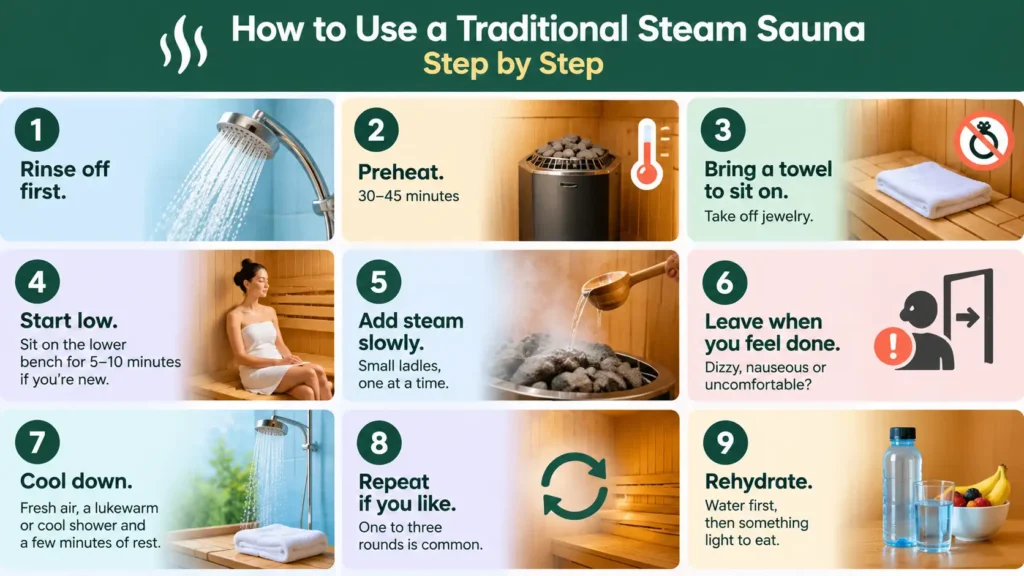
- Rinse off first. A quick shower keeps the sauna cleaner and helps you start comfortable.
- Preheat. Allow roughly 30 to 45 minutes unless the manufacturer says otherwise.
- Bring a towel to sit on. Take off jewelry, because metal heats up fast.
- Start low. Sit on the lower bench for 5 to 10 minutes if you’re new.
- Add steam slowly. Small ladles, one at a time. Flooding the stones gives you a scalding wave and not much else.
- Leave when you feel done. Dizzy, nauseous or just uncomfortable? Step out right away.
- Cool down. Fresh air, a lukewarm or cool shower and a few minutes of rest.
- Repeat if you like. One to three rounds is common.
- Rehydrate. Water first, then something light to eat.
Most people settle into 10 to 20 minutes per round, but how long you stay in a steam sauna depends on your experience and how you feel that day. There’s no prize for suffering.
Safety: Who Should Be Careful
Heat puts real demands on your body. Most healthy adults tolerate it well, but a few groups should be more careful.
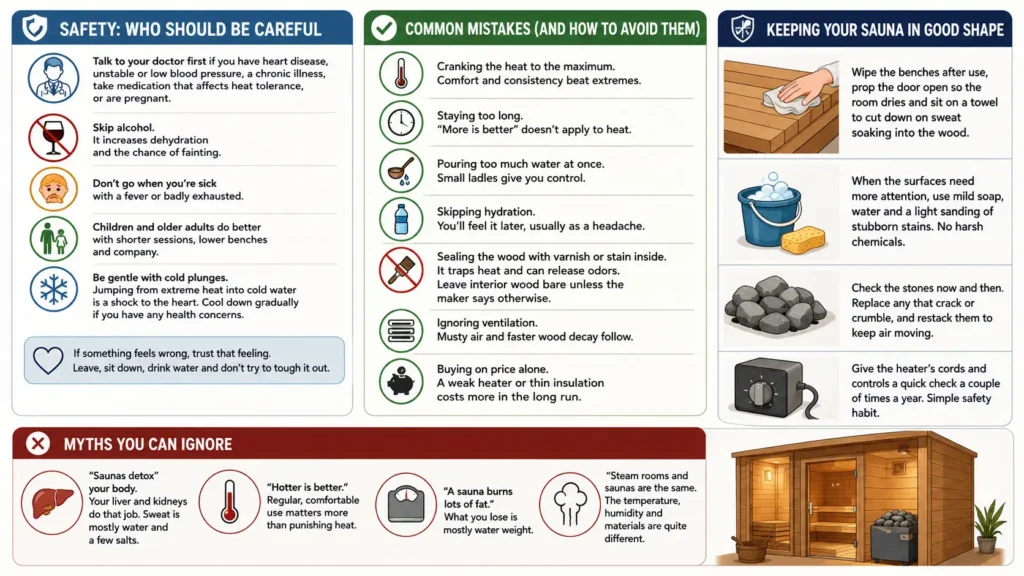
- Talk to your doctor first if you have heart disease, unstable or low blood pressure, a chronic illness, take medication that affects heat tolerance, or are pregnant.
- Skip alcohol. It increases dehydration and the chance of fainting.
- Don’t go when you’re sick with a fever or badly exhausted.
- Children and older adults do better with shorter sessions, lower benches and company.
- Be gentle with cold plunges. Jumping from extreme heat into cold water is a shock to the heart. Cool down gradually if you have any health concerns.
If something feels wrong, trust that feeling. Leave, sit down, drink water and don’t try to tough it out.
Common Mistakes (and How to Avoid Them)
- Cranking the heat to the maximum. Comfort and consistency beat extremes.
- Staying too long. “More is better” doesn’t apply to heat.
- Pouring too much water at once. Small ladles give you control.
- Skipping hydration. You’ll feel it later, usually as a headache.
- Sealing the wood with varnish or stain inside. It traps heat and can release odors. Leave interior wood bare unless the maker says otherwise.
- Ignoring ventilation. Musty air and faster wood decay follow.
- Buying on price alone. A weak heater or thin insulation costs more in the long run.
Keeping Your Sauna in Good Shape
A well-kept sauna lasts for decades. The routine is easy: wipe the benches after use, prop the door open so the room dries and sit on a towel to cut down on sweat soaking into the wood. When the surfaces need more attention, keeping it clean properly means mild soap, water and a light sanding of stubborn stains, with no harsh chemicals.
Check the stones now and then. Replace any that crack or crumble, and restack them to keep air moving. A quick look at the heater’s cords and controls a couple of times a year is a cheap safety habit.
Myths You Can Ignore
- “Saunas detox your body.” Your liver and kidneys do that job. Sweat is mostly water and a few salts.
- “Hotter is better.” Regular, comfortable use matters more than punishing heat.
- “A sauna burns lots of fat.” What you lose is mostly water weight.
- “Steam rooms and saunas are the same.” The temperature, humidity and materials are quite different.
Traditional Steam Sauna FAQs
What is a traditional steam sauna?
A wood-lined room heated by a stove and stones, where you can add steam by pouring water on the hot stones.
Is it the same as a steam room?
No. A steam room is cooler and almost fully humid. A traditional sauna is hotter and starts much drier.
How hot should it be?
Many people use roughly 160 to 200°F (70 to 95°C). Beginners are usually happier toward the lower end.
How often should I use one?
It depends on your health and how you feel. Finnish studies compared one session a week with several, but that’s research, not personal medical advice.
Is a traditional sauna better than infrared?
Neither wins overall. Traditional offers higher heat and steam. Infrared is gentler and runs cooler.
Can I pour water on any sauna’s heater?
Only if it’s designed for it. Check the manual first, and never pour water on infrared panels.
Do I need a special electrical circuit?
Many home heaters do, often a dedicated 240V line. Ask a licensed electrician.
Is it safe during pregnancy?
Ask your doctor first. Overheating is a concern.
Final Thoughts
A traditional steam sauna is a simple idea done well: hot stones, good wood, fresh air and a little water when you want it. The research is encouraging, though not a promise. The ritual itself, those quiet minutes where nobody needs anything from you, is often the real reward.
When purchasing, invest in the components that are not easily visible: the heater, the insulation, the ventilation and the safety features. Avoid fancy extras until they’re right. If you’re a beginner, start low, go slowly and drink water.
Your next steps are easy. Decide between sauna, steam room and infrared using the comparison above. Measure your space and talk to an electrician about your circuit. Get three installed-price quotes. And if you have a medical condition, check with your doctor before the first session.